


Search results
Search for "gelatin" in Full Text gives 52 result(s) in Beilstein Journal of Nanotechnology.
Biopolymer colloids for controlling and templating inorganic synthesis
Beilstein J. Nanotechnol. 2014, 5, 2129–2138, doi:10.3762/bjnano.5.222

- ] demonstrated the synthesis of iron oxide nanoparticles in a semi-interpenetrating polymer network of alginate and poly(N-isopropylacrylamide). Gold and AuNi alloy gelatin nanocomposites were developed by Brayner et al. [84]. A gelatin network incorporating metallic nanoparticles was obtained after reduction of
- gold salts. Like other gel biopolymer templates, gelatin has also been used in silicate sol–gel processes [72][85][86]. Ethirajan et al. [87] used the confinement provided by gelatin particles prepared through a miniemulsion to template the crystallization of hydroxyapatite (Figure 7). A further
- component takes place. On the other hand, the presence of functional groups such as carboxylic, amino or phosphate groups can provide a high ability to bind metal ions or to interact with growing crystal faces, influencing nucleation and growth. Hydrogels, such as those formed with chitosan or gelatin, are


Photoactivation of luminescence in CdS nanocrystals
Beilstein J. Nanotechnol. 2014, 5, 355–359, doi:10.3762/bjnano.5.40
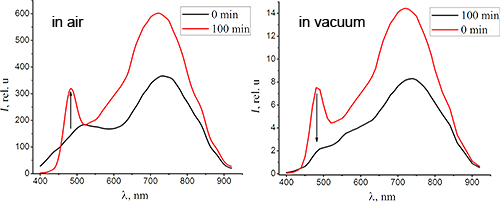
- nanocrystals used in these experiments were prepared by colloid chemistry of solutions of cadmium- and sulfursalts in an aqueous gelatin solution. Details of the sample preparation are described in [15]. The average radius of the cadmium sulfide nanocrystals was calculated from the optical absorption spectra
- prevails and an increase of the luminescence yield is observed. Our samples differ from the CdSe/ZnS QDs, in which an amplification of photoindiced luminescence has been previously observed [1][2][3][4][5], because they are synthesized in an aqueous solution of gelatin. During the synthesis of cadmium
- sulfide nanocrystals gelatin plays the role of a growth stabilizer and a coating agent. Gelatin is a natural polymer that is capable of absorbing large amounts of moisture from the environment. It is evident that the cadmium sulfide nanocrystals are contained in the gelatin matrix, which contains a high


Other Beilstein-Institut Open Science Activities



