


Search results
Search for "gene expression" in Full Text gives 56 result(s) in Beilstein Journal of Nanotechnology.
Silica nanoparticles are less toxic to human lung cells when deposited at the air–liquid interface compared to conventional submerged exposure
Beilstein J. Nanotechnol. 2014, 5, 1590–1602, doi:10.3762/bjnano.5.171
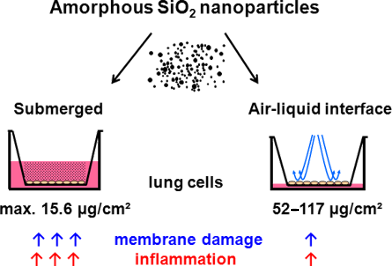
- of ZnO particles under submerged and ALI conditions. Interestingly, the response (LDH release, HO-1 induction) occurred more rapidly at the ALI but to a similar extend [37]. Similarly, exposure of A549 cells to ZnO particles at the ALI provoked a stronger increase in pro-inflammatory gene expression
- confirm a reduced toxicity of NPs at the ALI in general or rather to identify a NP-specific behaviour that depends on the exposure method. Furthermore, it is possible that at the ALI gene expression will change compared to submerged cultures, a topic which warrants further investigations. Indeed, human


In vitro interaction of colloidal nanoparticles with mammalian cells: What have we learned thus far?
Beilstein J. Nanotechnol. 2014, 5, 1477–1490, doi:10.3762/bjnano.5.161
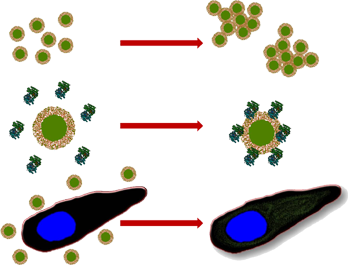
- has to be assessed. In the context of this review we have focused on in vitro studies. The advantage of such studies is the easy screening capability and the possibility to monitor in detail biomolecular pathways and changes in gene expression as a measure of a possible biologically adverse response


The cell-type specific uptake of polymer-coated or micelle-embedded QDs and SPIOs does not provoke an acute pro-inflammatory response in the liver
Beilstein J. Nanotechnol. 2014, 5, 1432–1440, doi:10.3762/bjnano.5.155
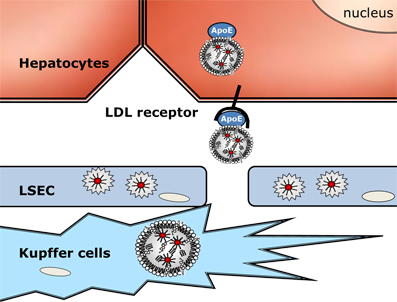
- process that is dependent on the LDL receptor and apolipoprotein E, by hepatocytes. Gene expression analysis of pro-inflammatory markers such as tumor necrosis factor alpha (TNFα) or chemokine (C-X-C motif) ligand 10 (Cxcl10) indicated that 48 h after injection internalized nanocrystals did not provoke
- , we measured pro-inflammatory markers by gene expression analysis after the injection of SPIO nanocrystals embedded by different coats. Intravenous injection of Ferinject® (contains ferric carboxymaltose that is commonly given to treat iron deficits) at high doses caused a significant induction of pro
- intracellular multiprotein oligomer, the so-called-inflammasome [31], which can be activated by intracellular aggregates such as ureate or cholesterol crystals [32]. Notably, hepatic internalization of Ferinject® or SPIOs delivered by polymer or lipid micelles did not influence Il1b gene expression underlining


Mimicking exposures to acute and lifetime concentrations of inhaled silver nanoparticles by two different in vitro approaches
Beilstein J. Nanotechnol. 2014, 5, 1357–1370, doi:10.3762/bjnano.5.149
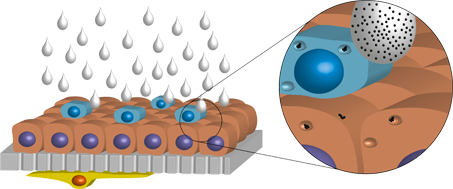
- could be observed when simultaneously exposed with Ag NPs. Ag NPs were not found to interfere with the ELISA assay (data not shown). Gene expression of pro-inflammatory and oxidative stress markers As described in [44], the total RNA content of the triple cell co-cultures was collected 4 and 24 h after



Molecular biology approaches in bioadhesion research
Beilstein J. Nanotechnol. 2014, 5, 983–993, doi:10.3762/bjnano.5.112
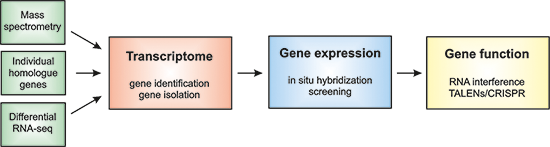
- temporary adhesives that contain a significant carbohydrate fraction usually also rely on proteins for adhesion. Review 1. Transcriptome sequencing and differential gene expression 1.1 What is a transcriptome? A transcriptome represents the entirety of RNA molecules expressed in an organism, a tissue or a
- differential RNA-seq experiment can be compared to the established transcriptome database. 3. Spatial gene expression 3.1 Aim of in situ hybridization For detecting the spatial (and temporal) expression of genes within a tissue, ISH is a widespread and straightforward method. The principle of ISH can be used
- validate the expression of an adhesion-related candidate transcript list that resulted from previous mass spectrometry or differential gene expression experiments. For high-throughput approaches, in situ robots such as “InsituPro VSi” from Invatis AG are available. For medium scale ISH screenings, a manual


Injection of ligand-free gold and silver nanoparticles into murine embryos does not impact pre-implantation development
Beilstein J. Nanotechnol. 2014, 5, 677–688, doi:10.3762/bjnano.5.80
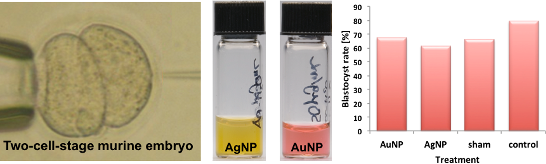
- control groups (gold nanoparticles: 67.3%, silver nanoparticles: 61.5%, sham: 66.2%, handling control: 79.4%). Real-time PCR analysis of six developmentally important genes (BAX, BCL2L2, TP53, OCT4, NANOG, DNMT3A) did not reveal an influence on gene expression in blastocysts. Contrary to silver
- microscopy; gene expression; protein corona; toxicity; Introduction Gold and particularly silver are among the most commonly used materials for nanoparticle applications. They can be found in an increasing amount of consumer products [1], but they also emerge as materials for medical and biotechnological
- . Gene expression in developed blastocysts For all injected treatment groups and the handling controls, the gene expression of candidate genes relevant for embryo development was determined. For none of the genes differential expression between treatment groups was detected. Relative expression values




Other Beilstein-Institut Open Science Activities



