


Search results
Search for "germanium" in Full Text gives 56 result(s) in Beilstein Journal of Nanotechnology.
Silicon and germanium nanocrystals: properties and characterization
Beilstein J. Nanotechnol. 2014, 5, 1787–1794, doi:10.3762/bjnano.5.189
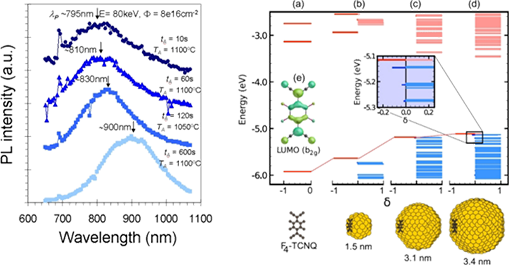
- , Portugal 10.3762/bjnano.5.189 Abstract Group-IV nanocrystals have emerged as a promising group of materials that extends the realm of application of bulk diamond, silicon, germanium and related materials beyond their traditional boundaries. Over the last two decades of research, their potential for
- regard to growth, characterization and modeling of silicon and germanium nanocrystals and related materials. Keywords: characterization; germanium; modelling; nanocrystals; silicon; Review I Introduction Nanocrystals (NCs) have emerged as one of the preferred ways to control quantum phenomena at the
- stands as a highly versatile tool for a variety of purposes including synthesis, modification and characterization of materials. The synthesis of NCs made of silicon and germanium by means of ion beams has been extensively studied in the past years [23]. QDs size, shape and distribution can be controlled


Probing the electronic transport on the reconstructed Au/Ge(001) surface
Beilstein J. Nanotechnol. 2014, 5, 1463–1471, doi:10.3762/bjnano.5.159
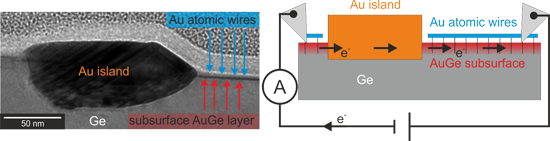
- the domain boundaries. Experimental The germanium substrate is cut from a wafer of a n-type Ge(001) crystal with a resistivity of about 30 Ω·cm. The cleaning procedure of the substrate consists of a few cycles of 600 eV Ar+ ion sputtering at a sample temperature of 1040 K (as measured by a pyrometer
- by the corresponding ac component of the tunnelling current. Further experimental details can be found elsewhere [12][16]. The contact tips are placed such that the direction of the applied lateral current is mainly oriented orthogonal to the main direction of the germanium surface steps originating
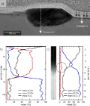
- dashed line. It is clearly seen that the substrate surface region does not propagate with crystalline order to the Au cluster. A discontinuity region (about 2 nm wide), called in the image “cavity”, may either be a substrate depletion filled with carbon or disordered germanium. In both cases, this




Review of nanostructured devices for thermoelectric applications
Beilstein J. Nanotechnol. 2014, 5, 1268–1284, doi:10.3762/bjnano.5.141
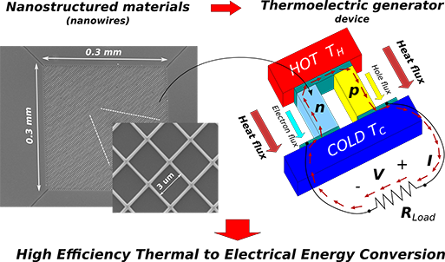
- temperature range, because silicon is a very stable material for temperatures in excess of 900 K. Silicon–germanium alloys, SiGe [38][39], and superlattices [40][41] showed a good Z factor value, of the order of 2 × 10⁻³ K−1 at 800 K. Furthermore, they can be used for power generation in devices exploiting


STM tip-assisted engineering of molecular nanostructures: PTCDA islands on Ge(001):H surfaces
Beilstein J. Nanotechnol. 2013, 4, 927–932, doi:10.3762/bjnano.4.104
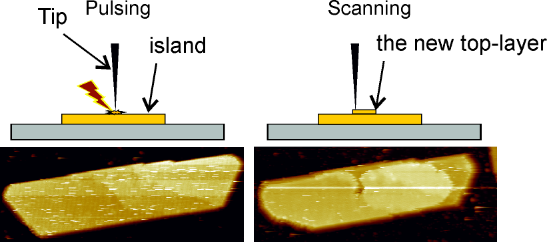
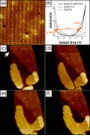
- -tetracarboxylic dianhydride (PTCDA) molecular islands on a hydrogen passivated germanium surface, Ge(001):H, are presented. The application of bias voltage pulses in STM allows for the modification of the islands. We found that the presence of a scanning tip of the tunneling microscope facilitates and speeds the
- system [20]. Most of the islands have a height of 2.1 nm, what corresponds to 6 molecular layers. Insight into the electronic structure of the studied system is obtained by rt STS measurements (see Figure 1b). For a bare germanium surface a band gap of ≈0.2 eV is obtained, in fair agreement with
- PTCDA island on Ge(001):H is measured as 4.2 eV. The latter value corresponds well with results reported for thick films (>5 nm) [26][27][28][29]. The electronic properties of the PTCDA islands are very different from the underlying passivated germanium, and there are no other features in the bias

Imaging ultra thin layers with helium ion microscopy: Utilizing the channeling contrast mechanism
Beilstein J. Nanotechnol. 2012, 3, 507–512, doi:10.3762/bjnano.3.58
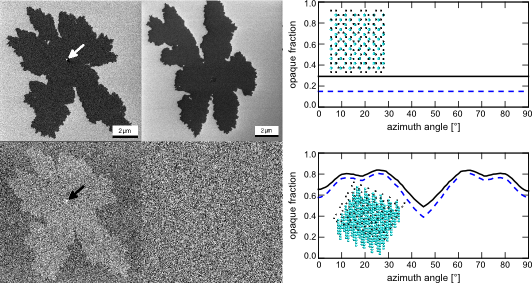
- larger deviation from the initial particle trajectory. We will discuss this in more depth in the next paragraph. For the present case in which a light adlayer (either carbon or cobalt) covers a heavier substrate (silicon or germanium), (1) does not play a significant role and (2) will be weak in general


Graphite, graphene on SiC, and graphene nanoribbons: Calculated images with a numerical FM-AFM
Beilstein J. Nanotechnol. 2012, 3, 301–311, doi:10.3762/bjnano.3.34
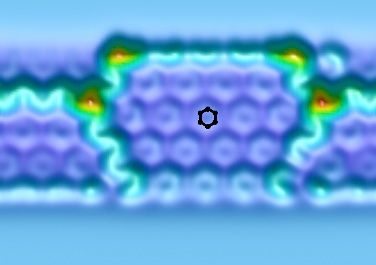
- , germanium, etc). Recent improvements of this potential [103] do not modify the results presented below. In the case of graphite, the van der Waals interaction between two layers is described by a standard Lennard-Jones potential: with ε = 0.011 eV and σ = 3.2963 Å. Results and Discussion Graphite surface


Other Beilstein-Institut Open Science Activities



