


Search results
Search for "hydroxyapatite" in Full Text gives 55 result(s) in Beilstein Journal of Nanotechnology.
Biocalcite, a multifunctional inorganic polymer: Building block for calcareous sponge spicules and bioseed for the synthesis of calcium phosphate-based bone
Beilstein J. Nanotechnol. 2014, 5, 610–621, doi:10.3762/bjnano.5.72
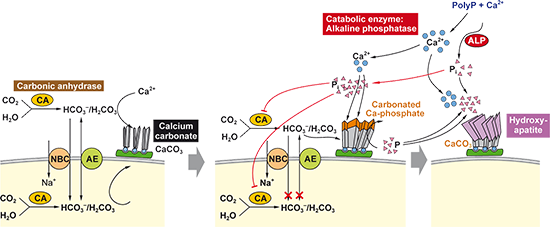
- phosphate/hydroxyapatite (HA). Evidence has been presented that during the initial phase of HA synthesis poorly crystalline carbonated apatite is deposited. Recent data summarized here indicate that during early bone formation calcium carbonate deposits enzymatically formed by CA, act as potential bioseeds
- crown mammals, the calcium phosphate/hydroxyapatite (HA)-based skeletal systems. The understanding of the genetic blueprint of any morphogenetic event must begin with the identification and functional characterization of the individual expressed genes (proteins), followed by the elucidation of the
- CaCl2) at a corresponding vmax of 24.9 ± 3.7 mmol·mL−1·min−1. Carbonic anhydrase: Evidence for forming bioseeds during mammalian hydroxyapatite formation Our experimental data show that SaOS-2 cells, exposed to bicarbonate and the MAC, form a significantly increased amount of Ca-deposits, as analyzed by



Exploring the retention properties of CaF2 nanoparticles as possible additives for dental care application with tapping-mode atomic force microscope in liquid
Beilstein J. Nanotechnol. 2014, 5, 36–43, doi:10.3762/bjnano.5.4
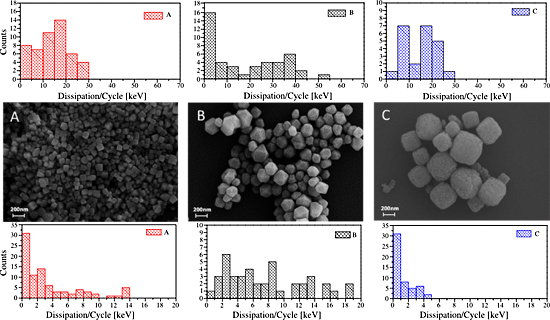
- the purpose to protect the inner sensitive part of the teeth from physical or chemical attacks. It consists of tightly packed hydroxyapatite crystals and has a thickness of up to 2.5 mm. The solubility of enamel depends highly on the pH value [20]. The consumption of acidic beverages directly lowers


Modulation of defect-mediated energy transfer from ZnO nanoparticles for the photocatalytic degradation of bilirubin
Beilstein J. Nanotechnol. 2013, 4, 714–725, doi:10.3762/bjnano.4.81
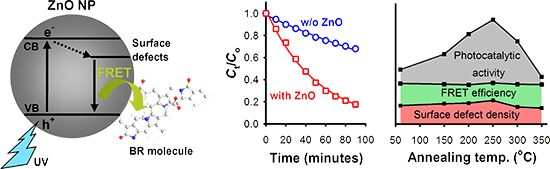
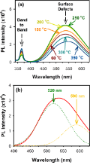
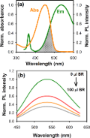
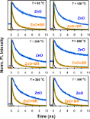
- molecular transformation of water-insoluble BR through photocatalysis is limited, a few studies are available on the photocatalytic degradation of BR adsorbed on nanostructured hydroxyapatite coatings [23] or molecularly imprinted titania films [24]. The current study focuses on the efficient utilization of


Nano-FTIR chemical mapping of minerals in biological materials
Beilstein J. Nanotechnol. 2012, 3, 312–323, doi:10.3762/bjnano.3.35
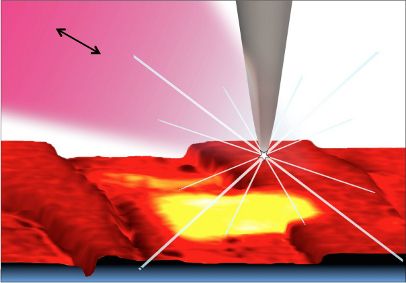
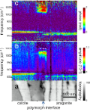
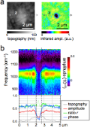
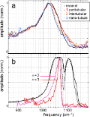
- 1063 cm−1 (as also in hydroxyapatite) and a weak one at 1090 cm−1, as shown in Figure 12b (for comparison we also show reflectivity spectra that nearly match for both apatites). The strong near-field resonance obviously comes from the strong infrared-active mode at 1030 cm−1, and thus is up-shifted by
- for hydroxyapatite, where indeed the last two peaks were found to be strongly split by the nonspherical shape of the particles [52]. Similar values were reported in other studies [24][53][54]. As the mineral in dentin and bone consists of isolated, locally ordered apatite platelets, strong
- assume f = 1 for enamel, which consists nearly entirely of hydroxyapatite nanocrystals. For simplicity we assume a flat spectrum sO. By setting sO = 0.00006 we then determine f = 0.54, 0.30, and 0.26 for the spectra 1, 2, and 3, respectively. With these values we compute the mineral component normalized





Ceria/silicon carbide core–shell materials prepared by miniemulsion technique
Beilstein J. Nanotechnol. 2011, 2, 638–644, doi:10.3762/bjnano.2.67
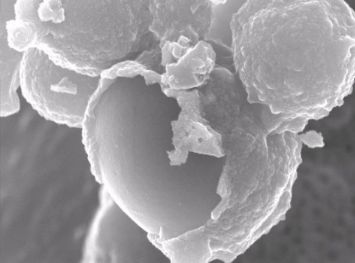
- functionalized polymer spheres coated with hydroxyapatite. Accordingly, we used the surface functionalized PCS/acrylic acid spheres for the growth of a CeO2 shell. Additionally, dip coating of the unfunctionalized PCS spheres in an ethanolic Ce(NO3)3 solution was investigated. Functionalized as well as


Other Beilstein-Institut Open Science Activities



