


Search results
Search for "impregnation" in Full Text gives 55 result(s) in Beilstein Journal of Nanotechnology.
Synthesis and catalytic applications of combined zeolitic/mesoporous materials
Beilstein J. Nanotechnol. 2011, 2, 785–801, doi:10.3762/bjnano.2.87
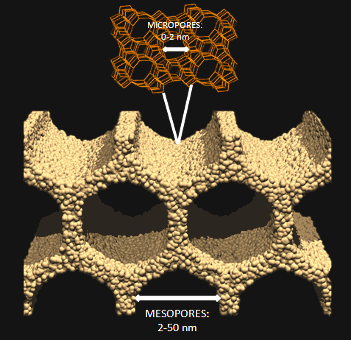
- on the shape of the particles [86][87][88]. The mesoporous supports are generally large-pore materials, such as SBA-15 and MCF (mesocellular foam) so that the nanoparticles can be accommodated inside the mesopores. The impregnation of the nanoparticles can occur through wet, incipient wetness and dry
- impregnation. During a wet impregnation, the mesoporous material is completely soaked in a solution of nanoparticles, while in the case of a dry impregnation a volume of solution identical to, or even smaller than, the total pore volume is added. An incipient wetness impregnation lies between these two
- expensive alternative. The most promising, but also most expensive, carbon templates are the CMKs. These carbons are replicas or inverse replicas of existing mesoporous silicates, such as MCM-48 (CMK-1) [106] and SBA-15 (CMK-3 [107] and CMK-5 [108]). By impregnation of the CMKs with zeolite nanoparticles




Template-assisted formation of microsized nanocrystalline CeO2 tubes and their catalytic performance in the carboxylation of methanol
Beilstein J. Nanotechnol. 2011, 2, 776–784, doi:10.3762/bjnano.2.86
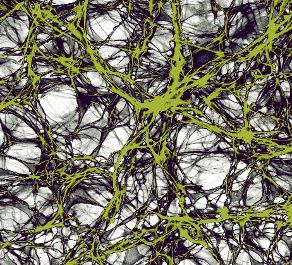
- , which form spherical and cylindrical micelles, and which could thus allow for a better contact of the inorganic ceria sol with the electrospun polymer fibres during impregnation. After spray-coating followed by sol–gel transformation to the ceramic green body at 80 °C overnight, the green body was
- overall ceramic yield was 10% and therefore significantly lower. This difference can be attributed to an enhanced wetting of the surface of the polymer fibres, as well as in the interstices between the packed PMMA fibre mats, during the impregnation step. This leads to a significantly enhanced wetting of
- ceria mats, obtained by plasma treatment and further calcination at 350 °C, for 3 h to remove the polymer template. The ceria-sol-impregnation step of the polymer fibres was performed with the addition of Pluronic P123®. SEM images (different magnifications) of interconnected microsized ceria tubes


Ceria/silicon carbide core–shell materials prepared by miniemulsion technique
Beilstein J. Nanotechnol. 2011, 2, 638–644, doi:10.3762/bjnano.2.67
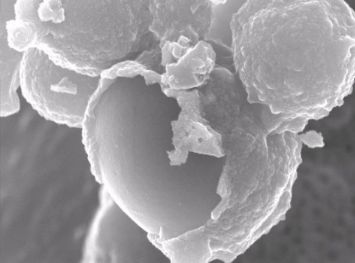
- confirms the presence of cerium (1.5 wt % Ce). Furthermore the catalytic tests, shown in the next chapter, prove the presence of ceria. The core–shell structure could be seen more clearly when CeO2/Si(O)C particles that were synthesized by an impregnation approach were considered. From the scanning
- SiC-SDS spheres, (B) SiC-Acr/CeO2 spheres prepared by molecular bonding approach and (C) SiC/CeO2 spheres prepared by impregnation. Elemental mapping investigations on CeO2/Si(O)C core–shell nanoparticles prepared by impregnation. TEM image of a cerium oxide particle (left) with the corresponding


Nanostructured, mesoporous Au/TiO2 model catalysts – structure, stability and catalytic properties
Beilstein J. Nanotechnol. 2011, 2, 593–606, doi:10.3762/bjnano.2.63
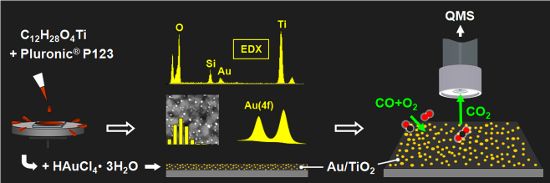
- ][21][22]. These model catalysts were prepared in different ways, e.g., by deposition of the respective active metal phase by evaporation, deposition of preformed metal nanoparticles or chemical impregnation and subsequent activation procedures. While structurally and chemically still reasonably well






Synthesis of LiNbO3 nanoparticles in a mesoporous matrix
Beilstein J. Nanotechnol. 2011, 2, 28–33, doi:10.3762/bjnano.2.3
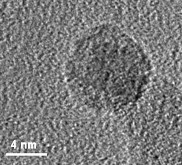
- impregnation from the metal precursor and mesoporous silica SBA-15 as the template. A rapid one-step treatment in an IR furnace reduces the preparation time to only 10 min. In comparison, a conventional furnace requires 5 h reaction time to produce nanoparticles with similar textural properties. Another
- mild reaction conditions involved [15]. Another ingenious route to generate nanoparticles is the use of porous template materials via impregnation techniques, where the oxide is obtained by calcination of suitable precursor solutions with simultaneously removal of the carbon matrix [16][17][18]. In the
- a consequence of the impregnation which reduces the scattering contrast between the silica walls and the empty pores. After removal of SBA-15 with LiOH solution, no peaks can be observed at low angles, which illustrates that the 2D ordered pore system - as expected - does not remain intact


Other Beilstein-Institut Open Science Activities



