Search results
Search for "melting" in Full Text gives 247 result(s) in Beilstein Journal of Nanotechnology. Showing first 200.
Bismuth-based nanostructured photocatalysts for the remediation of antibiotics and organic dyes
Beilstein J. Nanotechnol. 2023, 14, 291–321, doi:10.3762/bjnano.14.26
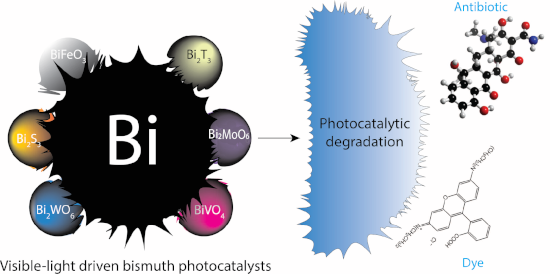
- have attracted the interest of a large community of scientists. With a low melting point of just above 544 K, Bi is less toxic than its neighbours in the periodic table, antimony, lead, and polonium. The structure of the bismuth crystal, which has rhombohedral symmetry, is typical of the group-V


The influence of structure and local structural defects on the magnetic properties of cobalt nanofilms
Beilstein J. Nanotechnol. 2023, 14, 23–33, doi:10.3762/bjnano.14.3
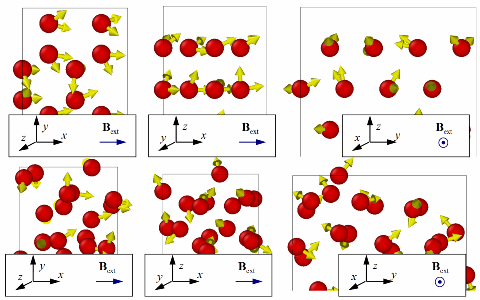
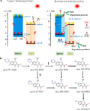
- materials [7][8], in which heat storage and accumulation occur due to phase transformations. The functioning of such storage media is based on energy fluctuations in the process of crystallization or melting of the media. In contrast to traditional media, thermal storage does not require sealing of the


Induced electric conductivity in organic polymers
Beilstein J. Nanotechnol. 2022, 13, 1551–1557, doi:10.3762/bjnano.13.128
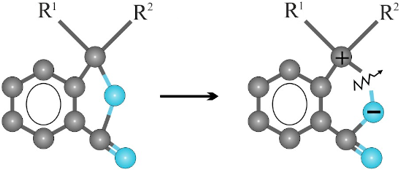
- cyclohexanone immediately before applying the polymer solution. The electrodes consisted of two mutually perpendicular lead strips with a width of ≈1 mm, between which the PDP polymer film was ‘sandwiched’ (Figure 2a). Lead was chosen as fairly low-melting metal exhibiting superconducting properties. Formation
- side view microphotographs made by high-resolution transmission electron microscopy occasionally reveal some macroscopic features such as lead electrode shortcuts through the polymer film (Figure 2c). These defects are episodic, and their character does not resemble the ‘melting through’ of the PDP
- film during the thermal deposition of lead. Moreover, the PDP decomposition starts at 440 °С, which is significantly higher than the melting point of lead, 327 °C. Moreover, it cannot be ruled out that such defects as ‘collapse’ of lead electrodes (Figure 2c) are not intrinsic, and could have appeared



Hydroxyapatite–bioglass nanocomposites: Structural, mechanical, and biological aspects
Beilstein J. Nanotechnol. 2022, 13, 1490–1504, doi:10.3762/bjnano.13.123
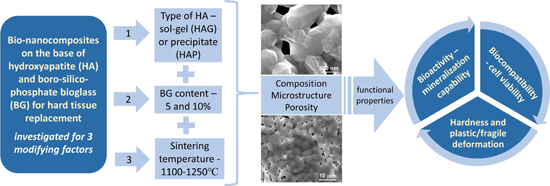
- by an unconventional wet route followed by melting [31][37][38]. As raw materials, the ultra-purity grade reagents boron oxide (B2O3), magnesium oxide (MgO,) potassium carbonate (K2CO3), phosphoric acid (H3PO4), silicon dioxide (SiO2), zinc oxide (ZnO), and cerium oxide (CeO2) have been used. The
- was heated up to 240 °C in an electrical oven, than introduced in an alumina crucible and heated in an electric furnace in two steps, namely a pre-melting step at low heating rate of about 50 °C/h from 240 up to 800 °C, followed by a melting step, at a higher heating rate of 250 °C/h, up to the
- melting temperature of 1200 °C, where the mixture maintained for 0.5 h. To obtain a homogeneous glass, an alumina stirrer homogenized the melt at 200–240 rpm. (iv) Casting, that is, the melt was cast into graphite molds, previously preheated at 1.1 Tg. (v) Cooling of the glass in air. (vi) Grinding the
Dry under water: air retaining properties of large-scale elastomer foils covered with mushroom-shaped surface microstructures
Beilstein J. Nanotechnol. 2022, 13, 1370–1379, doi:10.3762/bjnano.13.113
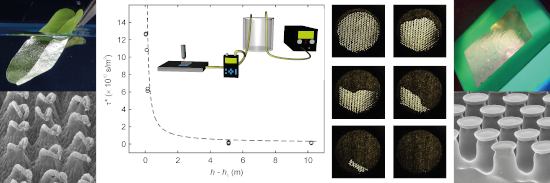
- lateral decrease in the area covered by air, leaving an unchanged high layer of air between the MSM structures. This lateral "melting" of the air layer patch then continued by diffusion of the air into the water until finally no air was visible. After elimination of the volume loss due to compression of


Straight roads into nowhere – obvious and not-so-obvious biological models for ferrophobic surfaces
Beilstein J. Nanotechnol. 2022, 13, 1345–1360, doi:10.3762/bjnano.13.111
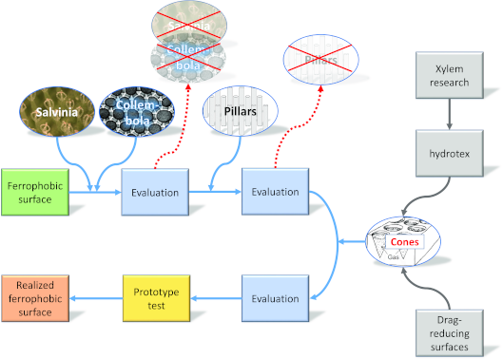
- walls should be much less prone to melting. The central idea was, therefore, to create a surface on the tuyère able to maintain an air layer that isolates the tuyère from the hot iron. For the persistence of the air layer, the following necessary conditions were identified: The surface should create a
- existence and stability of the gas/liquid interface and of the air pocket it encloses. Figure 5 right (b) and (c) are from [47] and were reprinted by permission from Springer Nature from the journal Journal of Bionic Engineering (“When Lotus Leaves Prevent Metal from Melting – Biomimetic Surfaces for High


Roll-to-roll fabrication of superhydrophobic pads covered with nanofur for the efficient clean-up of oil spills
Beilstein J. Nanotechnol. 2022, 13, 1228–1239, doi:10.3762/bjnano.13.102
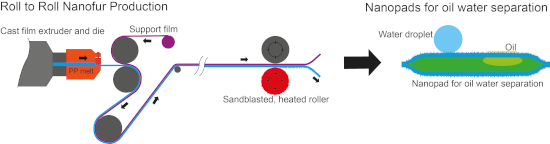
- slightly above the melting point of the respective PP type (170 °C in our case). For this temperature the viscosity of the polymer melt was sufficient to enable the hot-pulling process. The second roller of the calender was unheated and had a smooth surface. The gap between the rollers was adjusted to be
- support layer keeping the PP from melting completely and thus enables transport through the calender. The gap size is set slightly below the nominal film thickness so that the films experience minimal embossing forces. Temperature of the sandblasted roller is set slightly above the melting temperature of




Effects of focused electron beam irradiation parameters on direct nanostructure formation on Ag surfaces
Beilstein J. Nanotechnol. 2022, 13, 1004–1010, doi:10.3762/bjnano.13.87
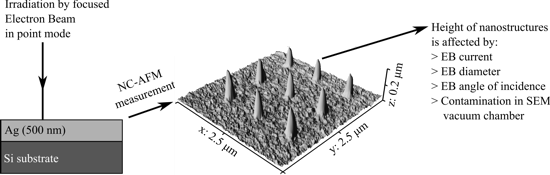
- on the growth rate of the nanodots was observed. Metals with lower melting points (implying lower interatomic bond energy) produced higher nanodots at similar irradiation parameters. Conversely, metals with higher volume magnetic susceptibility produced much wider nanodots with a higher volume. A




Temperature and chemical effects on the interfacial energy between a Ga–In–Sn eutectic liquid alloy and nanoscopic asperities
Beilstein J. Nanotechnol. 2022, 13, 817–827, doi:10.3762/bjnano.13.72
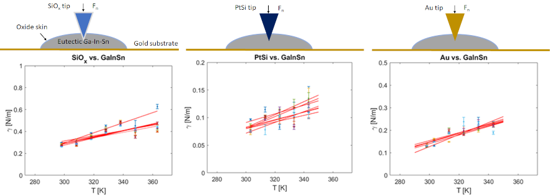
- prepared a eutectic Ga–In–Sn liquid alloy by melting the mixture of its solid constituents with the composition of 78.8 atom % Ga, 13.2 atom % In, and 8 atom % Sn. The melting point of the alloy is approximately 283 K [17]. We measured the interfacial tension between the Ga–In–Sn liquid eutectic alloy and
- . The surface energy of the eutectic Ga–In–Sn melt at the melting point has been reported to be 587 mN/m [21], while published values for SiOx, PtSi, and Au are = 53 mN/m [22], = 1150–1300 mN/m depending on its orientation [23], = 1710 mN/m [24]. These values lead to the following results for the
- each dZ/dt-values, the temperature dependence of γ was fitted with the linear function γ(T) = γm + κ(T – Tm), where γm is interfacial at the melting point, κ is the temperature sensitivity of γ, and Tm is the melting point of eutectic Ga–In–Sn melt. The values of γm and κ are also shown as a function



Gelatin nanoparticles with tunable mechanical properties: effect of crosslinking time and loading
Beilstein J. Nanotechnol. 2022, 13, 778–787, doi:10.3762/bjnano.13.68
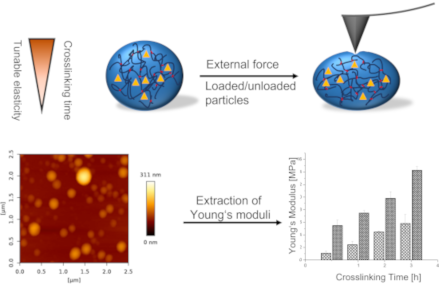
- ]. Contrarily, nanoparticles composed of a lipid bilayer with cores of different crosslinking extent showed higher uptake of softer particles in MCF-7 cells, which was thought to be due to a melting process of particles with the cell membrane that consumed less energy than endocytosis [8]. Regarding the in vivo


Electrostatic pull-in application in flexible devices: A review
Beilstein J. Nanotechnol. 2022, 13, 390–403, doi:10.3762/bjnano.13.32
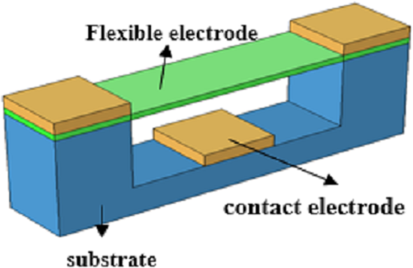
- increasing the electrode gap [54]. Due to the high voltage and the rapid local heating caused by the electrostatic discharge, the burning and melting electrode material will also affect the life cycles of the switch. Using AC voltage can reduce the need for high-temperature resistance of the electrodes. The


Effects of drug concentration and PLGA addition on the properties of electrospun ampicillin trihydrate-loaded PLA nanofibers
Beilstein J. Nanotechnol. 2022, 13, 245–254, doi:10.3762/bjnano.13.19
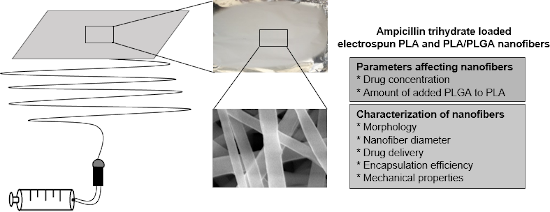
- the polymers added to PLA. As a result, the hydrophobic antibiotic ampicillin trihydrate had the lowest burst effect and the slowest controlled release with PLA/PLGA nanofibers compared to that of PLA, PCL and PLA/PCL nanofibers. As shown in Figure 5, the absence of the melting endotherm peak at


Chemical vapor deposition of germanium-rich CrGex nanowires
Beilstein J. Nanotechnol. 2021, 12, 1365–1371, doi:10.3762/bjnano.12.100
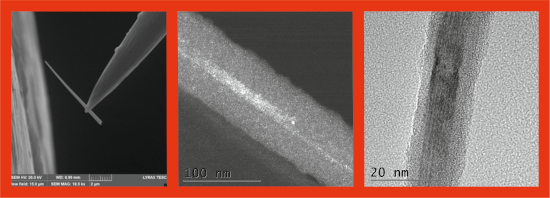
- in mind that the melting point of nanodroplets may be reduced by hundreds of kelvins [19]. Tapering of the CrGex coating is observed during the whole experiment as Cr and Ge atoms migrate from the NW bottom and/or are transferred directly from the gas phase [20]. Several attempts were made to



Biocompatibility and cytotoxicity in vitro of surface-functionalized drug-loaded spinel ferrite nanoparticles
Beilstein J. Nanotechnol. 2021, 12, 1339–1364, doi:10.3762/bjnano.12.99
- (low-melting and normal) were purchased from Thermo Fischer Scientific and Hydra Gene Co., Ltd, respectively. Ethanol, trichloroacetic acid (TCA, 99%), trypan blue, fetal bovine serum (FBS, sterile filtered), orange G, sodium hydroxide (NaOH, 99%), and dibutylphthalate polystyrene xylene (DPX, research






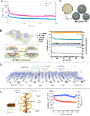
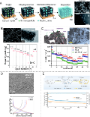
Progress and innovation of nanostructured sulfur cathodes and metal-free anodes for room-temperature Na–S batteries
Beilstein J. Nanotechnol. 2021, 12, 995–1020, doi:10.3762/bjnano.12.75
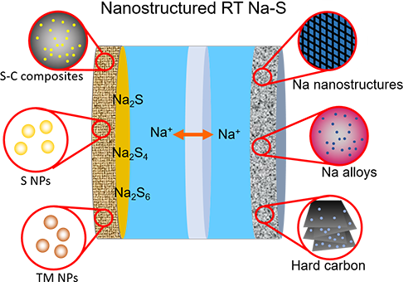
- physical and chemical impregnation, mechanical mixing and self-assembly. Straightforward approaches are sulfur melt and vapor impregnation of suitable matrices. These routes require heating to temperatures above the melting (115 °C) and boiling (446 °C) point of sulfur, respectively. While the former




The role of deep eutectic solvents and carrageenan in synthesizing biocompatible anisotropic metal nanoparticles
Beilstein J. Nanotechnol. 2021, 12, 924–938, doi:10.3762/bjnano.12.69
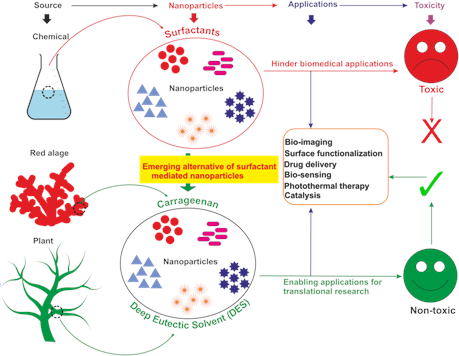
- melting points, which interact via hydrogen bond to form a fluid at room temperature with a freezing temperature much below that of the individual precursor components. These strong hydrogen bonds restrict the recrystallization of the parent compounds [72]. There are numerous reports on DESs from various


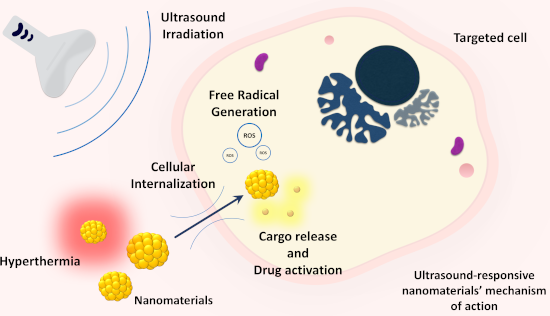
Comprehensive review on ultrasound-responsive theranostic nanomaterials: mechanisms, structures and medical applications
Beilstein J. Nanotechnol. 2021, 12, 808–862, doi:10.3762/bjnano.12.64


Rapid controlled synthesis of gold–platinum nanorods with excellent photothermal properties under 808 nm excitation
Beilstein J. Nanotechnol. 2021, 12, 462–472, doi:10.3762/bjnano.12.37
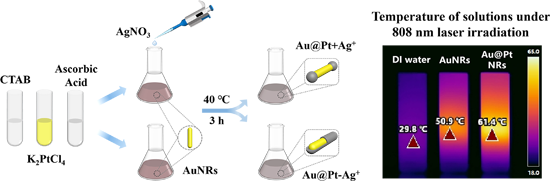
- ][14], have become one of the most extensively researched PTAs. It is acknowledged that thermal stability is extremely critical for noble metal PTAs. The observed melting temperature reduction at the nanoscale will affect the integrity of structure and morphology, thus affecting the optical properties


Doxorubicin-loaded gold nanorods: a multifunctional chemo-photothermal nanoplatform for cancer management
Beilstein J. Nanotechnol. 2021, 12, 295–303, doi:10.3762/bjnano.12.24
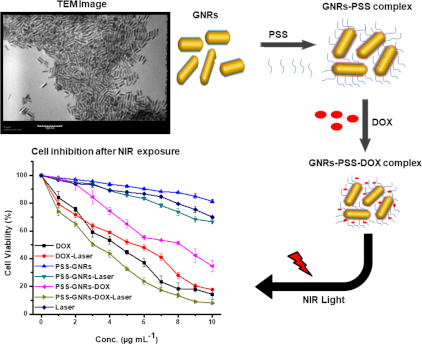
- than 10% of DOX was released within 4 h from PSS-GNR-DOX without NIR irradiation under the same experimental conditions (Figure 5). Drug release from the nanocomplex (PSS-GNR-DOX) might be easily turned “on” and “off” by NIR laser exposure. The NIR laser irradiation causes a melting of PSS that would


Gold(I) N-heterocyclic carbene precursors for focused electron beam-induced deposition
Beilstein J. Nanotechnol. 2021, 12, 257–269, doi:10.3762/bjnano.12.21
- ppm). Mass spectra were obtained on a Micromass QTOF II spectrometer and a Bruker Daltronics maXis II spectrometer. Melting point determinations were performed on a Stuart SMP10 melting point apparatus, using flame-sealed capillaries at a pressure of ca. 0.2 mbar in order to mimic a vacuum environment
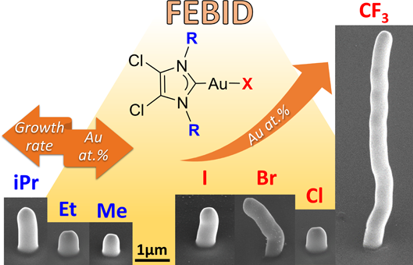
- ). The melting temperatures of the compounds are found not to be correlated directly with the sublimation temperatures. The sublimation temperature is a lower boundary of the FEBID operating range, to achieve a useful vapour pressure. The upper boundary is the upper pressure limit of the SEM. All
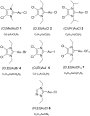
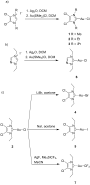
- the eye. Synthesis routes for 1–7. Sublimation temperatures, melting points, and the chosen temperature for deposition of the studied precursors. Elemental composition of deposits obtained by EDX with all values given in atom %. In addition, the ratio between carbon content and gold content in the





The role of gold atom concentration in the formation of Cu–Au nanoparticles from the gas phase
Beilstein J. Nanotechnol. 2021, 12, 72–81, doi:10.3762/bjnano.12.6
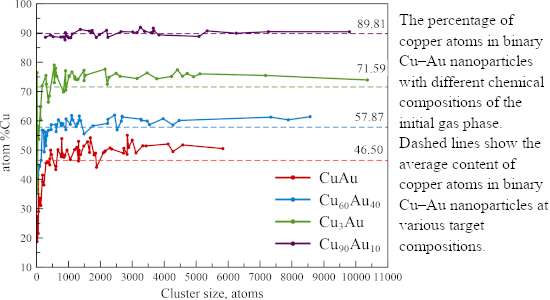
- ) were found in the spatial distribution shown in [3] and a pure copper cluster melts at 1100 K [21], even with a size of 2200 atoms, the temperature of the system should be equivalent to the higher melting point (Tm = 1358 K for copper). Therefore, a comparative analysis between the spatial distribution
- decrease in the maximum cluster size as well as in the number of clusters with a relatively large size (Figure 2). This means that there is a clear tendency to suppress the agglomeration of nanoparticles by increasing their content of gold atoms. It is known that in the bulk state, the melting points of
- copper and gold are practically equal (Tm = 1358 K and Tm = 1337 K, respectively). However, this is no longer true in the nanoscale case. The MD modeling [21][23] showed that at an equal size (D < 10 nm), the melting temperature of copper nanoclusters is 30–40% higher than that of gold clusters, which


Bio-imaging with the helium-ion microscope: A review
Beilstein J. Nanotechnol. 2021, 12, 1–23, doi:10.3762/bjnano.12.1
- alternative approach to the fixation, dehydration, drying, and even coating stages outlined above is to apply ionic liquids during sample preparation. Ionic liquids are organic salts with low melting points which are fluid at room temperature. They are persistent as liquids under the high-vacuum conditions of


Imaging and milling resolution of light ion beams from helium ion microscopy and FIBs driven by liquid metal alloy ion sources
Beilstein J. Nanotechnol. 2020, 11, 1742–1749, doi:10.3762/bjnano.11.156
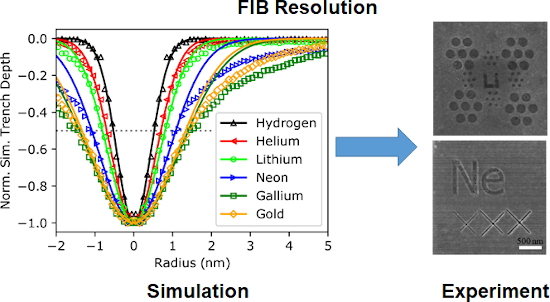
- different targets [42][43] and a Ga-LMIS driven FIB [44][45]. Light ion species, source type, source temperature for GFIS and LMAIS, source material, emitter tip material, and corresponding references. For the LMAIS, the listed temperatures are the melting points of the eutectic alloy. The actually used


Amorphized length and variability in phase-change memory line cells
Beilstein J. Nanotechnol. 2020, 11, 1644–1654, doi:10.3762/bjnano.11.147
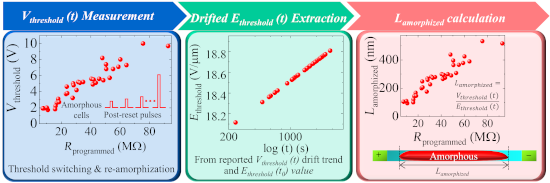
- read DC sweeps was applied. When a post-reset voltage pulse with sufficient amplitude was applied to a given cell, the measured current and the post-pulse resistance increased drastically, indicating that the cell re-amorphized after threshold switching, melting, and quenching. The amorphized length
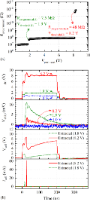
- pulse. When the applied post-reset pulse amplitude was high enough, a significant increase in the measured current and post-pulse cell resistance was observed. This indicated a re-amorphization after threshold switching, melting, and subsequent quenching, as inferred from the measurements and circuit
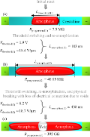
- , Ramorphous(after-pulse), (Figure 6c) for the two re-amorphization events shown in Figure 4. The Rmolten value is assumed to be 140 Ω for all simulations, which is slightly less than the Rcrystalline value, since melting incorporates a drop in the GST resistivity [26]. Table 2 lists these different resistance




High-responsivity hybrid α-Ag2S/Si photodetector prepared by pulsed laser ablation in liquid
Beilstein J. Nanotechnol. 2020, 11, 1596–1607, doi:10.3762/bjnano.11.142
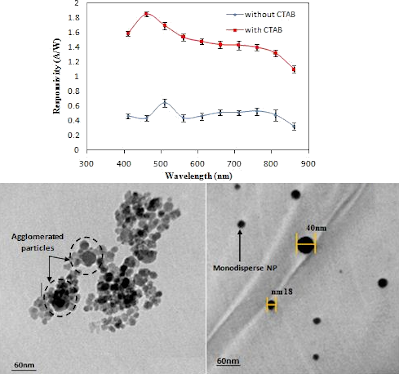
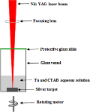
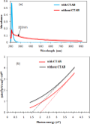
- melting/fragmentation [19]. In the present work, we demonstrate a novel technique to prepare monodisperse Ag2S NPs using CTAB surfactant-assisted pulsed laser ablation of Ag2S NPs in a thiourea (Tu) solution. Moreover, a high-performance hybrid Ag2S/Si photodetector was fabricated. Experimental Colloidal