


Search results
Search for "nanostructuring" in Full Text gives 53 result(s) in Beilstein Journal of Nanotechnology.
Tuning the properties of magnetic thin films by interaction with periodic nanostructures
Beilstein J. Nanotechnol. 2012, 3, 831–842, doi:10.3762/bjnano.3.93
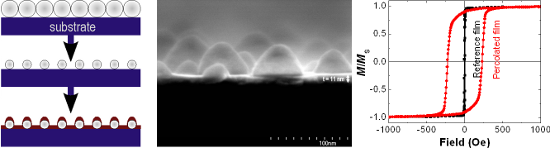
- nanostructuring techniques. Defects may consist of an array of voids [15] or, even simpler, of nonmagnetic nanoobjects, such as particles, optimized with respect to both mutual distance and rather low filling factor. In that case, the information-storing layer is subsequently deposited onto the nanoobjects. In
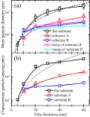
- nanostructuring and magnetism will be discussed in the following subsections. First, we present achievements and limitations of the approach. Monolayers of PS spheres have been prepared by drop-drying [21], spin-coating [22], Langmuir–Blodgett deposition or dip-coating techniques [23]. For PS sizes of 200 nm and
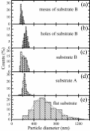
- , respectively. Alternatively to film deposition on size-reduced PS particles for percolated magnetic films, one may use self-assembly of inorganic spheres, such as Au nanoparticles, for nanostructuring. Commercially available Au colloid solutions with particle sizes of 60 and 40 nm have been used to prepare


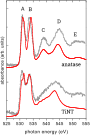
Towards atomic resolution in sodium titanate nanotubes using near-edge X-ray-absorption fine-structure spectromicroscopy combined with multichannel multiple-scattering calculations
Beilstein J. Nanotechnol. 2012, 3, 789–797, doi:10.3762/bjnano.3.88
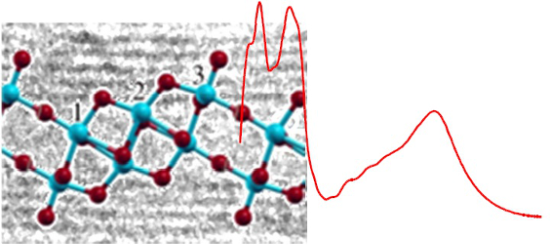
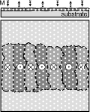
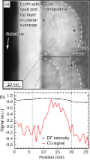
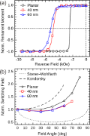
- resolution up to E/ΔE = 104 and spatial resolution approaching 10 nm. While the state-of-the-art spatial resolution of X-ray microscopy is limited by nanostructuring process constrains of the objective zone plate, we show here that it is possible to overcome this through close coupling with high-level



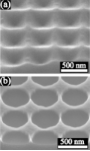
Formation of precise 2D Au particle arrays via thermally induced dewetting on pre-patterned substrates
Beilstein J. Nanotechnol. 2011, 2, 318–326, doi:10.3762/bjnano.2.37
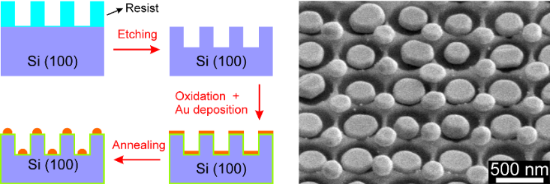
- nanostructuring. The synthesis of 3D arrays of ligand stabilized Au nanoparticles using the self-assembly method has been reported [7], and electron beam lithography has also been used to define positioned nanoparticles at low throughput [8]. Another simple method for the formation of nanoparticle arrays is based





Other Beilstein-Institut Open Science Activities



