


Search results
Search for "nuclear magnetic resonance" in Full Text gives 52 result(s) in Beilstein Journal of Nanotechnology.
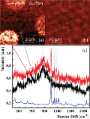
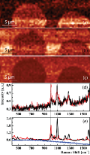
Tip-enhanced Raman spectroscopic imaging of patterned thiol monolayers
Beilstein J. Nanotechnol. 2011, 2, 509–515, doi:10.3762/bjnano.2.55
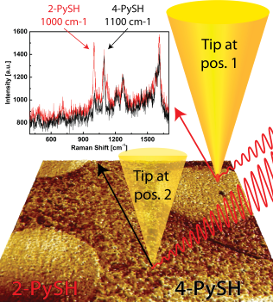
- magnetic resonance (NMR), infrared (IR) spectroscopy and Raman spectroscopy (RS) lack the necessary spatial resolution, while others such as scanning tunneling microscopy (STM) or scanning electron microscopy (SEM) do not provide enough chemical information. Furthermore, the limited quantity of analyte
- biological membranes or of artificially structured surfaces, used in molecular electronics, determines their properties as well as their function. However, characterization is difficult due to the small size and the low number of the molecules that comprise these structures. Most techniques such as nuclear




Magnetic nanoparticles for biomedical NMR-based diagnostics
Beilstein J. Nanotechnol. 2010, 1, 142–154, doi:10.3762/bjnano.1.17
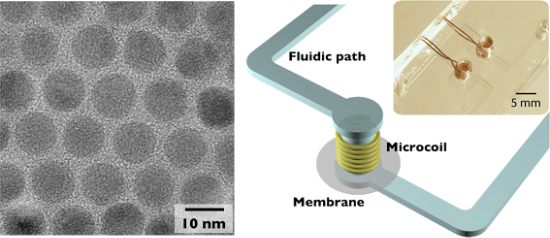
- /drugs, bacteria, and tumor cells, have been quantified. More recently, the capabilities of DMR technology have been further advanced with new developments such as miniaturized nuclear magnetic resonance detectors, better magnetic nanoparticles and novel conjugational methods. These developments have
- ; nuclear magnetic resonance; Introduction Rapid and sensitive measurement of clinically relevant biomarkers, pathogens and cells in biological samples would be invaluable for disease diagnosis, monitoring of malignancy, and for evaluating therapy efficacy in personalized medicine. To translate such
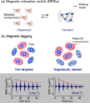
- targets. Another technology that has achieved considerable success is diagnostic magnetic resonance (DMR). Based on nuclear magnetic resonance (NMR) as the detection mechanism, DMR exploits MNPs as proximity sensors, which modulate the spin–spin relaxation time of water molecules adjacent to the


Other Beilstein-Institut Open Science Activities



