


Search results
Search for "photodetector" in Full Text gives 55 result(s) in Beilstein Journal of Nanotechnology.
Thermal noise limit for ultra-high vacuum noncontact atomic force microscopy
Beilstein J. Nanotechnol. 2013, 4, 32–44, doi:10.3762/bjnano.4.4
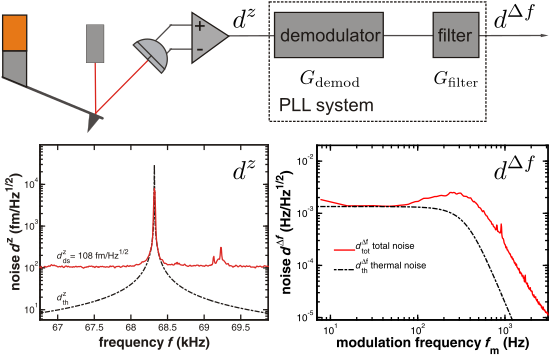
- beam deflection (OBD) setup were recently discussed in detail [3] and it was found that the major noise sources are shot noise arising from the photodetector as well as Johnson noise originating from the resistors in the preamplifier. Further noise is generated in the laser diode that is mainly quantum
- the optical beam-deflection scheme for measuring the cantilever displacement. Therefore, the laser-light power Ppd reaching the photodetector is a parameter characterising the system. Ppd is calculated from the sum signal of the PSD, which in turn depends on the spectral sensitivity of the photodiode


![[Graphic 53]](/bjnano/content/inline/2190-4286-4-4-i64.png?max-width=637&scale=1.18182) =
= ![[Graphic 32]](/bjnano/content/inline/2190-4286-4-4-i43.png?max-width=637&scale=1.18182) f...
f...


![[Graphic 56]](/bjnano/content/inline/2190-4286-4-4-i67.png?max-width=637&scale=1.18182) using three diff...
using three diff...

Characterization and properties of micro- and nanowires of controlled size, composition, and geometry fabricated by electrodeposition and ion-track technology
Beilstein J. Nanotechnol. 2012, 3, 860–883, doi:10.3762/bjnano.3.97
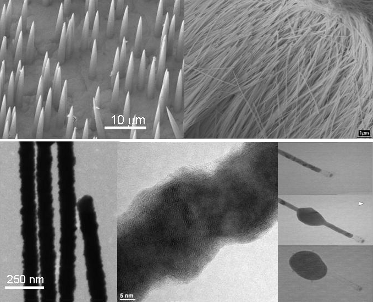
- containing Zn(NO3), Co(NO3), nitric acid, and polyvinylpyrrolidone (PVP) as an additive, 300 nm diameter Zn1−xCoxO nanowires with x ranging from 0.01 to 0.05 were grown [94]. The synthesis and properties of semiconducting CdTe and CdS nanowires are being investigated for their potential in photodetector and








Ultraviolet photodetection of flexible ZnO nanowire sheets in polydimethylsiloxane polymer
Beilstein J. Nanotechnol. 2012, 3, 353–359, doi:10.3762/bjnano.3.41
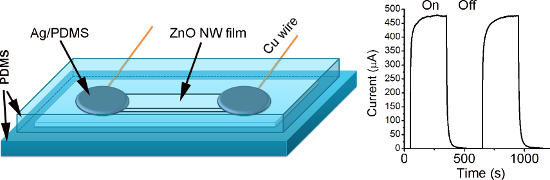
- normally exposed to an oxygen atmosphere to achieve high performance in UV photodetection. In this work we present results on a UV photodetector fabricated using a flexible ZnO nanowire sheet embedded in polydimethylsiloxane (PDMS), a gas-permeable polymer, showing reproducible UV photoresponse and


The atomic force microscope as a mechano–electrochemical pen
Beilstein J. Nanotechnol. 2011, 2, 659–664, doi:10.3762/bjnano.2.70
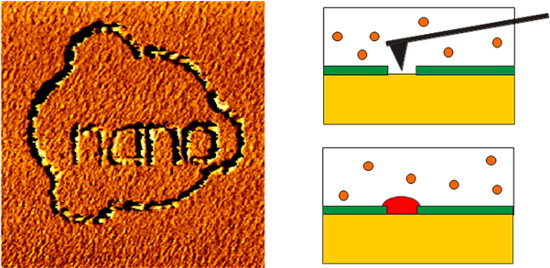
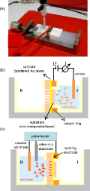
- scanner and a beam-deflection detection system with a four-quadrant photodetector, allowing the simultaneous detection of topography and lateral forces. The AFM was used in the contact mode both for lithography and for imaging. Contact-mode V-shaped silicon nitride cantilevers with pyramidal tips, and


Single-pass Kelvin force microscopy and dC/dZ measurements in the intermittent contact: applications to polymer materials
Beilstein J. Nanotechnol. 2011, 2, 15–27, doi:10.3762/bjnano.2.2
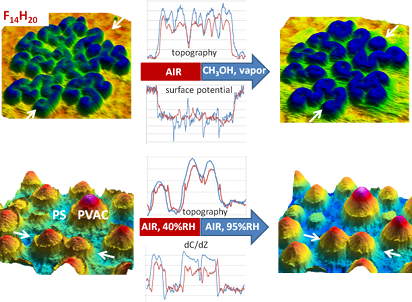
- amplifiers (LIAs) enabling multi-frequency measurements. The MAC III has three dual phase LIAs converting the AC inputs to amplitude and phase. These digitally-controlled analog LIAs have a broad bandwidth (up to 6 MHz) that cover the operational bandwidth of the photodetector employed in the microscope. A
- directly from the photodetector (AM–AM) or from the LIA-1 (AM–FM). The latter block scheme configuration is shown in Figure 1. In the AM–FM, the electrostatic interactions are excited by an AC voltage applied to the probe at ωelec = 3–5 kHz, which is within the bandwidth of ωmech. The electrostatic
- amplitude peak at 2ωmech is recorded and it is proportional to the force gradient signal, and therefore to d2C/dZ2. In the second configuration, the third LIA is connected directly to the photodetector and in this case the detected amplitude at 2ωelec is proportional to the electrostatic force and therefore





Other Beilstein-Institut Open Science Activities



