


Search results
Search for "polydimethylsiloxane (PDMS)" in Full Text gives 54 result(s) in Beilstein Journal of Nanotechnology.
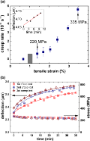
Mechanical characterization of carbon nanomembranes from self-assembled monolayers
Beilstein J. Nanotechnol. 2011, 2, 826–833, doi:10.3762/bjnano.2.92
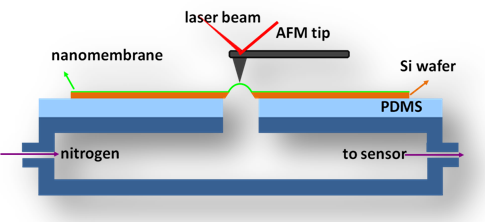
- the membrane and the pressure cell, a layer of polydimethylsiloxane (PDMS) with a thickness of 2 mm was prepared on top of the pressure cell. The deflection at the center of the membrane was recorded by scanning the membrane with AFM in the contact mode. In the central-point method, the AFM tip was

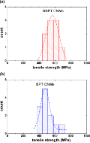
Plasmonic nanostructures fabricated using nanosphere-lithography, soft-lithography and plasma etching
Beilstein J. Nanotechnol. 2011, 2, 448–458, doi:10.3762/bjnano.2.49

- hemispheres Polydimethylsiloxane (PDMS) from Dow Chemical was prepared using the elastomer and curing agent in a ratio of 10:1. The two components were mixed and air bubbles were removed by submitting the liquid to primary vacuum for 15 min. The cast of polymer beads was achieved by filling a cylindrical ring
- . Spectra were normalized against the reference. Fabrication of arrays of metal film coated hemispheres. Main steps: (a) Preparation of 2D colloidal crystal; (b) cast of polydimethylsiloxane (PDMS); (c) detachment of substrate; (d) cast with epoxy resin; (e) PDMS detachment and (f) metal coating by physical


Hierarchically structured superhydrophobic flowers with low hysteresis of the wild pansy (Viola tricolor) – new design principles for biomimetic materials
Beilstein J. Nanotechnol. 2011, 2, 228–236, doi:10.3762/bjnano.2.27
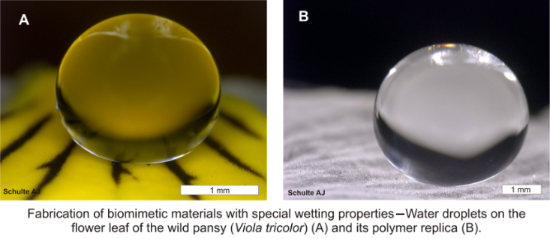
- design than the native petals used as biological models. Xi and Jiang [23] replicated native rose petals with polydimethylsiloxane (PDMS), and fabricated surfaces that are topographically very similar to those of the original rose petals. However, their replicas possessed high adhesive forces to small (2



Capillary origami: superhydrophobic ribbon surfaces and liquid marbles
Beilstein J. Nanotechnol. 2011, 2, 145–151, doi:10.3762/bjnano.2.18
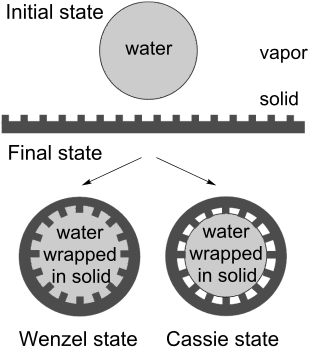
- = (κb/γLV)1/2 the solid can become deformed and shaped by the liquid. In practice, this effect has been given the name “capillary origami” based on experiments showing how films of polydimethylsiloxane (PDMS) shaped in two-dimensions can be folded by evaporating droplets of water to produce a designed
- adhesive forces between liquids and solids both within capillary origami and granular systems. Effect of droplets of blue-dyed water on a thin polydimethylsiloxane (PDMS) membrane: a) droplet causing bending of the substrate, b) initial shaped substrate with the three score lines for folding, c) droplet
- induced folding, and d) three-dimensional shape left after completion of evaporation. Effect of droplets of water on a thin polydimethylsiloxane (PDMS) membrane ribbon substrate hanging vertically: a) droplet causing a bending of the substrate which disappears as evaporation proceeds (three frames), b



Other Beilstein-Institut Open Science Activities



