


Search results
Search for "post-processing" in Full Text gives 56 result(s) in Beilstein Journal of Nanotechnology.
The effect of surface charge on nonspecific uptake and cytotoxicity of CdSe/ZnS core/shell quantum dots
Beilstein J. Nanotechnol. 2015, 6, 281–292, doi:10.3762/bjnano.6.26
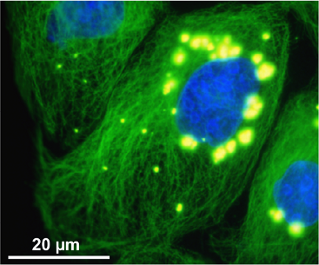
- averaging (for cells), post-processing algorithms to a 20-frame image sequence obtained during each measurement. Composite images of QD fluorescence (red) and cell autofluorescence (green) together with corresponding transmission micrographs. Fluorescence signals from QDs and cells are extracted from the
- overall fluorescent signal by applying standard deviation (for QDs) and averaging (for cells), post-processing algorithms to a 20-frame image sequence obtained during each measurement. CPZ: chlorpromazine (inhibitior of clathrin-mediated endocytosis), DMA: dimethylamyloride hydrochloride (inhibitor of



A reproducible number-based sizing method for pigment-grade titanium dioxide
Beilstein J. Nanotechnol. 2014, 5, 1815–1822, doi:10.3762/bjnano.5.192
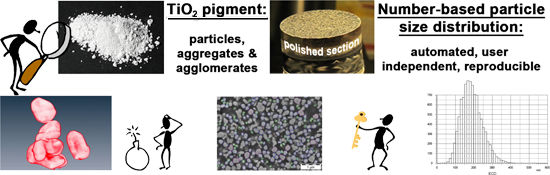
- a problem. The section finally analysed can therefore be reasonably assumed to be representative. The high area density of the pigment in all images ensures that constant conditions for the automated post-processing and detection procedure are assured. Measurement, pigment detection and size
- structures is used for calibration of the instrument. The size of the structures is certified by the PTB under Serial No. IMS-HR 08 3641-01 490 and the calibration mark 44049 11 PTB. An automated protocol (macro) for image post-processing and particle detection was developed. The procedure was realised with
- the pigments varies greatly, depending on viewing direction. Moreover, they illustrate the difficulty with particle detection in projection images in the event of overlapping particles. Imaging conditions and image post-processing for pigment sizing for a rutile pigment; a) original image superimposed


Current state of laser synthesis of metal and alloy nanoparticles as ligand-free reference materials for nano-toxicological assays
Beilstein J. Nanotechnol. 2014, 5, 1523–1541, doi:10.3762/bjnano.5.165
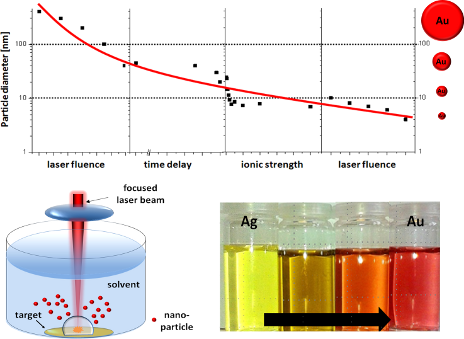
- the laser parameters during synthesis alone are not suitable for the size control during ablation of bulk solids in liquid. The next possible strategy for size control may be ligand-free post-processing of the laser-fabricated nanoparticles. To this end a rather simple but nonetheless feasible


Apertureless scanning near-field optical microscopy of sparsely labeled tobacco mosaic viruses and the intermediate filament desmin
Beilstein J. Nanotechnol. 2013, 4, 510–516, doi:10.3762/bjnano.4.60
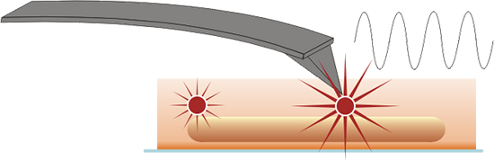
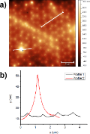
- is moved through the focal detection volume which has a characteristic radius of approx. 300 nm, the fluorescence emission is only enhanced at dye–tip distances lower than approx. 10 nm. Consequently, the raw near-field data exposes stray far-field fluorescence. During post-processing the far-field


Near-field effects and energy transfer in hybrid metal-oxide nanostructures
Beilstein J. Nanotechnol. 2013, 4, 306–317, doi:10.3762/bjnano.4.34
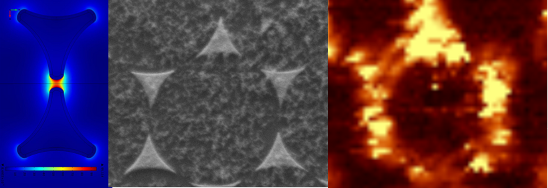
- structure of the TiO2:Eu core due to the perfect lattice matching possible in the homoepitaxial case. In order to investigate the possibility for generation of such coatings, TiO2:Eu nanoparticles were subjected to a post-processing step in an atomic layer deposition (ALD) chamber supplied with trimethyl
- using organic surfactants. Results of the ALD post-processing of TiO2:Eu nanoparticles are shown in Figure 7 and Figure 8. Figure 7 shows a STEM image of TiO2:Eu nanoparticles coated with 3 nm of Al2O3. In addition, a thin layer of TiO2 was added at the end of the process in order to test the
- post-processing. However, it has also become obvious that already existing agglomerates will be coated as a whole, therefore not leading to a separate protection of the surface of individual particle. This may be avoided by coating of the particles while they are still being carried in the gas flow of








Towards 4-dimensional atomic force spectroscopy using the spectral inversion method
Beilstein J. Nanotechnol. 2013, 4, 87–93, doi:10.3762/bjnano.4.10
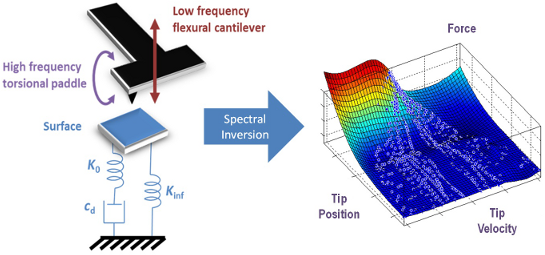
- and in order to filter out the effect of flexural–torsional cross-talk [8][11][12]. Upon completion of the scan and post-processing of the data [11], the user will have acquired for every (x,y) pixel on the surface (see Figure 1, expanded representation), which is equivalent to the 4D representation
- , even without explicitly acquiring velocity information, provided that the force curve inversion is accurate (a detailed analysis of parameter recovery from force curves for the SLS model can be found in [17]). Experimental feasibility The additional post-processing demands required to extend the
- spectral inversion method from three to four dimensions are relatively minor, since the tip position data is already recorded. Furthermore, all Fourier analysis is carried out during a post-processing step and the calculation of the velocity does not represent an excessive computational burden. Thus, the


Other Beilstein-Institut Open Science Activities



