Search results
Search for "protein corona" in Full Text gives 68 result(s) in Beilstein Journal of Nanotechnology.
Protein corona – from molecular adsorption to physiological complexity
Beilstein J. Nanotechnol. 2015, 6, 857–873, doi:10.3762/bjnano.6.88
- Hospital of Mainz, Langenbeckstrasse 1, 55101 Mainz, Germany 10.3762/bjnano.6.88 Abstract In biological environments, nanoparticles are enshrouded by a layer of biomolecules, predominantly proteins, mediating its subsequent interactions with cells. Detecting this protein corona, understanding its
- formation with regards to nanoparticle (NP) and protein properties, and elucidating its biological implications were central aims of bio-related nano-research throughout the past years. Here, we discuss the mechanistic parameters that are involved in the protein corona formation and the consequences of this
- involvement of Coulomb-type interactions between NPs and charged patches on the protein surface. Moreover, we discuss novel aspects related to the complexity of the protein corona forming under physiological conditions in full serum. Specifically, we address the relation between particle size and corona



Biological responses to nanoscale particles
Beilstein J. Nanotechnol. 2015, 6, 380–382, doi:10.3762/bjnano.6.37

- , their surface-active components (i.e., proteins) will adhere to the nanoparticles and form a so-called “protein corona”. As a result, biological systems never come into contact with bare nanoparticles, but rather with their protein-coated analogues. Since this discovery, a large variety of experimental
- preferred as a function of shape, size, and most importantly, surface functionalization and protein corona, could thus far not be established. The SPP1313 research network resulted from an open national call after an intensive evaluation of proposals by an international group of experts. It operated for a
Overview about the localization of nanoparticles in tissue and cellular context by different imaging techniques
Beilstein J. Nanotechnol. 2015, 6, 263–280, doi:10.3762/bjnano.6.25
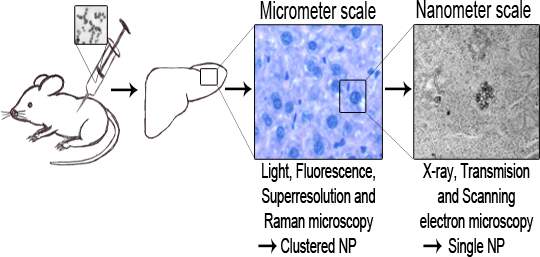
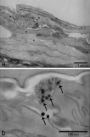
- their toxicity is of prime interest in the safety evaluation of NP. Importantly, for a precise understanding of the biological and toxicological effects of complex NP it is important to understand which part of the NP induces the observed effects, e.g., the inorganic core, the ligand shell, the protein
- corona or even the drug or label inside or associated with the particle. Therefore, more sophisticated imaging methods are needed that allow one to distinguish different parts of a NP within tissues or cells. Furthermore, the expertise of specially trained toxicological pathologists is essential in any



The distribution and degradation of radiolabeled superparamagnetic iron oxide nanoparticles and quantum dots in mice
Beilstein J. Nanotechnol. 2015, 6, 111–123, doi:10.3762/bjnano.6.11
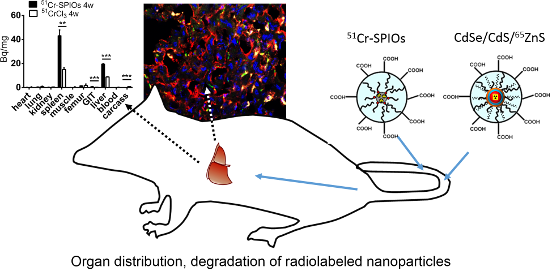
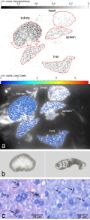
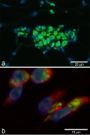
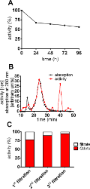
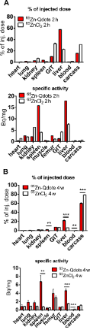
- to play important roles in endocytosing processes and are known to be among the most prominent cell types which take up protein-corona-covered nanoparticles [22][40]. The confocal images of the cryosections exhibit the cell distribution within the liver and confirm this hypothesis. Internalized Qdots





The fate of a designed protein corona on nanoparticles in vitro and in vivo
Beilstein J. Nanotechnol. 2015, 6, 36–46, doi:10.3762/bjnano.6.5
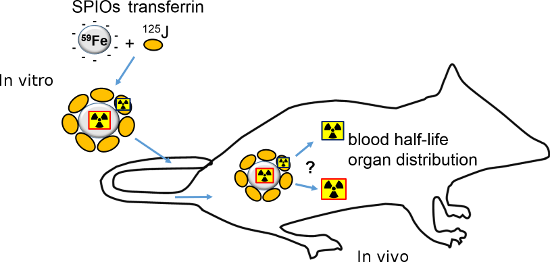
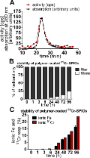
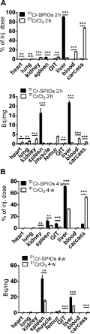
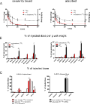
- back into the plasma and into tissue. This study confirms that adsorbed transferrin from a preformed protein corona is efficiently taken up by cells. It is also highlighted that a radiolabelling technique described in this study may be of value to investigate the role of protein corona formation in
- vivo for the respective nanoparticle uptake. Keywords: albumin; 59Fe; 125I; organ uptake; protein corona; SPIOs; transferrin; Introduction Nanoparticles (NPs) have unique capabilities to interact with cells and organs which mark them as attractive working material in nanobioscience and nanomedicine
- with biological matrices such as the blood, are immediately coated by a layer of proteins, resulting in a so called „protein corona“ [8][9][10][11][12][13][14]. The protein corona modifies and shields the surface of the xenobiotic particles and may subsequently influence or even determine their


Nanoparticle interactions with live cells: Quantitative fluorescence microscopy of nanoparticle size effects
Beilstein J. Nanotechnol. 2014, 5, 2388–2397, doi:10.3762/bjnano.5.248
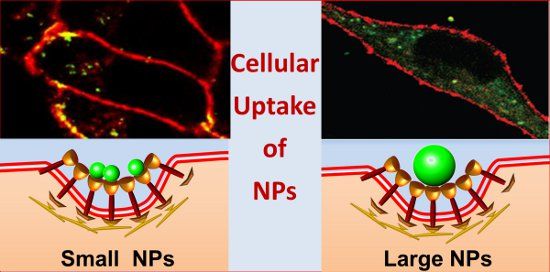
- machinery. An interesting aspect in this process is that, in the biological milieu, the NPs typically adsorb dissolved biomolecules, so that they are enshrouded by a so-called ‘protein corona’ [6][7][8]. NPs interact with cells via this layer of biomolecules, at least during the initial encounter, so that
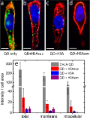
- [24][25][26][27]. Because of the inevitable protein corona formation in any biological environment, one has also to be aware that experiments on cultured cells may yield results different from in vivo studies. Over the past few years, we have used spinning disk confocal fluorescence microscopy to
- cells and the bare NP surfaces rather than NPs carrying a protein corona of unknown composition. By means of inhibitory drugs that specifically interfere with the one or the other endocytosis pathway, the endocytosis pathways involved in the uptake of small and large NPs have been revealed. Finally


Inorganic Janus particles for biomedical applications
Beilstein J. Nanotechnol. 2014, 5, 2346–2362, doi:10.3762/bjnano.5.244
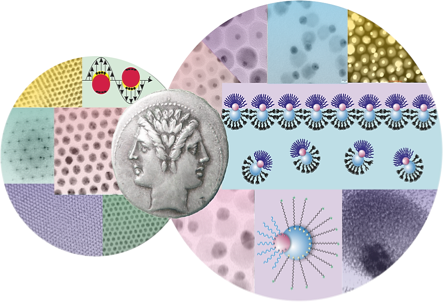
- activity, the magnetic properties, as well as their biocompatibility and interaction with human blood serum. Keywords: bioimaging (CT; MRI; Multi-photon); hetero-nanoparticles; Janus particles; protein corona; synthesis; Introduction In the recent years, there has been an increasing interest in design
- nanoparticles, while the composition of the protein corona is responsible for the fate of the nanoparticles in the organism. Up to now, the formation and the composition of the protein corona is far from being completely understood, but the importance is obvious for any further application of nanoparticles in
- theranostics [113]. The analysis of the protein corona of nanoparticles shows that the binding profiles do not reflect the relative protein concentrations of the plasma. Recently, Tenzer et al. showed that there is no direct correlation of the surface charge and the isoelectric point of proteins enriched in






Coating with luminal gut-constituents alters adherence of nanoparticles to intestinal epithelial cells
Beilstein J. Nanotechnol. 2014, 5, 2308–2315, doi:10.3762/bjnano.5.239
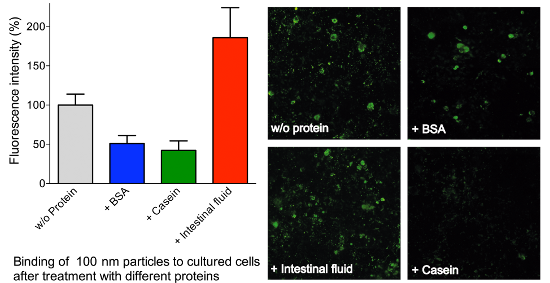
- conceivable increase in particle size, the modification of the particle surface with a protein corona will influence the interaction of NPs with the intestinal mucosal defense system - a multifactorial barrier against mucosal intruders, composed of, e.g., enzymes, soluble surrogate receptors, immunoglobulins
- particle adherence to the cells. The potential consequences of the presence of proteins in biological systems on the behaviour of NPs in that environment are gaining increasing interest. Indeed, the formation of a protein corona around NPs was reviewed in several articles in the last years [22][23][24
- ], and possible implications for the particle–cell interactions are considered. For example, it was shown that human serum albumin (HSA), BSA and fetal bovine serum can build a protein corona around NPs whereby the particles are stabilized against agglomeration and the colloid stability of the particle



Effects of surface functionalization on the adsorption of human serum albumin onto nanoparticles – a fluorescence correlation spectroscopy study
Beilstein J. Nanotechnol. 2014, 5, 2036–2047, doi:10.3762/bjnano.5.212
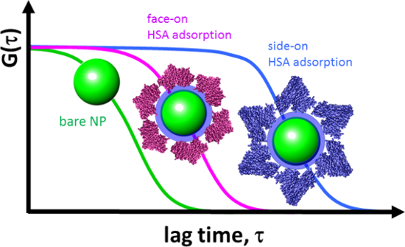
- , independent of their surface charge. The differences in the thickness of the protein corona were rationalized in terms of the different orientations in which HSA adsorbs onto the NPs. The midpoints of the binding transition, which quantifies the affinity of HSA toward the NP, were observed to differ by almost
- four orders of magnitude. These variations can be understood in terms of specific Coulombic interactions between the proteins and the NP surfaces. Keywords: fluorescence correlation spectroscopy; human serum albumin; nanoparticles; protein corona; quantum dots; Introduction In recent years, both
- contact with extracellular fluids such as blood plasma or lung epithelial lining fluid, which contain a huge variety of dissolved biomolecules including lipids and proteins. These can adsorb onto the NP surface and completely enshroud the NP, forming the so-called “protein corona” [11][12][13][14][15




PVP-coated, negatively charged silver nanoparticles: A multi-center study of their physicochemical characteristics, cell culture and in vivo experiments
Beilstein J. Nanotechnol. 2014, 5, 1944–1965, doi:10.3762/bjnano.5.205
- biological media (i.e., in the presence of proteins) the surface of silver nanoparticles is rapidly coated by a protein corona that influences their physicochemical and biological properties including cellular uptake. Silver nanoparticles are taken up by cell-type specific endocytosis pathways as
- down the release of the toxic silver ions. The formation of nanoscopic silver chloride may also be responsible for the cytotoxicity of silver [44]. The protein corona around silver nanoparticles It is now well accepted that nanoparticles acquire a protein corona after contact with biological media [45
- adsorption onto nanoparticle surfaces is a critical step towards understanding the formation of the protein corona at the full complexity of the physiological situation [45][54][55][56][57][58]. We have investigated the formation of a protein corona of serum albumin around silver nanoparticles [56


The surface properties of nanoparticles determine the agglomeration state and the size of the particles under physiological conditions
Beilstein J. Nanotechnol. 2014, 5, 1774–1786, doi:10.3762/bjnano.5.188
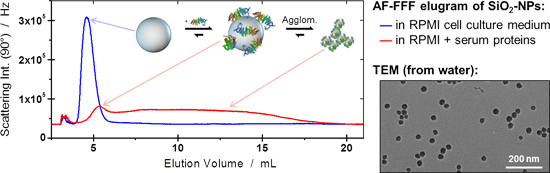
- presence of proteins [11] because NPs tend to form a protein corona [12][13] that is considered to mediate cellular responses [14] and uptake pathways [15][16]. Depending on the nature of colloidal stabilization, the formation of a protein corona and/or even the conditions of physiological salinity can
- the protein corona. Nevertheless, the use of this data for size determination would result in arbitrary results due to the fact that the surface properties are altered by protein adsorption. Additionally, a broad fraction was detected eluting at later elution volumes. Since in AF-FFF a sample is
- values are given in brackets since a loss of material due to the filtration process is likely (especially for the quaternized samples). Although the addition of serum proteins and the subsequent formation of a protein corona leads to an increase in colloidal stability of the electrostatically stabilized


In vitro and in vivo interactions of selected nanoparticles with rodent serum proteins and their consequences in biokinetics
Beilstein J. Nanotechnol. 2014, 5, 1699–1711, doi:10.3762/bjnano.5.180
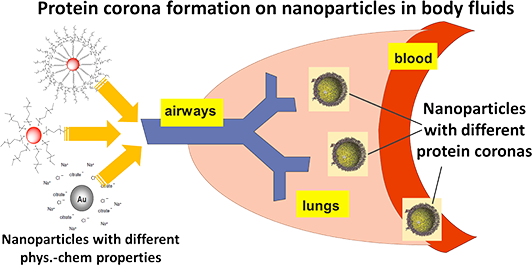
- , Germany 10.3762/bjnano.5.180 Abstract When particles incorporated within a mammalian organism come into contact with body fluids they will bind to soluble proteins or those within cellular membranes forming what is called a protein corona. This binding process is very complex and highly dynamic due to
- the plethora of proteins with different affinities and fractions in different body fluids and the large variation of compounds and structures of the particle surface. Interestingly, in the case of nanoparticles (NP) this protein corona is well suited to provide a guiding vehicle of translocation
- subsequent accumulation in secondary organs and tissues but also the the transport across organ membranes depended on the route of AuNP application. Our in vitro protein binding studies support the notion that the observed differences in in vivo biokinetics are mediated by the NP protein corona and its


Current state of laser synthesis of metal and alloy nanoparticles as ligand-free reference materials for nano-toxicological assays
Beilstein J. Nanotechnol. 2014, 5, 1523–1541, doi:10.3762/bjnano.5.165
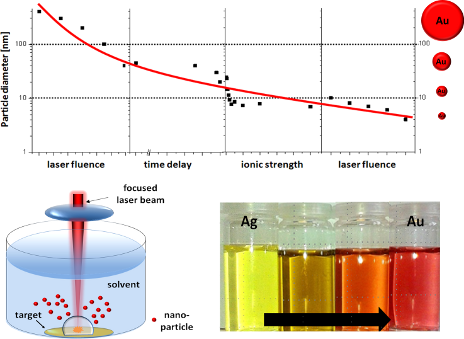
- , the fate of nanoparticles in biological fluids is not only dictated by electrostatic effects. Nanoparticles are known to spontaneously react with organic medium components, predominantly serum proteins, which rapidly (<0.5 min) form a stable protein corona on the nanoparticles [110], known to
- stabilize the particles against aggregation by sterical effects [111]. The mechanism of protein corona formation is still under vivid debate, though it is generally believed that proteins with high affinities strongly bind to the nanoparticle surface forming a hard corona, while other proteins more loosely
- occur on bare nanoparticle surfaces [111]. In order to examine the influence of protein stabilization on ligand-free nanoparticles, albumin may be an appropriate model substance, which is known to be abundant in the protein corona and is one of the most frequent proteins in serum-containing cell culture


In vitro interaction of colloidal nanoparticles with mammalian cells: What have we learned thus far?
Beilstein J. Nanotechnol. 2014, 5, 1477–1490, doi:10.3762/bjnano.5.161
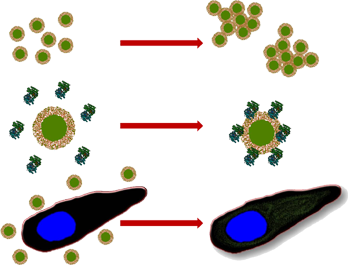
- number of fundamental principles exist, which are outlined in this review. Keywords: colloidal stability; intracellular particle distribution; nanoparticles; protein corona; toxicity of nanoparticles; Introduction There is a multitude of reports about the interaction of colloidal nanoparticles (NPs
- experimental approach. While after short times of exposure huge differences in the amount of incorporated NPs can exist (e.g., between ligand-modified and plain NPs), those differences typically become less significant after longer exposure times [29], e.g., by the presence of the protein corona [30], as will
- -called protein corona [93][94], which in fact can increase or reduce colloidal stability [95][96]. Thus, characterization of colloidal stability and other physicochemical properties of NPs needs to be carried out under the same conditions under which later on cells are incubated with the NPs (i.e., in


The cell-type specific uptake of polymer-coated or micelle-embedded QDs and SPIOs does not provoke an acute pro-inflammatory response in the liver
Beilstein J. Nanotechnol. 2014, 5, 1432–1440, doi:10.3762/bjnano.5.155
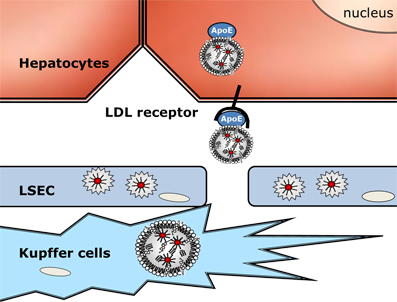
- inflammatory markers or changes in metabolite levels should be determined to access the biological response to nanocrystals in vivo. This is even more important as plasma proteins rapidly bind to the surface of nanoparticles to form a protein corona that influences distinct pathophysiological effects such as


The protein corona protects against size- and dose-dependent toxicity of amorphous silica nanoparticles
Beilstein J. Nanotechnol. 2014, 5, 1380–1392, doi:10.3762/bjnano.5.151
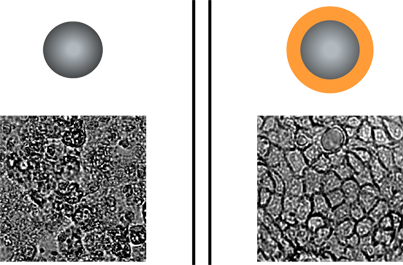
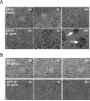
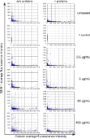
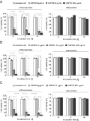
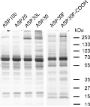
- be resolved. Moreover, proteins associate with NP in physiological fluids, forming the protein corona potentially transforming the biological identity of the particle and thus, adding an additional level of complexity for the bio–nano responses. Here, we employed amorphous silica nanoparticles (ASP
- ) and epithelial GI tract Caco-2 cells as a model to study the biological impact of particle size as well as of the protein corona. Caco-2 or mucus-producing HT-29 cells were exposed to thoroughly characterized, negatively charged ASP of different size in the absence or presence of proteins
- (ASP100; Ø = 100 nm) showed a similar zeta potential, they both displayed only low toxicity. Importantly, the adverse effects triggered by ASP30/ASP30L were significantly ameliorated upon formation of the protein corona, which we found was efficiently established on all ASP studied. As a potential




Injection of ligand-free gold and silver nanoparticles into murine embryos does not impact pre-implantation development
Beilstein J. Nanotechnol. 2014, 5, 677–688, doi:10.3762/bjnano.5.80
- microscopy; gene expression; protein corona; toxicity; Introduction Gold and particularly silver are among the most commonly used materials for nanoparticle applications. They can be found in an increasing amount of consumer products [1], but they also emerge as materials for medical and biotechnological
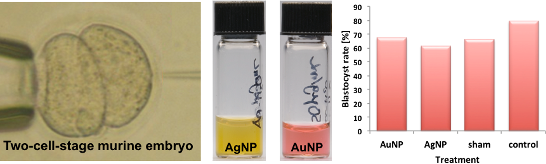
- intriguing. In all published trials where silver nanoparticle exposure to embryos was realized by co-incubation, a considerable toxicity was denoted. The co-incubations described in literature were always performed in serum-free media, thus prohibiting a protein corona to be formed around the particle
- . Notably, in all trials where silver nanoparticles were injected directly, no toxicity was observed. Inside embryos or chicken egg albumen, proteins are abundant, and a protein corona is probably formed immediately around the injected particles. Such protein coronas have been described and characterized




Characterization of protein adsorption onto FePt nanoparticles using dual-focus fluorescence correlation spectroscopy
Beilstein J. Nanotechnol. 2011, 2, 374–383, doi:10.3762/bjnano.2.43
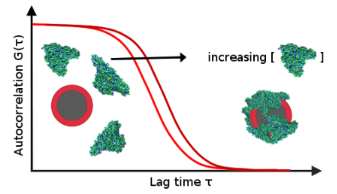
- proteins. Depending on the properties of its surface, a NP may adsorb proteins and other biomolecules from the fluid to a lesser or greater extent. A protein coating layer, the so-called ‘protein corona’, forms and can completely enshroud the NP [6][7][8][9][10][11]. Consequently, at least the initial
- encounter of a NP with a cell is governed by the properties of the protein corona rather than those of the NP surface [12]. NP–protein interactions are typically weaker than chemical bonds and still comparable to the thermal energy at physiological temperatures. Therefore, the protein corona is not static
- understand the structural and dynamic properties of the protein corona at the molecular level. Recently, we have used quantitative fluorescence microscopy, especially fluorescence correlation spectroscopy (FCS), to study protein adsorption of human serum albumin (HSA) on polymer-coated FePt NPs with an