


Search results
Search for "surface enhanced Raman scattering (SERS)" in Full Text gives 56 result(s) in Beilstein Journal of Nanotechnology.
Synthesis of Pt nanoparticles and their burrowing into Si due to synergistic effects of ion beam energy losses
Beilstein J. Nanotechnol. 2014, 5, 1864–1872, doi:10.3762/bjnano.5.197

- performance, Pt NPs are used in fabricating super capacitors [35]. The Pt NPs in core–shell structures (Pt forms the shell) are used in surface enhanced Raman scattering (SERS) studies [36] as well. Moreover, Pt is relatively inert in atmosphere and ex situ characterization of irradiated samples can also be



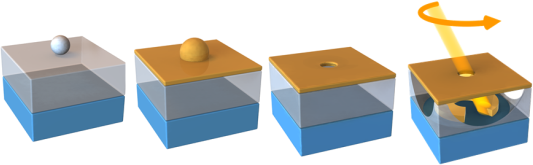
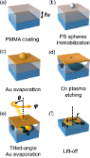
Hole-mask colloidal nanolithography combined with tilted-angle-rotation evaporation: A versatile method for fabrication of low-cost and large-area complex plasmonic nanostructures and metamaterials
Beilstein J. Nanotechnol. 2014, 5, 577–586, doi:10.3762/bjnano.5.68
- surface-enhanced Raman scattering (SERS), in particular when the particle plasmon resonance was tuned to the pump laser wavelength. Novel applications such as coupling of plasmons to atomic gases are on the horizon [14]. Most of these fundamental effects as well as the early applications have been


Optical near-fields & nearfield optics
Beilstein J. Nanotechnol. 2014, 5, 186–187, doi:10.3762/bjnano.5.19

- ” with a length of a few nanometers. This effect of strong near-field enhancement around sharp structures of noble metals has been known from Surface Enhanced Raman Scattering (SERS) for a long time [1]. Yet, the well-controlled tailoring of nanostructures necessary to quantitatively control the optical
Probing the plasmonic near-field by one- and two-photon excited surface enhanced Raman scattering
Beilstein J. Nanotechnol. 2013, 4, 834–842, doi:10.3762/bjnano.4.94
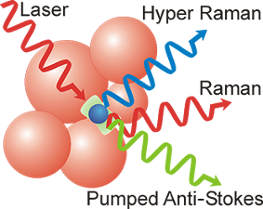
- . Keywords: near-field; plasmonics; silver nanoaggregates; single molecule; surface-enhanced Raman scattering (SERS); Introduction The resonance frequencies of collective oscillations of the electrons in the conduction band in metal nanostructures, which are called surface plasmons, fall in the optical
- such plasmonic structures [1][2]. Exploiting these optical near-fields opens up exciting new capabilities for photon-driven processes and particularly for optical spectroscopy. Surface-enhanced Raman scattering (SERS) might be one of the most prominent effects to demonstrate the potential of




Assessing the plasmonics of gold nano-triangles with higher order laser modes
Beilstein J. Nanotechnol. 2012, 3, 674–683, doi:10.3762/bjnano.3.77
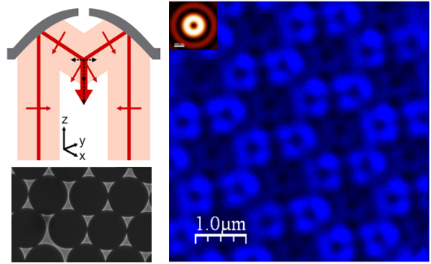
- thirdly with the employed substrate. Moreover, we obtained strongly enhanced Raman spectra of an adenine (sub-)monolayer on gold Fischer patterns on glass. We thus showed that gold Fischer patterns are promising surface-enhanced Raman scattering (SERS) substrates. Keywords: Fischer pattern; higher order
- arrays are long known to yield particle-enhanced Raman spectra [13][14][15]. Hence, there have also been several works [16][17][18] using the near field of Fischer patterns for surface-enhanced Raman scattering (SERS [19][20]). However, to our knowledge, no investigations of Fischer patterns by higher
- measure on a single molecular level, are required. Conventional Raman spectroscopy fails at such low concentrations because of the feebleness of the inelastically scattered light. Surface-enhanced Raman scattering (SERS) is a possible solution to this problem. Ultimately, we assessed the gold Fischer


The morphology of silver nanoparticles prepared by enzyme-induced reduction
Beilstein J. Nanotechnol. 2012, 3, 404–414, doi:10.3762/bjnano.3.47
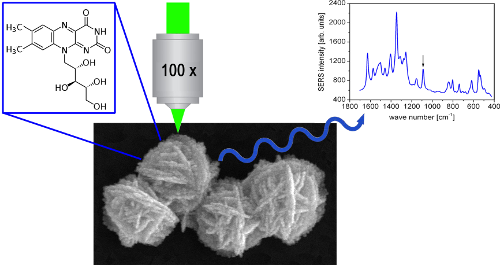
- -enhanced Raman scattering (SERS) substrates. Recently Strelau et al. reported the correlation between electrical conductivity and SERS activity [7]. For a fast, specific, and sensitive detection of molecules at low concentration, EGNP were applied for qualitative as well as quantitative SERS measurements
- time of 5 min. A number of samples were measured again after two months and we found a reproducibility of the RBS spectra within about 2 % indicating stable silver structures. SERS detection of riboflavin by using silver EGNP arrays Enzymatically generated silver nanoparticles are suitable as surface


Other Beilstein-Institut Open Science Activities



