


Search results
Search for "surface plasmons" in Full Text gives 54 result(s) in Beilstein Journal of Nanotechnology.
Assessing the plasmonics of gold nano-triangles with higher order laser modes
Beilstein J. Nanotechnol. 2012, 3, 674–683, doi:10.3762/bjnano.3.77
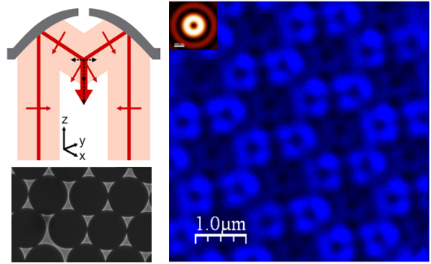
- laser modes; localised surface plasmons; near field; surface-enhanced Raman scattering; Introduction The interaction of light and matter is especially intriguing in those cases where the size of the matter particle is comparable to or smaller than the wavelength of the light. When illuminating metallic
- nano-particles with light of a matching frequency, particle plasmons (also called plasmon polaritons or localised surface plasmons, LSP) can be created and investigated [1]. These quantised collective oscillations of the electrons in the metal have been at the centre of a relatively recent field of


Highly efficient ZnO/Au Schottky barrier dye-sensitized solar cells: Role of gold nanoparticles on the charge-transfer process
Beilstein J. Nanotechnol. 2011, 2, 681–690, doi:10.3762/bjnano.2.73
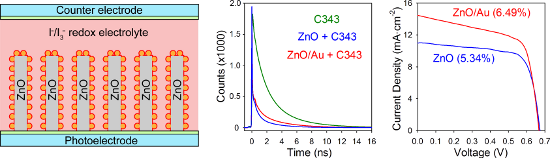
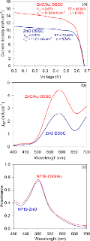
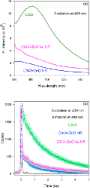
- nanorods. The optical absorptions of the ZnO-nanorod and ZnO/Au-nanocomposite photoelectrode are shown in Figure 2a. Due to the absorption by surface plasmons in the Au nanoparticles, a higher optical absorption of the ZnO/Au-nanocomposite photoelectrode near 520 nm was observed. The optical absorption by
- higher Jsc (82.46 μA/cm2) as well as Voc (0.39 V) compared to the bare ZnO-nanorod solar cell, which is mainly attributed to the higher optical absorption of the ZnO/Au photoelectrode due to the absorption by surface plasmons in Au nanoparticles. In the case of the ZnO/Au solar cells without any
- -nanocomposite DSSCs measured at different incident wavelengths are shown. Due to the absorption by surface plasmons in the Au nanoparticles, an improved photocurrent response was observed above 500 nm illumination in the case of the ZnO/Au-nanocomposite DSSC compared to the bare ZnO-nanorod DSSC. The ZnO/Au



Towards multiple readout application of plasmonic arrays
Beilstein J. Nanotechnol. 2011, 2, 501–508, doi:10.3762/bjnano.2.54
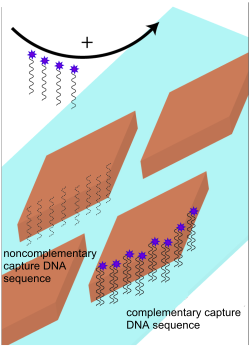
- periodically patterned gold surface. (B) Due to the interaction of the incident light with a metallic nanoparticle, surface plasmons are generated on the metal dielectric interface yielding a strong electromagnetic field with an evanescent decay on the nanoparticle surface. The strong electromagnetic field


Plasmonic nanostructures fabricated using nanosphere-lithography, soft-lithography and plasma etching
Beilstein J. Nanotechnol. 2011, 2, 448–458, doi:10.3762/bjnano.2.49

- can be utilized in experiments requiring light confinement. Keywords: nanosphere-lithography; near-field enhancement; plasma etching; soft-lithography; surface plasmons; Introduction Classical electromagnetic theories describing optical transmission through small apertures [1][2] do not take into
- account the role of surface plasmons on metal films. In contrast to the predictions of these theories, enhanced optical transmission (EOT) was found for arrays of holes in metal films [3]. The transmission enhancements were attributed to the surface plasmons excited in the array [4]. This discovery
- triggered extensive research on nanostructures that support surface plasmons, namely, nanocavities on metal films, arrays of interacting metal particles and gratings. The coupling between light and localized surface plasmons on metal nanostructures that have been favorably tailored leads to a variety of


Other Beilstein-Institut Open Science Activities



