


Search results
Search for "waveguide" in Full Text gives 56 result(s) in Beilstein Journal of Nanotechnology.
k-space imaging of the eigenmodes of sharp gold tapers for scanning near-field optical microscopy
Beilstein J. Nanotechnol. 2013, 4, 603–610, doi:10.3762/bjnano.4.67
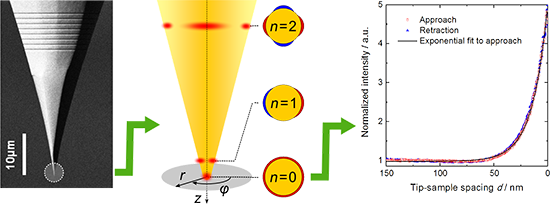
- light down to volumes well below the classical diffraction limit [5][6]. In particular, it has been predicted that SPP wavepackets may be localized both in space and time when they are launched onto a tapered metallic waveguide, e.g., a conical tip with a nanometer-sized apex and sufficiently small
- of a tapered wire In order to describe the process of linear SPP propagation on the SNOM probe in the framework of classical electrodynamics, it is useful to expand the SPP wavepacket in terms of orthonormal eigenmodes at any point along the waveguide. The concept of adiabatic nanofocusing assumes
- that the diameter of a tapered waveguide varies only slowly over the distance of one wavelength of the guided SPP. Therefore, a proper local set of eigenmodes is well approximated by the eigenmodes of an infinitely long waveguide having the local diameter of the taper. For a cylindrical metal wire


Grating-assisted coupling to nanophotonic circuits in microcrystalline diamond thin films
Beilstein J. Nanotechnol. 2013, 4, 300–305, doi:10.3762/bjnano.4.33
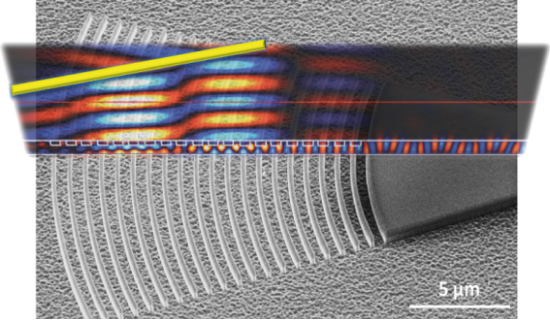
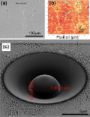
- waveguide fabricated this way is shown in Figure 1b. Focussed ion beam (FIB) milling is used to cut through a waveguide cross-section, which is the reason for the line features at the edge of the waveguide. The FIB image reveals that the sidewalls resulting from the etching are near vertical, illustrating
- that the etch recipe is indeed highly anisotropic. Also visible in the image is the residual e-beam resist (labelled HSQ for Hydrogen silsesquioxane) on top of the waveguide. Design of focussing grating couplers We fabricate nanophotonic waveguides with a width of 1000 nm using the procedure outlined
- above. Here we employ partially etched ridge waveguides as shown in the image in Figure 1b. By using such a waveguide geometry, the optical mode is confined more deeply into the diamond thin film compared to fully etched strip waveguides. This way, scattering effects due to the remaining surface


Diamond nanophotonics
Beilstein J. Nanotechnol. 2012, 3, 895–908, doi:10.3762/bjnano.3.100
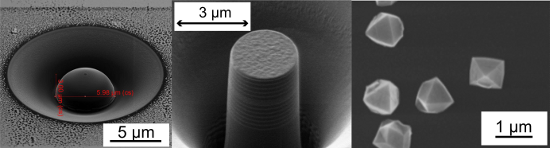
- due to the total internal reflection at the pillar sidewalls [13][14]. Due to the waveguide nature of pillar resonators, the photoluminescence emission is strongly directional, which results in the efficient collection of radiation with a microscope objective. A broadband light transmission
- of these resonances (Figure 8d) are calculated based on an effective-waveguide model. The theoretical results are in excellent agreement with the values obtained by the experiment. The simulations also yield the spatial mode patterns depicted in Figure 8c. The recorded CCD image of the





Synthesis and electrical characterization of intrinsic and in situ doped Si nanowires using a novel precursor
Beilstein J. Nanotechnol. 2012, 3, 564–569, doi:10.3762/bjnano.3.65
- perchlorinated polysilanes an industrial microwave device (MX 4000, Muegge Electronics GmbH), connected to a rectangular waveguide that leads into a reaction chamber, was used. The reactor itself consisted of a quartz-glass tube, inserted into the microwave cavity, with the axis of the waveguide being


Macromolecular shape and interactions in layer-by-layer assemblies within cylindrical nanopores
Beilstein J. Nanotechnol. 2012, 3, 475–484, doi:10.3762/bjnano.3.54
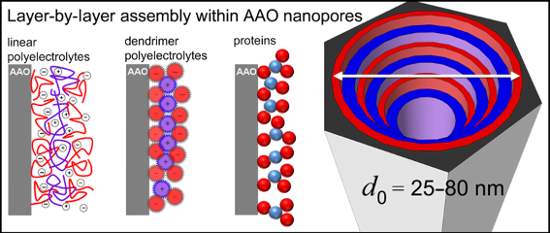
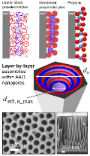
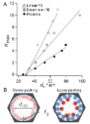
- studied by optical waveguide spectroscopy (OWS). AAO has aligned cylindrical, nonintersecting pores with a defined pore diameter d0 and functions as a planar optical waveguide so as to monitor, in situ, the LbL process by OWS. The LbL deposition of globular proteins, i.e., avidin and biotinylated bovine
- . Keywords: avidin-biotin; dendrimers; nanoporous substrates; optical lightmode waveguide spectroscopy; polyelectrolytes; Introduction Layer-by-layer (LbL) deposition is a versatile technique [1][2] to create functional submicrometer thin films and consists of the sequential deposition of functional
- morphologies. Techniques such as optical waveguide spectroscopy [21][22][23][24] (OWS) and thin-film reflectometry [25][26] have recently been used to independently characterize the thickness and refractive index of optically transparent dielectric thin films. Here, we studied the formation of LbL assemblies




Infrared receptors in pyrophilous (“fire loving”) insects as model for new un-cooled infrared sensors
Beilstein J. Nanotechnol. 2011, 2, 186–197, doi:10.3762/bjnano.2.22
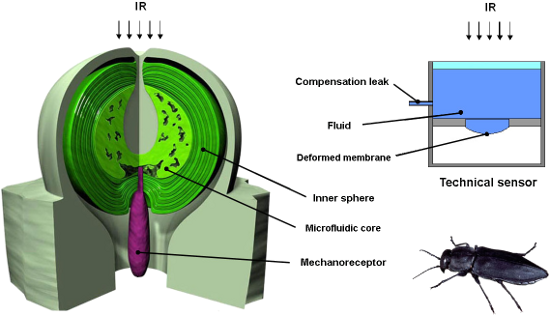
- waveguide with a diameter of about 1.5 µm. Due to the absorption of IR photons at the inner cuticular walls of the cavity, the enclosed air is heated up and expands. In a way not further specified the resulting increase in gas pressure should stimulate the mechanoreceptor. Our recent findings have clearly


Other Beilstein-Institut Open Science Activities



