


Search results
Search for "E. coli" in Full Text gives 77 result(s) in Beilstein Journal of Nanotechnology.
FTIR nanobiosensors for Escherichia coli detection
Beilstein J. Nanotechnol. 2012, 3, 485–492, doi:10.3762/bjnano.3.55
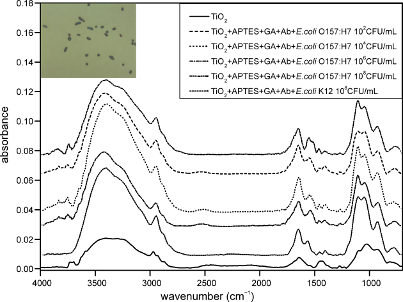
- due to enterohaemorrhagic E. coli (Escherichia coli) have a low incidence but can have severe and sometimes fatal health consequences, and thus represent some of the most serious diseases due to the contamination of water and food. New, fast and simple devices that monitor these pathogens are
- necessary to improve the safety of our food supply chain. In this work we report on mesoporous titania thin-film substrates as sensors to detect E. coli O157:H7. Titania films treated with APTES ((3-aminopropyl)triethoxysilane) and GA (glutaraldehyde) were functionalized with specific antibodies and the
- absorption properties monitored. The film-based biosensors showed a detection limit for E. coli of 1 × 10² CFU/mL, constituting a simple and selective method for the effective screening of water samples. Keywords: biosensors; E. coli; FTIR spectroscopy; foodborne pathogens; nanomaterials; Introduction


Mapping mechanical properties of organic thin films by force-modulation microscopy in aqueous media
Beilstein J. Nanotechnol. 2012, 3, 464–474, doi:10.3762/bjnano.3.53
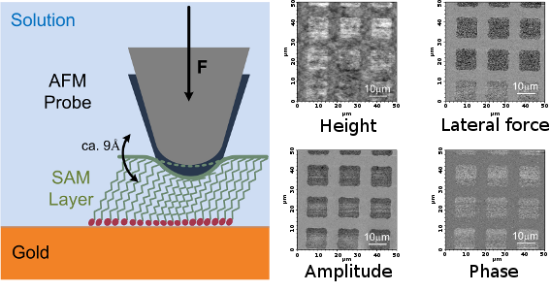
- thermal evaporator (Kurt Lesker PVD 75), and subsequently cleaned by ozone plasma ashing (Emitech K-1050X). Protein monolayer Five tandem B-domains of staphylococcal protein A were expressed and purified from E. coli. The C-terminus of the terminal protein was modified with cysteine to enable protein



Other Beilstein-Institut Open Science Activities



