


Search results
Search for "Kelvin probe" in Full Text gives 78 result(s) in Beilstein Journal of Nanotechnology.
Single-pass Kelvin force microscopy and dC/dZ measurements in the intermittent contact: applications to polymer materials
Beilstein J. Nanotechnol. 2011, 2, 15–27, doi:10.3762/bjnano.2.2
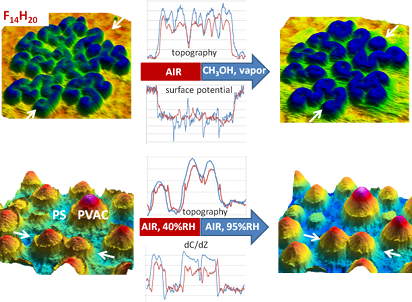
- . Therefore, macroscopic Kelvin probe studies of Langmuir–Blodgett layers of different FnHm revealed a strong surface potential of −0.8 V [6][7] that is assigned to vertically oriented molecular chains with fluorinated parts facing air. Therefore, the fluoroalkane structures are the useful models for the
- of charges and interfacial and field-induced dipoles. In polar polymers, the situation can be much more complicated and the apparent surface potential of polymer molecules has to be discussed in connection with macroscopic Kelvin probe studies of thin PMMA films. These studies revealed that surface





Defects in oxide surfaces studied by atomic force and scanning tunneling microscopy
Beilstein J. Nanotechnol. 2011, 2, 1–14, doi:10.3762/bjnano.2.1
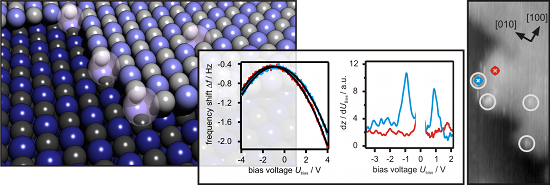
- surface termination by NC-AFM with atomic resolution, point defects in magnesium oxide on Ag(001) and line defects in aluminum oxide on NiAl(110), respectively, were thoroughly studied. The contact potential was determined by Kelvin probe force microscopy (KPFM) and the electronic structure by scanning
- applied on thin oxide films beyond imaging the topography of the surface atoms. Keywords: aluminum oxide; charge state; contact potential; defects; domain boundaries; dynamic force microscopy; frequency modulation atomic force microscopy; Kelvin probe force microscopy; magnesium oxide; non-contact atomic
- defects in oxide surfaces was studied by non-contact atomic force microscopy (NC-AFM) and scanning tunneling microscopy (STM). Furthermore, the contact potential was determined by Kelvin probe force microscopy (KPFM). This technique has a high spatial resolution, thus avoiding averaging over various


Scanning probe microscopy and related methods
Beilstein J. Nanotechnol. 2010, 1, 155–157, doi:10.3762/bjnano.1.18

- molecules on surfaces. AFM has evolved considerably in the last few years, where new operation modes, such as non-contact force microscopy (nc-AFM), Kelvin probe force microscopy (KPFM) or friction force microscopy (FFM), were developed. One main focus is the high resolution capabilities of nc-AFM, which
- Microscopy, FMM: Force Modulation Microscopy, ic-AFM: intermittent contact AFM, TMAFM: tapping mode AFM, nc-AFM: non-contact AFM, KPFM: Kelvin probe force microscopy, EFM: Electrostatic force microscopy, MFM: Magnetic force microscopy, MRFM: Magnetic resonance force microscopy, NSOM: Near-field scanning

Other Beilstein-Institut Open Science Activities



