


Search results
Search for "MRI" in Full Text gives 77 result(s) in Beilstein Journal of Nanotechnology.
Near-infrared dye loaded polymeric nanoparticles for cancer imaging and therapy and cellular response after laser-induced heating
Beilstein J. Nanotechnol. 2014, 5, 313–322, doi:10.3762/bjnano.5.35
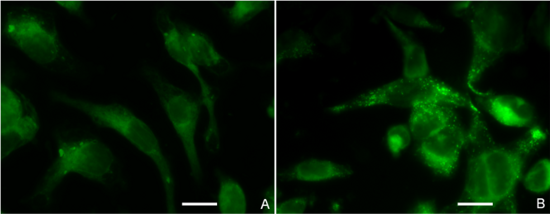
- synthesis of PGMD polymer, PGMD NPs were also successfully formulated. Optical imaging has several advantages over more traditional imaging techniques (MRI, PET, CT, etc.), such as high spatial resolution, real time imaging, and systems that are usually smaller and less expensive. Near-infrared imaging dyes


Magnetic nanoparticles for biomedical NMR-based diagnostics
Beilstein J. Nanotechnol. 2010, 1, 142–154, doi:10.3762/bjnano.1.17
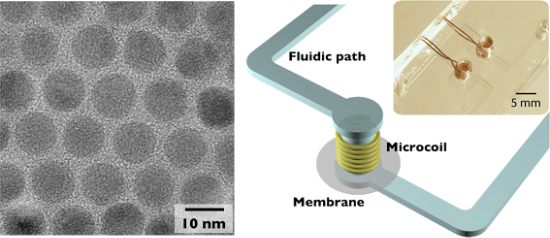
- ][21][22][23][24][25]. A variety of chemical methods, ranging from traditional wet chemistry to high-temperature thermal decomposition, have been employed to synthesize MNPs. Colloidal iron oxide nanoparticles, which are used as clinical magnetic resonance imaging (MRI) contrast agents, are generally
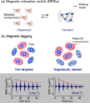
- -assembled clusters, and the consequent increase in cross-sectional area of the particles shortens T2 relaxation times. DMR assay configurations Analogous to MRI, DMR exploits targeted MNPs to modulate the spin–spin T2 relaxation time of biological samples. Depending on the size of the target biomarker, DMR
- systems Nuclear magnetic resonance (NMR) can be detected with instruments such as clinical MRI scanners (routinely used for deep tissue whole body imaging), and NMR spectroscopy (used to study proteins and small molecules). Both of these techniques have been used to measure T2 relaxation time for DMR


Other Beilstein-Institut Open Science Activities



