Search results
Search for "Rh" in Full Text gives 140 result(s) in Beilstein Journal of Nanotechnology.
Study of the correlation between sensing performance and surface morphology of inkjet-printed aqueous graphene-based chemiresistors for NO2 detection
Beilstein J. Nanotechnol. 2017, 8, 1023–1031, doi:10.3762/bjnano.8.103
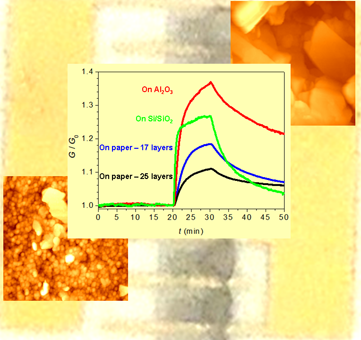
- surface tension of the prepared dispersion has been evaluated by using the contact angle equipment OCA20-Dataphysics in pendant drop configuration. The measurements have been performed under ambient conditions (21 °C, RH 50%) and the estimated value has been the result of measurements repeated five times
- °C), the relative humidity (RH = 50%) and under controlled nitrogen environment at atmospheric pressure, by keeping the flow constant at 500 sccm. All devices, biased at 1 V, have been analyzed through a measurement protocol consisting of an exposure towards the analyte for 10 min, preceded and


CVD transfer-free graphene for sensing applications
Beilstein J. Nanotechnol. 2017, 8, 1015–1022, doi:10.3762/bjnano.8.102
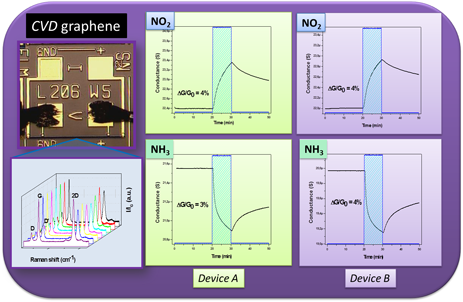
- , setting the flow rate at 500 sccm, the temperature at 25 °C and the relative humidity (RH) at 50%. An increase of the conductance response has been recorded upon exposure towards NO2, whereas a decrease of the signal has been detected towards NH3. The material appears totally insensitive towards CO


Synthesis of coaxial nanotubes of polyaniline and poly(hydroxyethyl methacrylate) by oxidative/initiated chemical vapor deposition
Beilstein J. Nanotechnol. 2017, 8, 872–882, doi:10.3762/bjnano.8.89
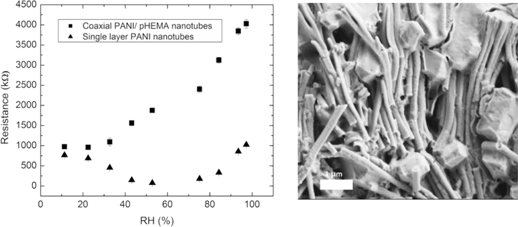
- the probes in the presence of gold electrodes. For PANI flat films, the actual resistance values (R) versus relative humidity (RH%) are plotted in Figure 7. The resistance slightly decreases as RH% increases up to a certain value (RH% of 84.3%). Above 84.3% resistance starts to increase with humidity
- hoping distances and creates distortion in the polymer chains, reducing the conductivity. The maximum resistance of 4372 kΩ was obtained at RH% of 11.3%, whereas the minimum was obtained at 84.3% which is 3301 kΩ. Single-component PANI and coaxial PANI/pHEMA nanotubes were fabricated using sacrificial
- resistance on the humidity as observed in the thin films was also observed in the nanotube samples (Figure 9). This type of parabolic dependence of resistance on the humidity was previously reported for PANI nanotubes [53]. The competition between the doping and swelling effects determines at which RH% value


α-((4-Cyanobenzoyl)oxy)-ω-methyl poly(ethylene glycol): a new stabilizer for silver nanoparticles
Beilstein J. Nanotechnol. 2017, 8, 627–635, doi:10.3762/bjnano.8.67
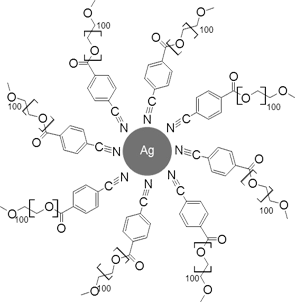
- synthesis, that is, no dilution or other sample processing was performed prior to Raman analysis. NMR spectroscopy. 1H NMR spectra were recorded on a Bruker Avance 300 MHz or 500 MHz spectrometer in D2O with TMS as an internal standard. Light scattering and zeta potential. The hydrodynamic diameter Rh and
- dispersion at pH 7 via dynamic light scattering (DLS) yields a hydrodynamic radius Rh of around 60 nm after dialysis; often the samples have a bimodal size distribution (Table 1). Figure 2C shows Raman spectra of a dispersion of CBAmPEG@SNP and of an aqueous solution of the pure polymer CBAmPEG. The intense
- ) for samples incubated in dispersions with a pH of 12. In contrast, the zeta potentials measured for samples treated at lower pH are around −20 to −30 mV. Unlike the zeta potential, the hydrodynamic radius Rh (as determined by DLS) remains the same at all pH values and over the entire time of


Gas sensing properties of MWCNT layers electrochemically decorated with Au and Pd nanoparticles
Beilstein J. Nanotechnol. 2017, 8, 592–603, doi:10.3762/bjnano.8.64
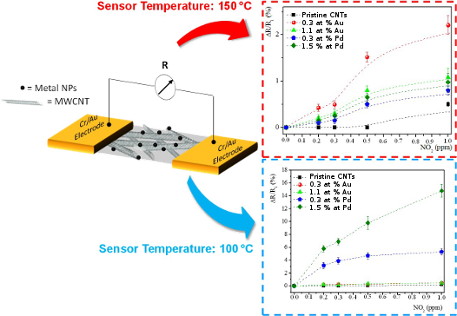
- of CNT-based sensors, due to an increase in the number of the adsorption sites for the targeted gases [18]. CNT sidewalls can be decorated with various noble metals such as Au, Pt, Pd, Rh, and Ag [19][20][21][22][23][24]. Different methods have been used to decorate CNTs, including electrodeposition


Nanoscale isoindigo-carriers: self-assembly and tunable properties
Beilstein J. Nanotechnol. 2017, 8, 313–324, doi:10.3762/bjnano.8.34
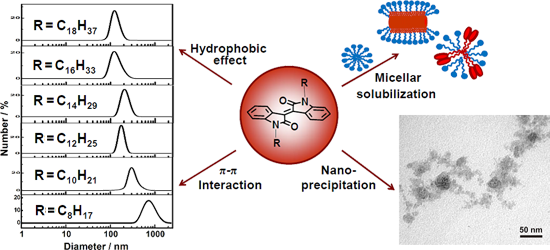
- -order cumulant expansion methods. The effective hydrodynamic radius (RH) was calculated according to the Einstein–Stokes equation: D = kBT/6πηRH, in which D is the diffusion coefficient, kB is the Boltzmann constant, T is the absolute temperature, and η is the viscosity. The diffusion coefficient was




Nanocrystalline ZrO2 and Pt-doped ZrO2 catalysts for low-temperature CO oxidation
Beilstein J. Nanotechnol. 2017, 8, 264–271, doi:10.3762/bjnano.8.29
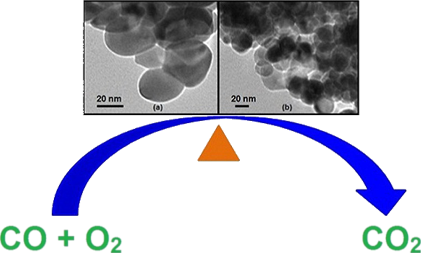
- anthropogenic activities. The catalytic CO oxidation is a very well established and exploited process. So far, noble metals such as Pt, Pd, Rh and Au dominated as catalysts for CO oxidation [10][11][12]. Various supports such as Al2O3, TiO2, SiO2, CeO2, Fe2O3 and carbon nanotubes (CNTs) have also been used for
- CO oxidation by different researchers [13][14][15][16]. The addition of precious metals such as Pd, Pt and Rh increased the reactivity of the support by increasing its oxygen mobility and number of oxygen vacancies (the source of oxygen in CO oxidation) [10][11][12]. In recent years, ZrO2 has been


Nanocrystalline TiO2/SnO2 heterostructures for gas sensing
Beilstein J. Nanotechnol. 2017, 8, 108–122, doi:10.3762/bjnano.8.12
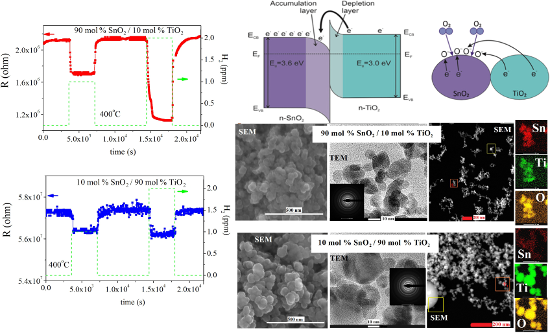
- were carried out in dry atmosphere. The synthetic air contained less than 1 ppm of water vapor while that of hydrogen + argon mixture had less than 10 ppm of contaminants. The relative humidity level was verified to be of about 0–1% RH at room temperature. Dynamic changes in the electrical resistance




Cubic chemically ordered FeRh and FeCo nanomagnets prepared by mass-selected low-energy cluster-beam deposition: a comparative study
Beilstein J. Nanotechnol. 2016, 7, 1850–1860, doi:10.3762/bjnano.7.177
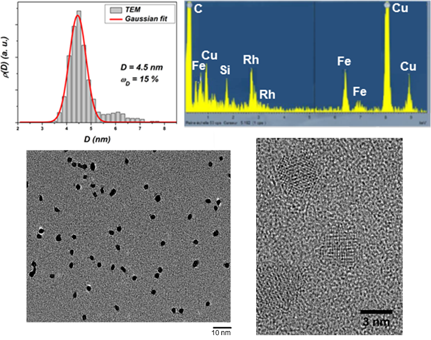
- of chemical ordering in the B2 phase for equiatomic AB alloys. The B2 structure can be seen as the imbrication of two simple cubic sub-lattices, each occupied by either A or B atoms (with A = Fe and B = Rh/Co for FeRh/FeCo). Indeed, the structure factor is expected to present two maxima at fA + fB
- spectroscopy experiments at each specific Fe and Rh M edge (respectively the Co L edge), at the “X-Treme” beamline at the Swiss Light Source for the FeRh sample and at the “DEIMOS” beamline at the SOLEIL synchrotron for FeCo for various nanocluster sizes (Figure 9); before and after annealing of the same
- obtained the experimental persistence of high ferromagnetic magnetization down to 3 K for size-selected chemically ordered B2-like FeRh nanocrystals up to 5 nm in diameter. In particular, magnetic measurements on annealed 3.3 nm FeRh samples, have demonstrated ferromagnetic alignment of Fe and Rh at low


Role of RGO support and irradiation source on the photocatalytic activity of CdS–ZnO semiconductor nanostructures
Beilstein J. Nanotechnol. 2016, 7, 1684–1697, doi:10.3762/bjnano.7.161
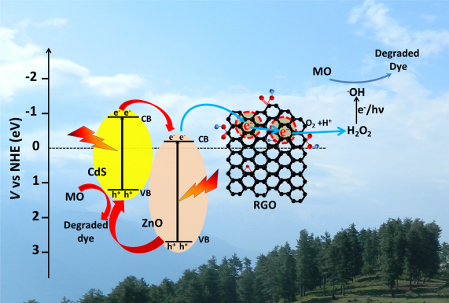
- degradation of MO under irradiation from natural sun light. Comparison of photocatalytic activities of CdS–ZnO–RGO based nanocomposites for degradation of pollutants, including methylene blue (MB), rhodamine B (Rh B) and MO. Acknowledgements We are thankful to Advanced Materials Research Centre (AMRC), IIT




Development of adsorptive membranes by confinement of activated biochar into electrospun nanofibers
Beilstein J. Nanotechnol. 2016, 7, 1556–1563, doi:10.3762/bjnano.7.149
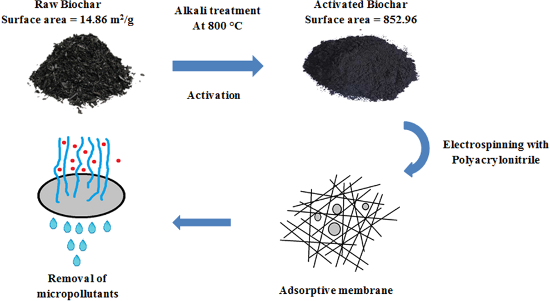
- concentration of 10 wt % and stirred until a clear solution was obtained. Activated biochar at ratios of 0, 0.5, 1, 1.5 and 2% (w/w) of the polymer was added to the solution and the mixture was stirred for 48 h. Nanofibrous membranes were fabricated via electrospinning under ambient conditions (T = 25 °C, RH




A composite structure based on reduced graphene oxide and metal oxide nanomaterials for chemical sensors
Beilstein J. Nanotechnol. 2016, 7, 1421–1427, doi:10.3762/bjnano.7.133
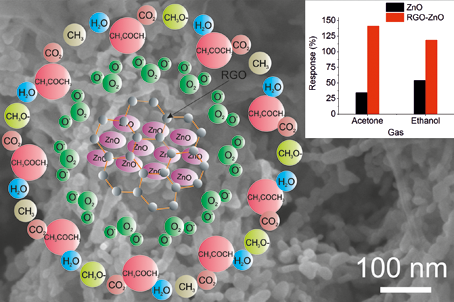
- and ZnO annealed at 250 °C. Dynamical response of ZnO and RGO–ZnO structures at 250 °C and RH = 50% @ 20 °C: (a) towards 50 and 100 ppm of acetone and (b) towards 100 and 250 ppm of ethanol. Schematic diagram of the sensing mechanism between acetone and the RGO–ZnO structure: Oxygen is absorbed on the
- ethanol at a working temperature of 250 °C and in humid air (relative humidity RH = 50% @ 20 °C). Calibration curve for acetone at an operating temperature of 250 °C and in a humid air background (RH = 50% @ 20 °C). The results of the compositional analysis of as-prepared and annealed samples (at 100 and


Microwave synthesis of high-quality and uniform 4 nm ZnFe2O4 nanocrystals for application in energy storage and nanomagnetics
Beilstein J. Nanotechnol. 2016, 7, 1350–1360, doi:10.3762/bjnano.7.126
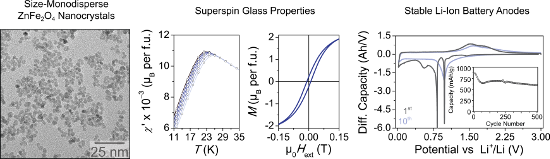
- in a Rh matrix. The center shifts are quoted relative to α-Fe foil at room temperature. The spectra were analyzed using the WinNORMOS software [24]. Transmission electron microscopy was performed on a Tecnai G2-F20ST microscope (FEI) operated at 200 keV. The bright-field images were analyzed using


Influence of ambient humidity on the attachment ability of ladybird beetles (Coccinella septempunctata)
Beilstein J. Nanotechnol. 2016, 7, 1322–1329, doi:10.3762/bjnano.7.123
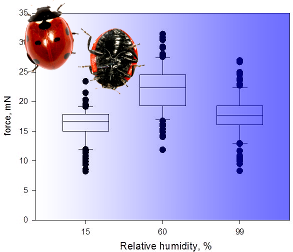
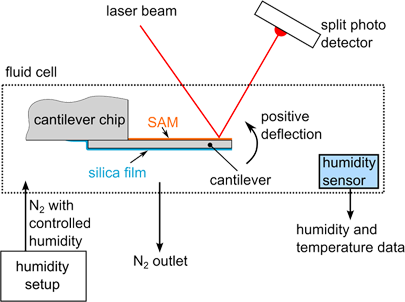
- atmosphere Traction force experiments were performed in a polymethylmethacrylate (PMMA) chamber (30 × 14 × 14 cm) in which relative humidity could be manipulated by the controlled mixture of dry and wetted air (Figure 2, for details see [14]). For this experiment, three levels of relative humidity (RH) were
- used: 15%, 60% and 99%. The RH was monitored with a P330 digital hygrometer (Dostmann electronic GmbH, Wertheim-Reicholzheim, Germany). To generate humid conditions, air was passed through a water bottle, so that the vapour concentration in the air increased. To reach 99% of relative humidity, slight
- . Additionally, to the three previously used humidity adjustments (RH of 15%, 60% and 99%), we made some observations at RH higher than 99%, when water began to condense on the substrate. Results Observational experiments We observed that the beetle’s attachment is affected, as the water begins to condense on


On the pathway of cellular uptake: new insight into the interaction between the cell membrane and very small nanoparticles
Beilstein J. Nanotechnol. 2016, 7, 1296–1311, doi:10.3762/bjnano.7.121
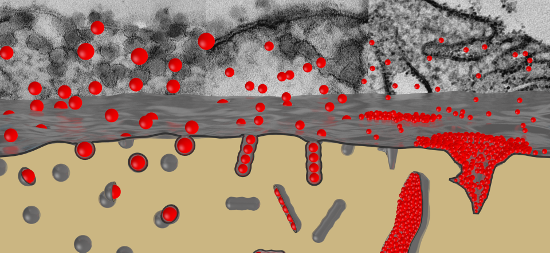
- rn and the z-weighted radius rz from the entirety of measured particles with The values for the effective z-average Stokes–Einstein hydrodynamic radii RH as well as the polydispersity index PDI (determined by the Cumulant method) are given in Supporting Information File 1, Table S1. In order to




Cantilever bending based on humidity-actuated mesoporous silica/silicon bilayers
Beilstein J. Nanotechnol. 2016, 7, 637–644, doi:10.3762/bjnano.7.56
- structures that swell anisotropically and differently between the two layers upon the change of relative humidity (RH) [8]. This bilayer principle has been used to build simple artificial actuators based on the swelling of paper–plastic bilayers [9], and also more general routes have been proposed to create
- method [18] was used to calibrate the cantilevers and was performed directly before every measurement. In order to start every experiment under the same conditions, the first step was to reduce RH to the lowest possible value (around 5%). The cantilever was left in these conditions for several hours to
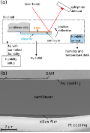
- equilibrate RH and the cantilever deflection to a stationary value. From this point, the adsorption curve followed by the desorption curve were recorded stepwise with 30–45 min equilibration time before reading out the cantilever deflection for each step. A cross section of the AFM cantilever after the


Case studies on the formation of chalcogenide self-assembled monolayers on surfaces and dissociative processes
Beilstein J. Nanotechnol. 2016, 7, 263–277, doi:10.3762/bjnano.7.24
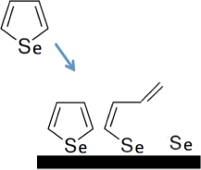
- . Interestingly, on transition metals such as Rh, W and Ni, there are observations of multicomponent S 2p spectra [66][67][68], which could be due to some type of interface sulfide layers. Understanding the interfaces in these situations is thus very important. A good knowledge of monolayer atomic chalcogen


pH-Triggered release from surface-modified poly(lactic-co-glycolic acid) nanoparticles
Beilstein J. Nanotechnol. 2015, 6, 2504–2512, doi:10.3762/bjnano.6.260
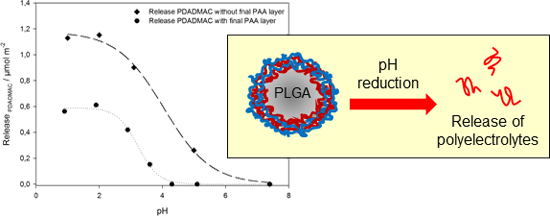
- polymer than PDADMAC. Released amount of PDADMAC per surface area in dependence of the pH. The amount of released PDADMAC was related to the total particle surface to yield the released amount per surface area. Zeta potential (ζ) and hydrodynamic radii (RH) of PAA-coated PLGA-PEI nanoparticles in


Lower nanometer-scale size limit for the deformation of a metallic glass by shear transformations revealed by quantitative AFM indentation
Beilstein J. Nanotechnol. 2015, 6, 1721–1732, doi:10.3762/bjnano.6.176
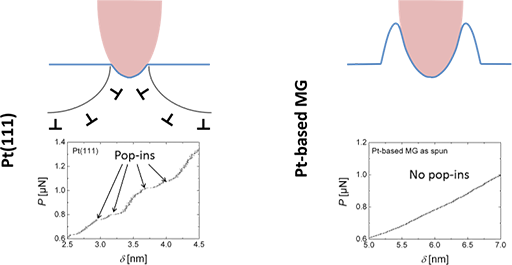
- radiation and differential scanning calorimetry (DSC). We observed a broad diffraction peak at 39.866 degrees of 2θ, a clear glass transition at Tg = 223 °C, and crystallization at Tx = 295 °C using a heating rate RH = 0.67 K/s. The surface of an as-spun Pt-based metallic glass ribbon was prepared by



Structural and magnetic properties of iron nanowires and iron nanoparticles fabricated through a reduction reaction
Beilstein J. Nanotechnol. 2015, 6, 1652–1660, doi:10.3762/bjnano.6.167
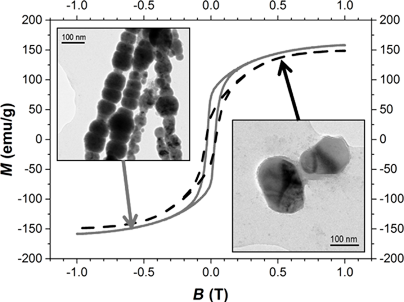
- = 0.1542 nm) and a LYNXEYE detector and also a standard Mössbauer spectrometer (POLON) equipped with a 57Co/Rh source of γ-radiation placed on a vibrator, working in a constant acceleration mode. Magnetic properties were determined by means of an Oxford Instruments Ltd. vibrating sample magnetometer (VSM



Possibilities and limitations of advanced transmission electron microscopy for carbon-based nanomaterials
Beilstein J. Nanotechnol. 2015, 6, 1541–1557, doi:10.3762/bjnano.6.158
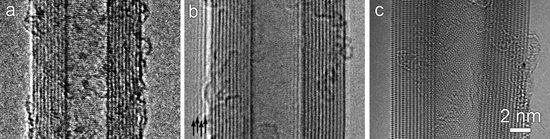
- ]. Systematic studies of different metals on CNTs has been reported, including Au, Pt, Pd, Rh, Cu and Ti [67][70][71][72][73][74][75]. Early studies using HRTEM have revealed that Au and Pt form mostly well-crystallized nanocrystal islands with limited contact areas with the CNTs walls, whereas Pd and Rh form


Pt- and Pd-decorated MWCNTs for vapour and gas detection at room temperature
Beilstein J. Nanotechnol. 2015, 6, 919–927, doi:10.3762/bjnano.6.95
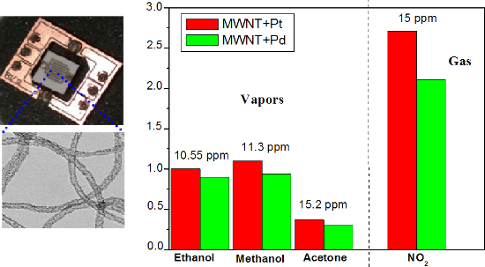
- multiwalled carbon nanotubes decorated with Au, Pd or Ni nanoparticles (formed by evaporation of metals) and also with Rh or Pt nanoparticles (from a colloidal solution) for detecting benzene, nitrogen dioxide and hydrogen sulphide [34][35][36]. Although the detection could be performed at room temperature
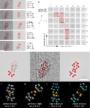
- within the sensor chamber was 10% RH. Results and Discussion Morphological and compositional studies The morphology of the plasma-treated, metal-decorated, multiwalled carbon nanotubes was studied by TEM and the main results are summarised in Figure 1. It can be derived that the sputtering technique
- with bare oxygen-plasma-treated or Rh- and FeO-decorated MWCNTs, which were found to be responsive to aromatic VOCs [24][36][38]. Pd- and Pt-decorated MWCNT sensors were responsive to the non-aromatic VOCs tested. Typical response and recovery cycles toward non-aromatic VOCs are shown Figure 3 and



Capillary and van der Waals interactions on CaF2 crystals from amplitude modulation AFM force reconstruction profiles under ambient conditions
Beilstein J. Nanotechnol. 2015, 6, 809–819, doi:10.3762/bjnano.6.84
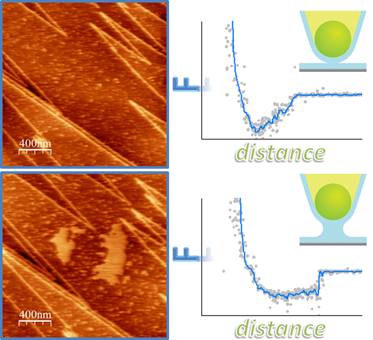
- Figure 1a. At ambient temperature and RH (RH ca. 40%) water accumulates at the flat terraces on the crystal surface forming rounded islands [40] (see Figure 1b and Experimental section) over a time scale of few minutes. Under our experimental conditions, the islands exhibited a typical thickness of 1–1.5
- the one shown in Figure 2b. A similar distance of 3.93 ± 0.40 nm from the jump-to-contact to the point of zero separation is found in the approach path of force curves collected in contact mode on CaF2 crystals with adsorbed water layers on top of the surface (see Figure 2c) at ca. 40% RH. Force
- of hydrated CaF2 and the expected thickness of the water layer on top of the tip (1 nm at room temperature, RH ca. 40% and in the absence of contamination) [46]. This distance indicates that water meniscus forms upon geometrical contact of the absorbed water layers on top of the tip and the crystal


Magnetic properties of self-organized Co dimer nanolines on Si/Ag(110)
Beilstein J. Nanotechnol. 2015, 6, 777–784, doi:10.3762/bjnano.6.80
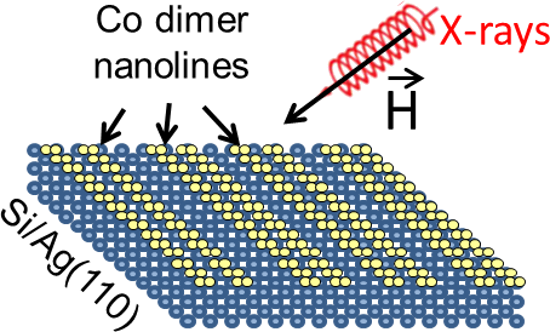
- ]. Although the shoulder at +4 eV from the L3 edge can be observed for other Co nanostructures (e.g., an ultrathin 1.25 ML Co film grown on Rh(111) [33] or a superlattice of 0.35 ML 2D Co nanoparticles on Au(788) [4]) this feature is more pronounced in the case of our Co nanolines, especially for low Co


Nanoparticle shapes by using Wulff constructions and first-principles calculations
Beilstein J. Nanotechnol. 2015, 6, 361–368, doi:10.3762/bjnano.6.35
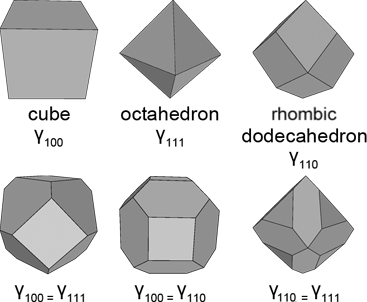
- ], Si in amorphous SiO2 [37], diamond in amorphous C [38], Rh and Pd under oxidizing conditions [39], Cu in N gas [40], Au under oxidizing conditions [41], noble metals with an environment [42], complex metal hydrides [43], iron carbides [44] and dawsonites [45][46], just to name a few. Atomistic Wulff