


Search results
Search for "SDS" in Full Text gives 80 result(s) in Beilstein Journal of Nanotechnology.
How to remove the influence of trace water from the absorption spectra of SWNTs dispersed in ionic liquids
Beilstein J. Nanotechnol. 2011, 2, 653–658, doi:10.3762/bjnano.2.69
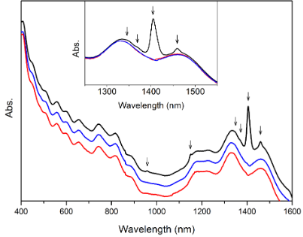
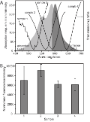
- as the deconvoluted individual peaks corresponding to different chiralities of the semiconducting nanotubes, as indicated in the figure. Compared to surfactant SDS-dispersed HiPco SWNTs [23], an average of 30 meV red-shift in energy is observed in the semiconducting nanotube E11 region and this can




Ceria/silicon carbide core–shell materials prepared by miniemulsion technique
Beilstein J. Nanotechnol. 2011, 2, 638–644, doi:10.3762/bjnano.2.67
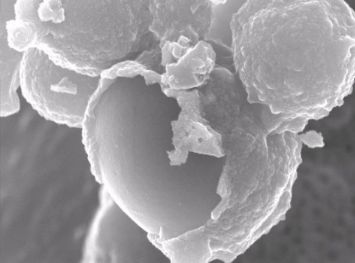
- photon cross-correlation spectroscopy (PCCS) reveal that PCS-spheres synthesized with 2.5 wt % (with respect to the inner phase) of the cationic surfactant cetyl trimethylammonium bromide (CTAB) or the anionic surfactant sodium dodecyl sulfate (SDS) have diameters of approximately 300 nm, whereas the use
- of SDS concentration in the range of 1–10 wt % does not influence the particle size, but in the case of CTAB an increasing amount of surfactant leads to increasing sphere sizes. This is contrary to our expectations, but FESEM (Field Emission Scanning Electron Microscopy) investigations verified that
- particles the addition of comonomers is useful. The sizes of PCS spheres prepared with 50 wt % of styrene or MMA were reduced to 100 nm (surfactant 2.5 wt % SDS) (Figure 2C). Particles sizes as well as their elemental distribution were very uniform, indicating that copolymerization had occurred. The


Towards multiple readout application of plasmonic arrays
Beilstein J. Nanotechnol. 2011, 2, 501–508, doi:10.3762/bjnano.2.54
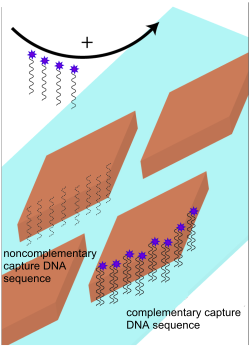
- chips were thoroughly washed to remove all unbound capture DNA. Before the hybridization, the dye-labeled target DNA (50 nM Cy3.5-labeled sequence: Cy3.5-5'-CAT AGA ATC AAG GAG CAC ATG CTG AAA AAA-3') was suspended in 5× saline–sodium citrate (SSC) and 0.1% sodium dodecyl sulphate (SDS). Droplets of
- approximately 10 μL of the target DNA were added onto the chip and incubated for 1 h at 40 °C in a humidity chamber. Afterwards, the substrates were washed for 5 min each in 2× SSC and 0.1% SDS, 2× SSC and 0.2× SSC. Finally, the chips were dried under a stream of nitrogen. Fluorescence measurements


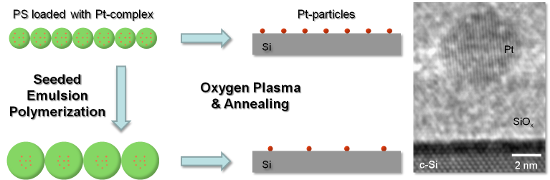
Platinum nanoparticles from size adjusted functional colloidal particles generated by a seeded emulsion polymerization process
Beilstein J. Nanotechnol. 2011, 2, 459–472, doi:10.3762/bjnano.2.50
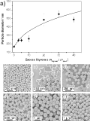
- dodecylsulfate (SDS, relative to the amount of water used) was heated to 75 °C. Ammonium peroxodisulfate, (APS, (NH4)2S2O8), used as initiator, was dissolved in a small amount of ultra-pure water and added to the dispersion. Styrene, as monomer, was added to the solution using a syringe pump with a flow rate of
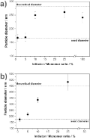
- previous experiments (Figure 3a shows the result of the standard reaction). Obviously, the amount of SDS added in the standard recipe is insufficient to induce stable reaction conditions. Hence, the SDS concentration in the continuous phase was increased from 0.01 wt % up to 0.1 wt %. All SDS
- , massive secondary nucleation took place, leading to bimodal size distributions. In the first case (0.05 wt % SDS), the size enhanced seed particles feature an excellent monodispersity and have a size of approximately 600 nm, indicating a more stable course of reaction. In contrast, higher amounts of SDS



Detection of interaction between biomineralising proteins and calcium carbonate microcrystals
Beilstein J. Nanotechnol. 2011, 2, 222–227, doi:10.3762/bjnano.2.26
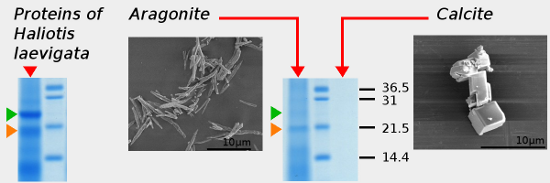
- ]. Figure 3 shows the result of the protein–crystal binding experiment. The proteins in the shell from Haliotis laevigata that were insoluble in 6% acetic acid were removed from the chitin core with an SDS/DTT/Tris buffer as described in the experimental section. This protein solution contained several
- proteins or protein fragments visible in lane P on sodium dodecyl sulfate polyacrylamide gel electrophoresis (SDS-PAGE) in Figure 3. The protein solution was gel-filtered to remove the SDS and DTT. The obtained gel-filtered protein solution (lane gfP) shows the major bands on SDS-PAGE. The gel-filtered
- protein solution was incubated with aragonite or calcite microcrystals. After incubation, the supernatant liquid from the aragonite or calcite microcrystals was removed and subjected to SDS-PAGE at two different concentrations (AS, AS* and CS, CS*). The crystals were washed 3 times with a NaCl/Tris


Other Beilstein-Institut Open Science Activities



