


Search results
Search for "cell proliferation" in Full Text gives 87 result(s) in Beilstein Journal of Nanotechnology.
Synthesis of boron nitride nanotubes and their applications
Beilstein J. Nanotechnol. 2015, 6, 84–102, doi:10.3762/bjnano.6.9
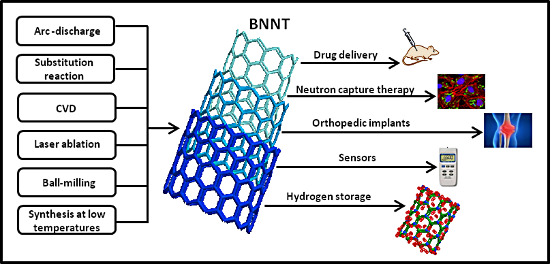
- dispersion in aqueous media for biological applications [12]. The effect of the PEI-coated BNNTs with respect to viability, metabolism and cell proliferation of human neuroblastoma cell line (SH-SY5Y) was investigated. The PEI-coated BNNTs exposed cells analyzed at different time intervals. The viability
- -embedded polylactide-polycaprolactone (PLC–BNNT) in orthopedic implants [75]. Using real-time PCR methods, they studied the RunX2 gene expression profile, which is a transcription factor responsible for enhancing the cell proliferation. The results of the experiments showed that the PLC–BNNTs increased the
- RunX2 gene expression of the osteoblast cells up to sevenfold. It was concluded that the positive effect of the BNNTs embedded into the scaffold on the cell proliferation was due to the natural affinity of proteins to the hydrophobic BNNTs [75]. Ciofani et al. investigated the cytotoxicity of GC–BNNTs




Proinflammatory and cytotoxic response to nanoparticles in precision-cut lung slices
Beilstein J. Nanotechnol. 2014, 5, 2440–2449, doi:10.3762/bjnano.5.253
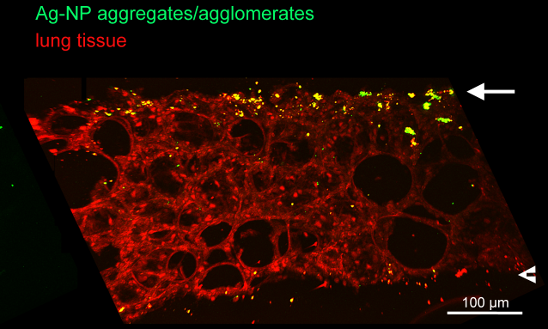
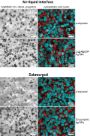
- persisted up to 72 h (Figure 2). Since an increased WST-1 conversion could also indicate cell proliferation, we examined if there was enhanced cell proliferation by performing a proliferation assay (Click-iT® EdU Alexa Fluor® 488 Imaging Kit) in which the incorporation of 5-ethynyl-2′-deoxyuridine, a
- nucleoside analogue to thymidine, into replicated DNA can be visualized by confocal laser scanning microscopy. As shown in Figure 3, cell proliferation was not significantly altered as shown by this assay. Responses of PCLS after exposure to (nano)particles Cytotoxic response After 4 h of incubation with 20
- control (WST-1 conversion at 0 h). All tests were performed in duplicates. Cell proliferation assay For determination of cell proliferation, the Click-iT® EdU Alexa Fluor® 488 Imaging Kit (Invitrogen, Karlsruhe, Germany) was used. PCLS were incubated for 4 h with 20 µM EdU (5-ethynyl-2′-deoxyuridine, a


Functionalized polystyrene nanoparticles as a platform for studying bio–nano interactions
Beilstein J. Nanotechnol. 2014, 5, 2403–2412, doi:10.3762/bjnano.5.250
- used superparamagnetic iron oxide nanoparticles. Keywords: amino groups; apoptosis; carboxyl groups; cell proliferation; leukemia cell lines; macrophages; mTOR; polystyrene nanoparticles; Review Applications of polystyrene Polystyrene, one of the most extensively used types of plastic [1], is an
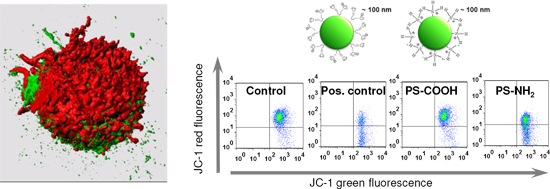
- -localized with lysosomes independent of the cell type (Figure 3, and [41][42][43]). Further analysis demonstrated that PS-COOH did not affect the THP-1 cell proliferation, whereas PS-NH2 particles virtually immediately terminated the cell division [41]. It is also notable, that the cell size decreased after


Effect of silver nanoparticles on human mesenchymal stem cell differentiation
Beilstein J. Nanotechnol. 2014, 5, 2058–2069, doi:10.3762/bjnano.5.214
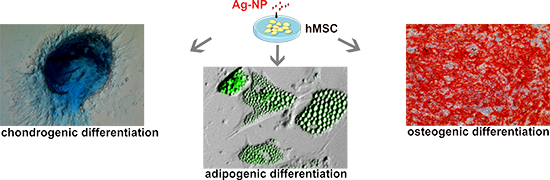
- . analyzed the expression of alkaline phosphatase in MSCs in the presence of Ag-NP (up to 1 μg·mL−1) after prolonged cell sulture (35 d). In contrast to the significant inhibition in cell proliferation observed at the highest concentration of Ag-NP, the authors found no influence on the activity of alkaline
- Technologies) while using 75 cm2 flasks (Falcon, Becton Dickinson GmbH, Heidelberg, Germany). Cells were maintained at 37 °C in a humidified 5% CO2 atmosphere. hMSCs were sub-cultivated every 7–14 d depending on cell proliferation. Adherent cells were washed with phosphate buffered saline solution (PBS, Life


PVP-coated, negatively charged silver nanoparticles: A multi-center study of their physicochemical characteristics, cell culture and in vivo experiments
Beilstein J. Nanotechnol. 2014, 5, 1944–1965, doi:10.3762/bjnano.5.205

- extracellular silver nanoparticles, the intracellular occurrence of silver agglomerates of silver-pulsed cells had decreased in a process which was clearly not related to cell proliferation under these conditions (Figure 10). Interestingly, the decrease in the number of particles was almost completely inhibited


Carbon-based smart nanomaterials in biomedicine and neuroengineering
Beilstein J. Nanotechnol. 2014, 5, 1849–1863, doi:10.3762/bjnano.5.196
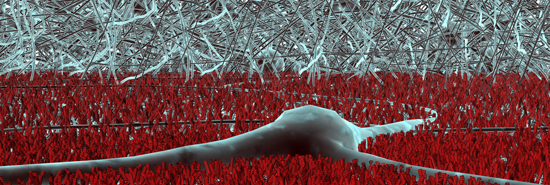
- primary focus of a study conducted by Heo and colleagues [95], who developed a graphene/PET film to test the effects of a non-contact field stimulation on cell-to-cell coupling. This film was found to be biocompatible and improved cell proliferation and viability compared to those observed in the control


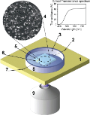
Influence of the PDMS substrate stiffness on the adhesion of Acanthamoeba castellanii
Beilstein J. Nanotechnol. 2014, 5, 1393–1398, doi:10.3762/bjnano.5.152
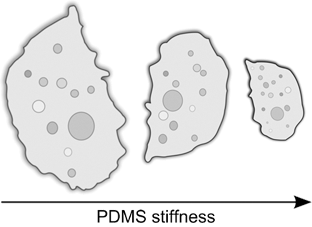
- parameters such as cell proliferation, as the doubling time of acanthamoeba in axenic culture is on the timescale of days [38]. As acanthamoeba can also be grown in suspension [19], their proliferation might not be strongly influenced by the presence of any substrate. In a recent study, we had investigated



Mimicking exposures to acute and lifetime concentrations of inhaled silver nanoparticles by two different in vitro approaches
Beilstein J. Nanotechnol. 2014, 5, 1357–1370, doi:10.3762/bjnano.5.149
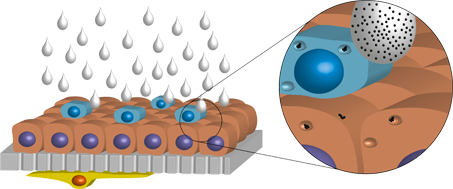
- . Others found dissolution and thus a subsequent release of Ag ions from PVP-coated Ag NPs that were synthesized similar to the particles used in the current study [64]. Other studies using the same PVP-capped Ag NPs as we used, showed a similar aggregation pattern as we found [46]. Furthermore, cell
- proliferation and migration (chemotaxis) both decreased, and the release of cytokines was affected. Increased IL-8 and decreased IL-6 and vascular endothelial growth factor (VEGF) levels were detected at high Ag NP concentrations [65]. These studies however, were obtained with human mesenchymal stem cells



PEGylated versus non-PEGylated magnetic nanoparticles as camptothecin delivery system
Beilstein J. Nanotechnol. 2014, 5, 1312–1319, doi:10.3762/bjnano.5.144
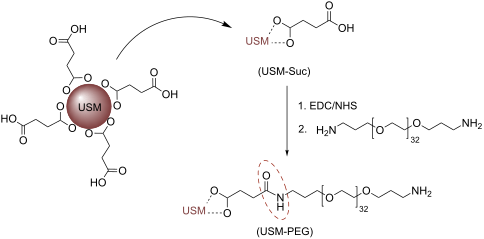
- ; cancer therapy; iron oxide superparamagnetic nanoparticles; polyethylene glycol; Introduction Camptothecin (CPT) is a quinoline based alkaloid, which exhibits a potent cytotoxic activity against a broad spectrum of tumours [1][2][3]. While most antineoplastic agents inhibit cancer cell proliferation by


Antimicrobial nanospheres thin coatings prepared by advanced pulsed laser technique
Beilstein J. Nanotechnol. 2014, 5, 872–880, doi:10.3762/bjnano.5.99
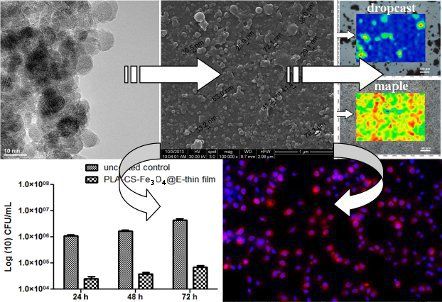
- (Sigma Aldrich, St. Louis, MO, USA). For cell proliferation and viability CellTiter96 Non-Radioactive Cell Proliferation Assay, (Promega, Madison, USA) was used. Endothelial cells were seeded in a 96-well plate at a density of 5 × 10³ cells/well in DMEM medium, supplemented with 10% FBS, and incubated
- with nanospheres coated with eugenol for 72 h. The controls were represented by endothelial cells grown under the same culture conditions, but on bare substrates. Following the guidelines of the manufacturer the cell proliferation assay was performed in triplicates at different time intervals. Briefly




Nanoglasses: a new kind of noncrystalline materials
Beilstein J. Nanotechnol. 2013, 4, 517–533, doi:10.3762/bjnano.4.61
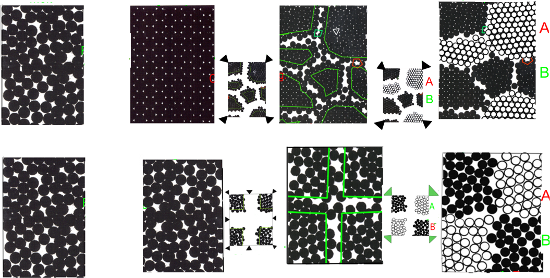
- microstructure of nanoglasses on the bioactivity, hierarchically structured layers of Ti34Zr14Cu22Pd30 metallic nanoglass were created by magnetron sputtering. The cell proliferation on the surfaces of these materials was studied by seeding ten thousand osteoblasts on the free surface of the Ti34Zr14Cu22Pd30
- higher than that on the surface of the corresponding melt-spun ribbon. Moreover, it was about five-fold and about ten-times higher than the cell densities on surfaces of the MGR and MGS ribbons, respectively. This high level of cell proliferation does not seem to be caused primarily by the surface
- 16% total strain. Right: Atomic shear strain in a Cu36Zr64 nanoglass of 10 nm grain diameter at 8% and 16% total strain. The symbols show the position of Cu- and Zr-rich grains, respectively. Reproduced with permission from [52]. Cell proliferation at the surface of a melt-spun ribbon and at the






Magnetic-Fe/Fe3O4-nanoparticle-bound SN38 as carboxylesterase-cleavable prodrug for the delivery to tumors within monocytes/macrophages
Beilstein J. Nanotechnol. 2012, 3, 444–455, doi:10.3762/bjnano.3.51
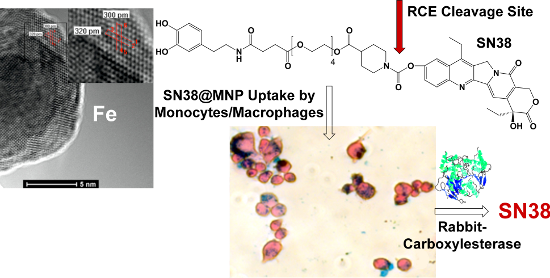
- . Different concentrations of nanoparticles were taken up by double-stable Mo/Ma cells over 24 h; the nanoparticle-concentration ranged from 0 to 320 μg/mL MNP-SN38 in fresh medium. After 24 h, the inhibition of cell proliferation was measured by using the MTT assay (Figure 4). We found only 20% of inhibition
- of cell proliferation at 160 μg/mL. Our aim is the loading of high payloads onto each delivery cell without causing a high level of necrosis or apoptosis of the delivery cells. Even a loading of 320 μg/mL of nanoparticles in the medium inhibits only 50% of the cell proliferation. We are also
- of nanoparticles contained 0.427 mg of iron, indicating that this amount of iron would be high enough for alternating magnetic field hyperthermia in combination with chemotherapy [54]. The MTT assay indicated that 8 pg of iron can be easily loaded in each cell (20% inhibition of cell proliferation





