Search results
Search for "chemisorption" in Full Text gives 86 result(s) in Beilstein Journal of Nanotechnology.
Photoresponse from single upright-standing ZnO nanorods explored by photoconductive AFM
Beilstein J. Nanotechnol. 2013, 4, 208–217, doi:10.3762/bjnano.4.21
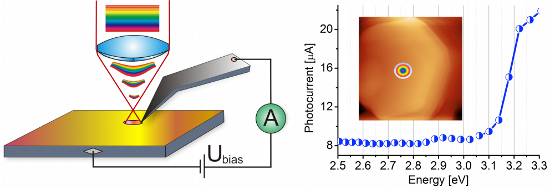
- . The surface conductivity of ZnO is highly dependent on the presence of adsorbates [20][21][22][23]. Such surface defects serve as binding sites for chemisorption processes and may contribute to the scattering and trapping of carriers [24], which lower the intrinsic conductivity of the material



Nanostructure-directed chemical sensing: The IHSAB principle and the dynamics of acid/base-interface interaction
Beilstein J. Nanotechnol. 2013, 4, 20–31, doi:10.3762/bjnano.4.3
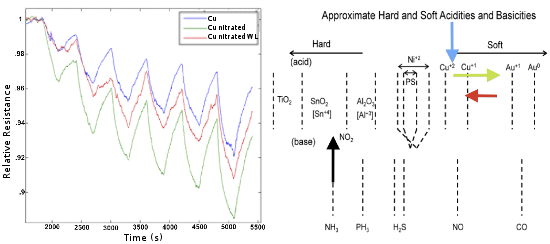
- this process induces. In combination, this provides a focused chemistry that tailors electron flow at the interface, differentiates electron transduction versus chemisorption, and can enhance light-harvesting efficiency. This approach is now developed to the extent that the dynamics of analyte
- tenets of HSAB interactions [14][15]. It includes the coupling of analyte/interface acid/base chemistry with select interfaces, leading to a balance and separation of surface electron transduction and chemisorption, and enables the ability of active nanostructure-based sites to utilize these differences
- transformation from acidic to basic sites. These studies also define a broadened interaction matrix as it extends from physisorption (sensing) applications to chemisorption and microreactor design. Recently, we have produced visible-light-absorbing TiO2−xNx photocatalyst nanoparticles in seconds at room


Pure hydrogen low-temperature plasma exposure of HOPG and graphene: Graphane formation?
Beilstein J. Nanotechnol. 2012, 3, 852–859, doi:10.3762/bjnano.3.96
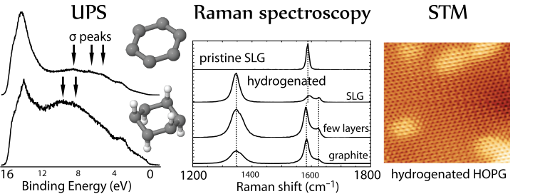
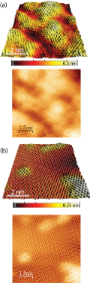
- of the graphene. The elegant yet simple solution to obtain such a chemisorption may be to use a pure hydrogen low-temperature plasma (LTP) with a typical average electron temperature (Te) of 2–5 eV, where the hydrogen would be easily dissociated (with the required energy being Te: 4.52 eV) and
- theoretical [15], and experimental works focused on the chemisorption of atomic hydrogen [16][17][18][19][20]. A new research focus is the investigation of hydrogen-containing plasmas with graphitic surfaces [5][21]. Particularly the work of Elias et al. is interesting, in which graphane growth was claimed



Current–voltage characteristics of single-molecule diarylethene junctions measured with adjustable gold electrodes in solution
Beilstein J. Nanotechnol. 2012, 3, 798–808, doi:10.3762/bjnano.3.89
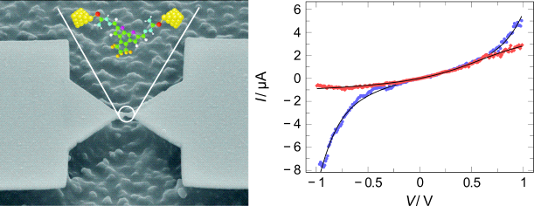
- curves is that the molecule is chemisorbed to one electrode only and physisorbed to the other one. While there is no strict distinction between physisorption and chemisorption, we use these terms for describing strong coupling including a bond formation (chemisorption), and van der Waals like coupling
- (physisorption). In the case of physisorption, one can expect that the current is mediated by tunneling. For thiol end-groups on gold, it has been shown that both chemisorption and physisorption is possible [42][43][44] depending on the surface morphology and the deposition method. For the amine end-group the


Spontaneous dissociation of Co2(CO)8 and autocatalytic growth of Co on SiO2: A combined experimental and theoretical investigation
Beilstein J. Nanotechnol. 2012, 3, 546–555, doi:10.3762/bjnano.3.63
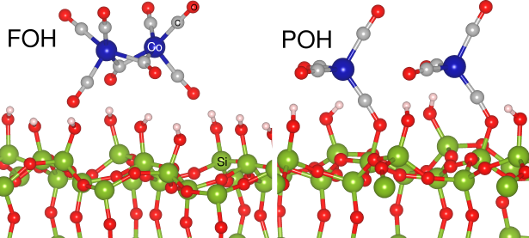
- settings, using dispersion-corrected density functional theory, support this assumption. We observe physisorption of the precursor molecule on a fully hydroxylated SiO2 surface (untreated surface) and chemisorption on a partially hydroxylated SiO2 surface (pretreated surface) with a spontaneous


Directed deposition of silicon nanowires using neopentasilane as precursor and gold as catalyst
Beilstein J. Nanotechnol. 2012, 3, 535–545, doi:10.3762/bjnano.3.62
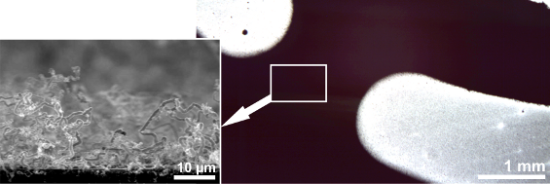
- process of nanoparticles often requires other reagents, e.g., for micelle nanolithography or chemisorption at surface-attached organic monolayers [24][25]. These organic additives (stabilizer/monolayer) might disturb the growth process of the silicon NWs and lead to contaminations, thus they need to be
- coordinate to the Au nanoparticles. The chemisorption of the nanoparticles proceeded by simple immersion into the respective solution and resulted in surfaces that were evenly, but not closely decorated by the nanoparticles (Figure 8). The average distance between two nanoparticles could be estimated to be


Functionalised zinc oxide nanowire gas sensors: Enhanced NO2 gas sensor response by chemical modification of nanowire surfaces
Beilstein J. Nanotechnol. 2012, 3, 368–377, doi:10.3762/bjnano.3.43
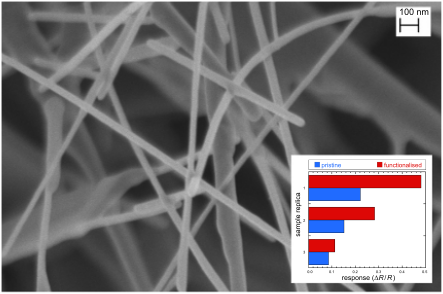
- semiconductor surface towards chemisorption or else to ensure heterogeneous catalysis of a high proportion of target gas molecules at the sensor surface. High-temperature operation also ensures the complete desorption of gaseous species following transduction. Maintaining a semiconductor gas sensor at a stable
- decreased number of “active” sites for chemisorption may arise through chemical functionalisation by an organic layer, the effect may be offset by increased rates of gas decomposition or reduced interference caused by moisture or other species present in a gas stream. It should be noted that since
- chemisorption involves electronic charge transfer, functionalisation of the surface of a metal-oxide semiconductor gas sensor with an organic monolayer will strongly influence the electronic properties of the surface. Transfer of electron density into the semiconductor will reduce the depletion layer, which is


Surface functionalization of aluminosilicate nanotubes with organic molecules
Beilstein J. Nanotechnol. 2012, 3, 82–100, doi:10.3762/bjnano.3.10
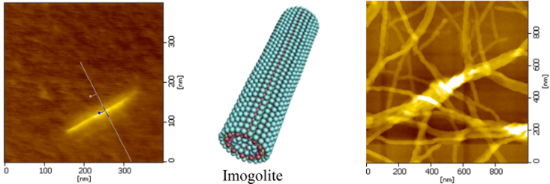
- groups of organic molecules and the aluminol (AlOH) surface of imogolite nanotubes. An aqueous modification process employing a water soluble ammonium salt of alkyl phosphate led to chemisorption of molecules on imogolite at the nanotube level. Polymer-chain-grafted imogolite nanotubes were prepared
- hybrid. Keywords: chemisorption; imogolite; inorganic nanotube; surface functionalization.; Review Surface functionalization of metal or metal-oxide surfaces has received considerable attention in recent years [1][2][3]. It presents an easy, accurate and precise approach for the fabrication of
- selectively assemble on the surfaces of metal oxides rather than on SiO2 surfaces in an aqueous medium, due to the sensitivity of Si–O–P bonds to hydrolysis [19][20][21]. In this review paper, the chemisorption and assembly of several phosphonic-acid-containing organic compounds on imogolite nanotubes, based


Self-assembled monolayers and titanium dioxide: From surface patterning to potential applications
Beilstein J. Nanotechnol. 2011, 2, 845–861, doi:10.3762/bjnano.2.94
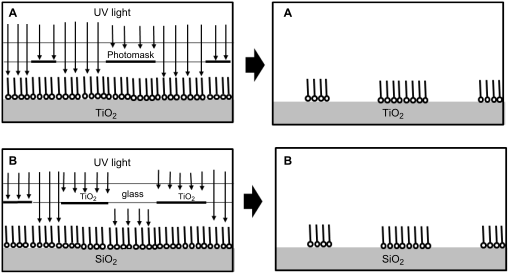
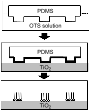
- monolayers may affect the photocatalytic properties of titania as well as be affected by these properties. Likewise, the superhydrophilicity of TiO2 known to be induced upon exposure to UV light [13] may affect the chemisorption process of SAMs. This gives rise to diverse phenomena, which can be utilized in
- the metallic micro-islands were denser than monolayers chemisorbed on TiO2 substrates that had no metallic islands. Results were explained in terms of charging effects [18]. That charging of the substrate may affect the chemisorption of organosiloxane monolayers can be deduced also from a comparison
- grafting density with respect to chemisorption by conventional methods (2.8–3.0 molecules per nm2 versus 4.3–4.8 molecules per nm2). It is worth mentioning that a study on organosilane monolayers formed on the surfaces of zirconia and titania (anatase and rutile), by a gas–phase process employing



STM visualisation of counterions and the effect of charges on self-assembled monolayers of macrocycles
Beilstein J. Nanotechnol. 2011, 2, 674–680, doi:10.3762/bjnano.2.72
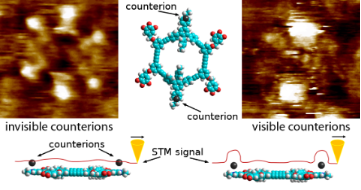
- principle, an additional functionality can be introduced in physisorbed molecular monolayers by co-adsorption of, for instance, thiols [8], combining physisorption and chemisorption. It can be envisioned that counterions of charged molecules that are adsorbed at the surface could be used not only to control


Sensing surface PEGylation with microcantilevers
Beilstein J. Nanotechnol. 2010, 1, 3–13, doi:10.3762/bjnano.1.2
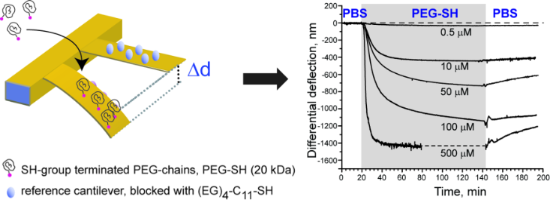
- , time resolved manner [13][14]. By an asymmetrical chemisorption of molecules (i.e., on one side of the microcantilever), the sensors can detect processes in “static” mode by measuring the bending of a microcantilever due to stress formation during the adsorption process; or in “dynamic” mode where the
- shown in Figure 2A, the chemisorption of mPEG–SH chains generates a compressive force that bends the Au-coated microcantilevers downwards. This behavior is significantly different to that of the cantilever pre-functionalized with EG4–C11–SH where no adsorption-related bending is observed and confirms