Search results
Search for "elastic modulus" in Full Text gives 118 result(s) in Beilstein Journal of Nanotechnology.
Finite-size effect on the dynamic and sensing performances of graphene resonators: the role of edge stress
Beilstein J. Nanotechnol. 2016, 7, 685–696, doi:10.3762/bjnano.7.61
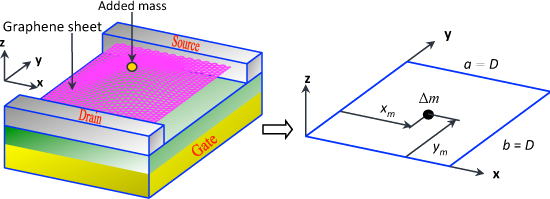
- [12][13] properties, which imply that graphene can be used for developing a multifunctional NEMS device. For instance, a monolayer graphene sheet has recently been reported to exhibit a high elastic modulus of the order of 1 TPa [14][15][16], which is much larger than that of conventional engineering
- of 1 MHz to 1 GHz [18][19][20][21]. This high-frequency dynamics of a graphene resonator is ascribed to its remarkable elastic modulus and its low mass density. Here, the resonant frequency of a graphene operating in the harmonic oscillation regime is given by a relation of with E and ρ being the
- elastic modulus and mass density of a graphene, respectively. Since the pioneering work by researchers at Cornell [17], there have recently been efforts to develop the graphene-based resonators for applications in actuation and sensing (e.g., atomic mass detection). The high-frequency dynamic range of


Nanoscale effects in the characterization of viscoelastic materials with atomic force microscopy: coupling of a quasi-three-dimensional standard linear solid model with in-plane surface interactions
Beilstein J. Nanotechnol. 2016, 7, 554–571, doi:10.3762/bjnano.7.49
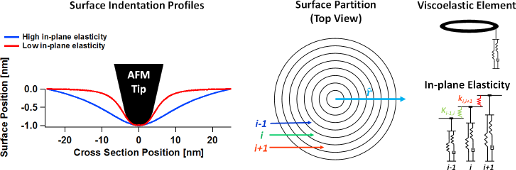
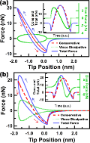
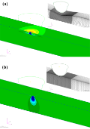
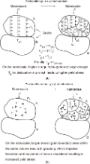
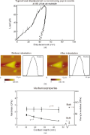
- the surface elastic modulus is zero. Figure 9 compares the shape of the indentation profiles and their relaxation in time for the case of zero surface elastic modulus (Figure 9a) and a 2D surface elastic modulus of 3.1 N/m (Figure 9b). The latter corresponds to approximately 1/120 of the 2D Young’s
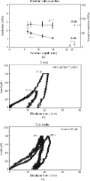
- also worth emphasizing the counterintuitive observation that in Figure 8a the force curves corresponding to a larger 2D surface elastic modulus (which Figure 8f indicates lead to shallower indentations) exhibit the largest amount of dissipation (they have hysteresis loops of larger area [14]). This is
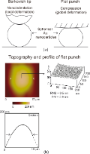
- amplitude on the order of 1–2 nm for the parameters considered, which will give a comparable error in the topographical measurement. Interaction between 2D surface elastic modulus and tip geometry One of the most relevant consequences of having different properties at the surface in comparison to the bulk


Free vibration of functionally graded carbon-nanotube-reinforced composite plates with cutout
Beilstein J. Nanotechnol. 2016, 7, 511–523, doi:10.3762/bjnano.7.45
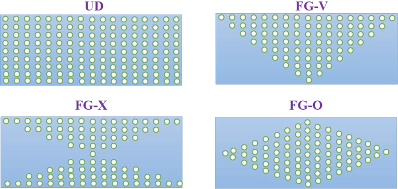
- superscript m. Following the classical solid mechanics notation, E and G are the elastic modulus and shear modulus of the constituents, respectively. In comparison to the conventional rule of mixtures approach, three unknown constants, η1, η2 and η3, are introduced in Equation 1; these are known as efficiency


High-bandwidth multimode self-sensing in bimodal atomic force microscopy
Beilstein J. Nanotechnol. 2016, 7, 284–295, doi:10.3762/bjnano.7.26
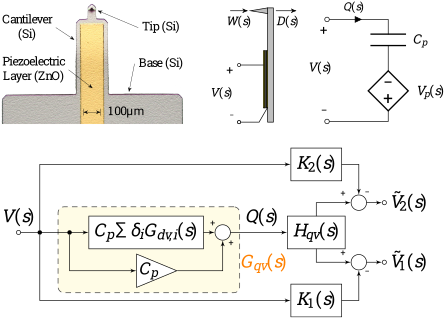
- calibration grating available from NT-MDT with periodic rectangular features of heights h = 21.6 ± 1.5 nm and a blend of polystyrene (PS) and polyolefin elastomer (ethylene-octene copolymer) (LDPE) available from Bruker (PS-LDPE-12M). The PS regions of the sample have elastic modulus numbers around 2 GPa
- , while the LDPE regions have elastic modulus numbers around 0.1 GPa making it a widely used standard to image material contrast. The scan speed was set to 20 μm/s at an area of 10 μm × 10 μm. Approach curves Approach and retract curves have been performed on the (stiff) TGZ1 calibration grating where the


Development of a novel nanoindentation technique by utilizing a dual-probe AFM system
Beilstein J. Nanotechnol. 2015, 6, 2015–2027, doi:10.3762/bjnano.6.205
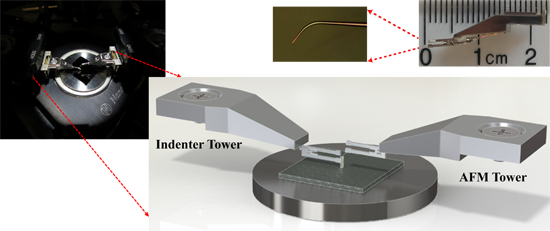
- models for determining the elastic modulus of cells [2]. In addition to the biomedical engineering field, nanoindentation has been widely used in many other disciplines where accurate mechanical characterization is of high importance [3][4]. The improvement of sensor technology has enabled the
- value of the cantilever. Depending on the type of the material, various models can be applied in order to interpret and extract the elastic modulus of materials. One of the problems with this AFM-based approach is cantilever bending. Most of the conventional AFM nanoindentation probes have spring
- references in the literature. The last section is devoted to the conclusions. Theoretical background on nanoindentation A widely used mechanical model in nanoindentation experiments is the Oliver–Pharr (OP) model [16]. Properties such as elastic modulus or hardness of materials can be extracted from force


Simulation of thermal stress and buckling instability in Si/Ge and Ge/Si core/shell nanowires
Beilstein J. Nanotechnol. 2015, 6, 1970–1977, doi:10.3762/bjnano.6.201
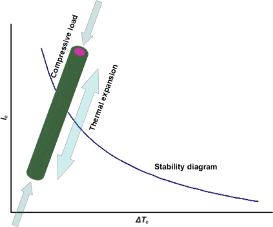
- present features that restrict the prediction of the overall elastic modulus through simple analytical means. Decomposing the system into an isolated nanowire (core) and outer tube (shell) to apply the parallel spring model yields incorrect results due to the effect of the core–shell interface [16
- . This behavior can be understood simply by observing the elastic modulus of the monoelemental NWs (represented as 10 nm core diameter). Silicon, being stiffer than germanium, shows a general tendency of an increasing Young’s modulus with a rise in its compositional contribution in the hetrerostructure
- . Interestingly, the crossover between the elastic modulus of Si/Ge and Ge/Si NWs occurs near a core diameter of ≈7 nm. This is a structure with equal volume occupied by the core and shell parts of the material. The next step of our computation involved the estimation of coefficient of thermal expansion (CTE


Atomic force microscopy as analytical tool to study physico-mechanical properties of intestinal cells
Beilstein J. Nanotechnol. 2015, 6, 1457–1466, doi:10.3762/bjnano.6.151
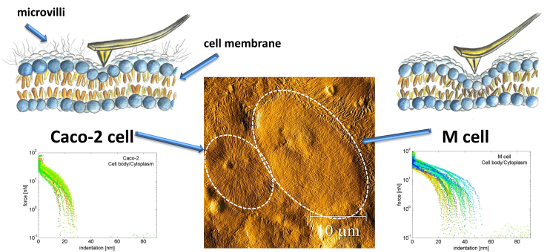
- studies [44][45]. It was shown in astrocytes (glial cells) that the elastic modulus near the nuclear region was an order of magnitude higher than at the edge of the cell. However, Caco-2 cells showed a 1.7-fold reduced elasticity compared to M cells (Figure 4A–F). Specifically at regions near the nucleus


Capillary and van der Waals interactions on CaF2 crystals from amplitude modulation AFM force reconstruction profiles under ambient conditions
Beilstein J. Nanotechnol. 2015, 6, 809–819, doi:10.3762/bjnano.6.84
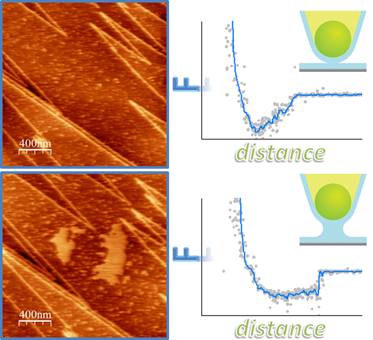
- (DMT) model of contact mechanics [54] has been employed to account for short range repulsion: where E* is the effective Young’s modulus that includes the elastic modulus of the tip and of the sample [14]. This profile is shown in Figure 4b. 2) The second profile corresponds to a linear decay in the


Mapping of elasticity and damping in an α + β titanium alloy through atomic force acoustic microscopy
Beilstein J. Nanotechnol. 2015, 6, 767–776, doi:10.3762/bjnano.6.79
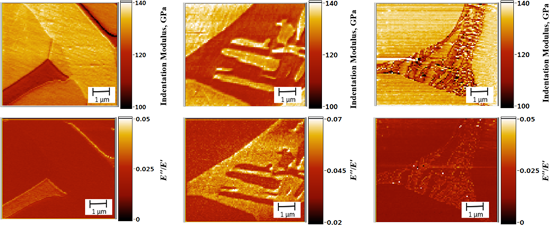
- successfully mapped the indentation modulus of α- and β-phases in a Ti-6Al-4V alloy by using AFAM while using a cantilever dynamic model in which damping, however, was neglected. In this paper, we report mapping of elastic modulus and damping using a modified cantilever dynamic model in various phases, such as
- moment of inertia. By using an appropriate contact mechanics model, one can convert the obtained stiffness values to the reduced elastic modulus E* and then to the indentation modulus M. The contact mechanics for AFM tips is very difficult to model as the exact shape of the tip in contact with the sample
- * is the reduced elastic modulus, R is the radius of curvature of the cantilever tip and P is the load applied on the specimen through the cantilever. There is one unknown, R, which can be eliminated by using a reference method. Reference material can either be a single crystal with known orientations


Influence of grain size and composition, topology and excess free volume on the deformation behavior of Cu–Zr nanoglasses
Beilstein J. Nanotechnol. 2015, 6, 537–545, doi:10.3762/bjnano.6.56
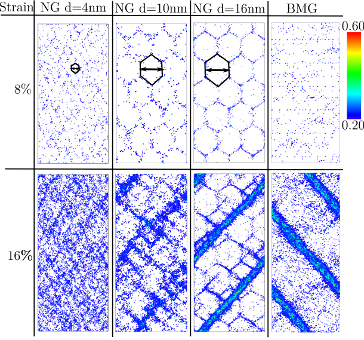
- hardness and a low elastic modulus as compared to their bulk counterparts [8]. In light of these interesting results, further studies on the mechanical properties of this new type of material seem to be mandatory. Critical questions are, if and how mechanical properties of NGs change by varying the grain



Oxygen-plasma-modified biomimetic nanofibrous scaffolds for enhanced compatibility of cardiovascular implants
Beilstein J. Nanotechnol. 2015, 6, 254–262, doi:10.3762/bjnano.6.24
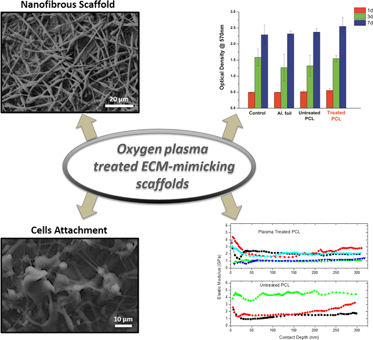
- , the elastic modulus (E) values of the untreated and the O2-plasma-treated PCL versus the contact depth are presented. In every nanoindentation test the same behavior was noticed: As the nanoindenter penetrates from the surface to the ‘body’ of the PCL films the E value decreases mainly due to the
- locations of the samples to 300 nm maximum penetration depth. The nanoindentation load–displacement curves were analyzed by using the Oliver–Pharr model to calculate the elastic modulus of the samples versus the indenter penetration (contact) depth [31]. Cell studies MTT assay: MTT assay (Sigma-Aldrich
- the O2-plasma modified ones, with P = 20 W and P = 40 W. The elastic modulus values of the untreated PCL electrospun scaffolds and the plasma-modified ones (20 W) versus the contact depth. Every curve comes from a nanoindentation measurement to a different surface location of the samples. (a,b) MTT


Multifunctional layered magnetic composites
Beilstein J. Nanotechnol. 2015, 6, 134–148, doi:10.3762/bjnano.6.13
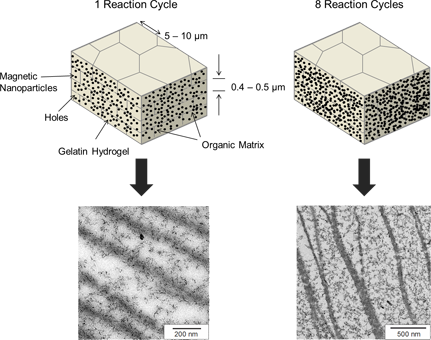
- fit the obtained curves assuming the Hertz model for a sphere in contact with a plane surface [60] (see Supporting Information File 1). Thus, an elastic modulus of 2.6 ± 0.3 kPa is calculated which is in good agreement with data from literature reporting modulus values in the low-kPa range [58][61





The capillary adhesion technique: a versatile method for determining the liquid adhesion force and sample stiffness
Beilstein J. Nanotechnol. 2015, 6, 11–18, doi:10.3762/bjnano.6.2
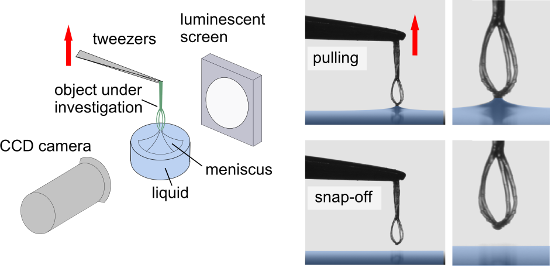
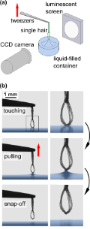
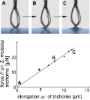
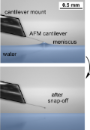
- also resulted in the measurement of an elastic modulus (Young’s modulus) for individual hairs of 3.0 × 10⁵ N/cm2, which is within the typical range known for human hair. (3) Finally, the accuracy and validity of the capillary adhesion technique was proven by examining calibrated atomic force microscopy


Nanometer-resolved mechanical properties around GaN crystal surface steps
Beilstein J. Nanotechnol. 2014, 5, 2164–2170, doi:10.3762/bjnano.5.225
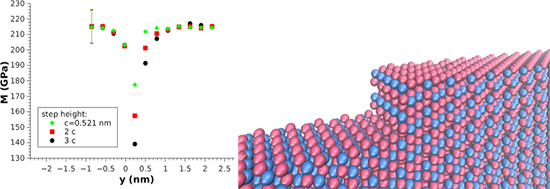
- contact area leads to an underestimation of the elastic modulus when maintaining a load. This effect is demonstrated for a GaN step of 5 nm in height (see Figure 7). The step is high enough to theoretically exhibit a visible reduction in the indentation modulus with a sufficiently sharp tip


![[Graphic 3]](/bjnano/content/inline/2190-4286-5-225-i13.png?max-width=637&scale=1.18182) along the y-axis of the upper Ga atom...
along the y-axis of the upper Ga atom...


Modeling viscoelasticity through spring–dashpot models in intermittent-contact atomic force microscopy
Beilstein J. Nanotechnol. 2014, 5, 2149–2163, doi:10.3762/bjnano.5.224
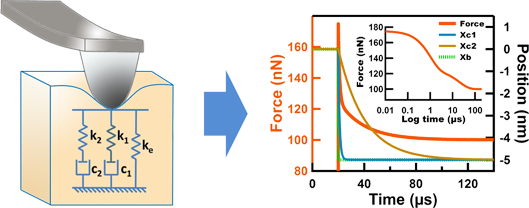
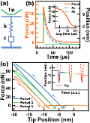
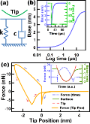
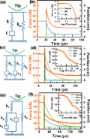
- the tip radius, z the tip position with respect to the sample, a0 the intermolecular distance, E* the effective tip–sample elastic modulus, Et and Es the elastic modulus of tip and sample, respectively, and νt and νs are the Poisson’s ratios of the tip and the sample, respectively. In general, the


Equilibrium states and stability of pre-tensioned adhesive tapes
Beilstein J. Nanotechnol. 2014, 5, 1725–1731, doi:10.3762/bjnano.5.182
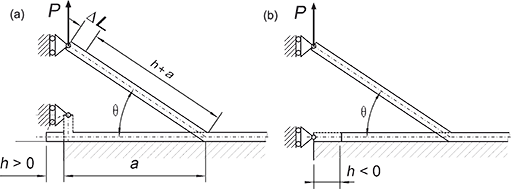
- the elastic modulus of the tape and on the surface energy of adhesion. Vice versa, in the unstable region, depending on the initial conditions of the system, the tape can evolve towards a state of complete detachment or fail before reaching a state of equilibrium with complete adhesion. We find that
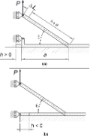

![[Graphic 5]](/bjnano/content/inline/2190-4286-5-182-i14.png?max-width=637&scale=1.18182) as a function of the peeling angle θeq at equilibrium (a); the tot...
as a function of the peeling angle θeq at equilibrium (a); the tot...


![[Graphic 11]](/bjnano/content/inline/2190-4286-5-182-i20.png?max-width=637&scale=1.18182) as a function of the peeling angle θeq at equilibrium, for differen...
as a function of the peeling angle θeq at equilibrium, for differen...
On the structure of grain/interphase boundaries and interfaces
Beilstein J. Nanotechnol. 2014, 5, 1603–1615, doi:10.3762/bjnano.5.172
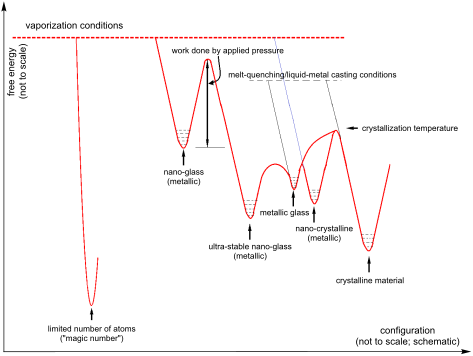
- electronic interactions and those due to their spatial distribution). It is not clear if such configurations are possible in non-metals and if it is not possible, the reason for the same is not known. Such a structure may have an elastic modulus greater than that of the bulk. Free energy increases even if


Surface topography and contact mechanics of dry and wet human skin
Beilstein J. Nanotechnol. 2014, 5, 1341–1348, doi:10.3762/bjnano.5.147
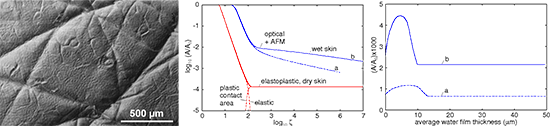
- glassy region. It is well know that the effective elastic modulus of stratum corneum may decrease by a factor of 100–1000 with increasing water content down to values of the order of E ≈ 5–10 MPa in the wet state, which is comparable to rubber in the rubbery region [3][4]. The tissues beneath stratum
- corneum are very soft. This has been demonstrated in indentation experiments on the inner forearm by using a macroscopic indentor (a ball with a diameter of about 1 cm). The measurements are explained well by using the Hertzian contact theory. The effective elastic modulus was found to be 10–40 kPa [3
- ]. In a first approximation, a two layers model, with a thin stiff layer on top of a thick soft layer, is sufficient for a satisfactory description of the contact mechanics between the skin and the indentor. The change of skin morphology and elastic modulus in the wet state contributes to the high


Physical principles of fluid-mediated insect attachment - Shouldn’t insects slip?
Beilstein J. Nanotechnol. 2014, 5, 1160–1166, doi:10.3762/bjnano.5.127
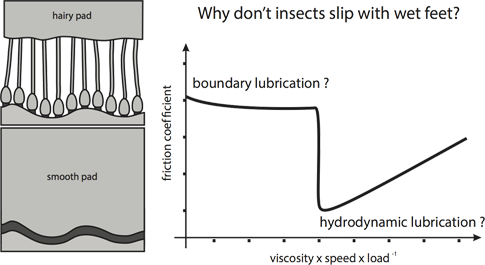
- adhesive pad can play an important role in determining the capillary adhesion [51][52]. In these models the overall capillary force is taken as the sum of the capillary attraction and the counter-acting elastic repulsion of the deformed pad/substrate (which depends on the elastic modulus). In simple terms


Organic and inorganic–organic thin film structures by molecular layer deposition: A review
Beilstein J. Nanotechnol. 2014, 5, 1104–1136, doi:10.3762/bjnano.5.123
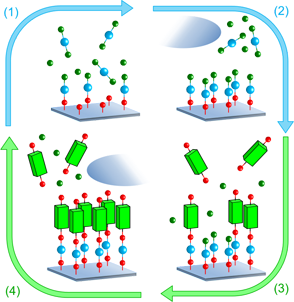
- , with a toughness of about 0.17 MPa·m0.5 [81]. The brittleness was also observed with nanointendation measurements, giving an elastic modulus of about 37 GPa and a Berkovich hardness of about 0.47 GPa [84]. However, when the TMA+EG hybrid with an additional H2O pulse was employed as an interlayer
- , after which there was a larger drop to 1.5 Å per cycle at 135 °C. The TiCl4+EG hybrid thin films were unstable: The thickness diminished by 15% over five days and after 25 days the total reduction was 20%. The elastic modulus and hardness values measured by using nanointendation were extremely low, i.e
- these films was between 130 and 210 °C. The GPC value at 130 °C was 2.8 Å per cycle and dropped with increasing temperature gradually to 2.1 Å per cycle at 210 °C. A small increase of film thickness was observed when thin films were exposed to air. The elastic modulus and hardness were both higher for




Dry friction of microstructured polymer surfaces inspired by snake skin
Beilstein J. Nanotechnol. 2014, 5, 1091–1103, doi:10.3762/bjnano.5.122

- parameters. The radius of the glass sphere was Rs = 0.5 mm. For the glass sphere, an elastic modulus of 70 GPa and a Poisson's ratio of 0.2 were assumed [43]. The elastic modulus of the epoxy resin was estimated to be 7 GPa and the Poisson's ratio to be 0.5 [43]. The geometric deformation between the sphere


A nanometric cushion for enhancing scratch and wear resistance of hard films
Beilstein J. Nanotechnol. 2014, 5, 1005–1015, doi:10.3762/bjnano.5.114
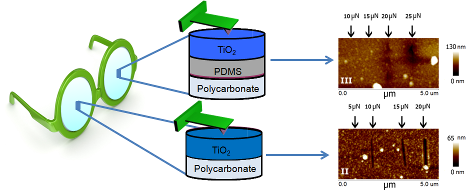
- without being deformed at their apex which would lead to junction growth. These combined effects of hard film and compliant underlayer can be directly related to the ratio of hardness to elastic modulus. This quotient has proven to be an excellent indicator of wear resistance where larger values indicate



Controlling mechanical properties of bio-inspired hydrogels by modulating nano-scale, inter-polymeric junctions
Beilstein J. Nanotechnol. 2014, 5, 887–894, doi:10.3762/bjnano.5.101
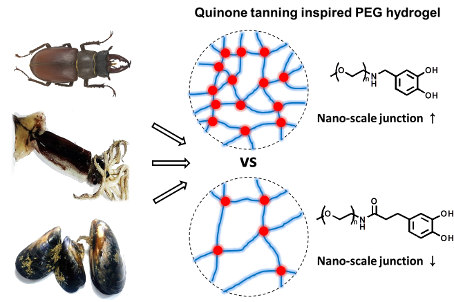
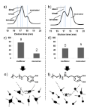
- times each on both 6Arm-PEG-NH-catechol and 6Arm-PEG-catechol hydrogels, after allowing time for complete gelation (10 min). The elastic modulus, G’, and loss modulus, G”, were found to be independent over a wide range of frequencies and strains, demonstrating that the gelation was successfully
- completed within 10 min. The elastic modulus of the hydrogel made of 6Arm-PEG-NH-catechol was about 1,000 Pa, but the G’ of the hydrogel prepared by 6Arm-PEG-catechol was low, as expected (about 500 Pa). The two-times increase in the elastic modulus indicates that amine-catechol quinone tanning is more
- kinetics In rheology, gelation point is defined by the intersection of the elastic modulus (G’) and the loss modulus (G”). We tried to measure the point by a rheometer, but it was found that gelation occurred within a minute in both hydrogels (6Arm-PEG-NH-catechol and 6Arm-PEG-catechol), preventing a



Scale effects of nanomechanical properties and deformation behavior of Au nanoparticle and thin film using depth sensing nanoindentation
Beilstein J. Nanotechnol. 2014, 5, 822–836, doi:10.3762/bjnano.5.94
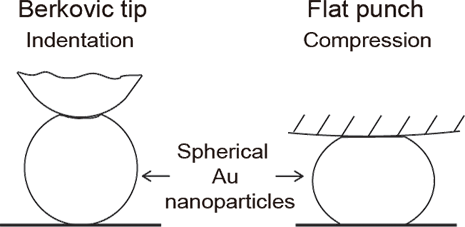
- 3100, Santa Barbara, CA) with a diamond tip. For nanoindentation experiments a three-sided diamond pyramidal Berkovich tip of approximately 100 nm in radius was used as shown in Figure 6a (left). Hardness and elastic modulus were obtained as a function of contact depth for the 100 nm thin film by
- the elastic modulus. By using this method the Young’s modulus of elasticity and Poisson’s ratio for diamond were taken as 1140 GPa and 0.07, respectively. Poisson’s ratio for Au was taken as 0.42. The data from these experiments is the average of five measurements on five different nanoparticles for






The optimal shape of elastomer mushroom-like fibers for high and robust adhesion
Beilstein J. Nanotechnol. 2014, 5, 630–638, doi:10.3762/bjnano.5.74
- fiber in contact with a rigid flat surface whose height is much larger than its radius by using the DB cohesive zone model. According to their study, normalized pull-off stress Φ ≡ σs/σo depends on a single dimensionless parameter χ defined as Here, a is the radius, E is the elastic modulus, and ν is
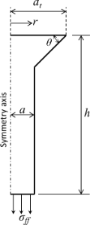
- = 0.5) with elastic modulus E = 1.42 MPa [16]. For glass–PDMS contact, wadh = 25 mJ/m2 [46]. Let us also assume an intrinsic adhesive stress of σo = 1 MPa, a reasonable value for PDMS [47][48][49]. By inserting the materials properties, interfacial properties and fiber dimensions into Equation 1, one
- initiated at the center indicating little dependence on the wedge angle. Thus, a qualitative argument suggests that while fibers with small diameters and high elastic modulus (large χ) favor wedge-angle independence, the dependence of pull-off stress to the wedge angle is significant for high strength