


Search results
Search for "electron beam induced deposition" in Full Text gives 78 result(s) in Beilstein Journal of Nanotechnology.
Spontaneous dissociation of Co2(CO)8 and autocatalytic growth of Co on SiO2: A combined experimental and theoretical investigation
Beilstein J. Nanotechnol. 2012, 3, 546–555, doi:10.3762/bjnano.3.63
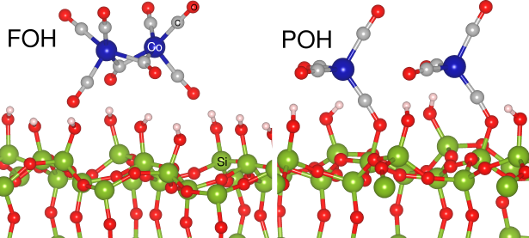
- dissociation of the precursor molecule. In view of these calculations, we discuss the origin of this dissociation and the subsequent autocatalysis. Keywords: Co2(CO)8; deposition; dissociation; EBID; FEBID; precursor; radiation-induced nanostructures; Introduction In recent years, focused electron beam
- induced deposition (FEBID) has emerged as a versatile, high-resolution technique for nanostructure fabrication in contrast to the more conventional nanolithographic techniques. In FEBID, a previously adsorbed precursor gas is dissociated in the focus of an electron beam. The nonvolatile part of the


Radiation-induced nanostructures: Formation processes and applications
Beilstein J. Nanotechnol. 2012, 3, 533–534, doi:10.3762/bjnano.3.61

- –liquid–solid approach and the preparation of monolayers of metal–organic frameworks attached to the functional groups of a self-assembled monolayer (see, e.g., [1][2][3][4]). Not as wide-spread, but rapidly developing, is the technique of focused electron beam induced deposition (FEBID) [5]. In this
Distinguishing magnetic and electrostatic interactions by a Kelvin probe force microscopy–magnetic force microscopy combination
Beilstein J. Nanotechnol. 2011, 2, 552–560, doi:10.3762/bjnano.2.59
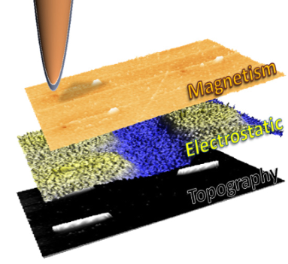
- array of Co nanostructures that exhibit high electrostatic interaction with the MFM tip. Thanks to the use of the KPFM/MFM system we were able to separate the electric and magnetic interactions between the tip and the sample. Keywords: electrostatic interaction; focused electron beam induced deposition
- Discussion In the present work we have studied cobalt nanowires grown by focused-electron-beam-induced deposition (FEBID). The sample growth was performed in a commercial dual beam® equipment using a field emission scanning electron microscope with Co2(CO)8 as gas precursor. The substrate material used in


Other Beilstein-Institut Open Science Activities



