Search results
Search for "endothelial" in Full Text gives 88 result(s) in Beilstein Journal of Nanotechnology.
The fate of a designed protein corona on nanoparticles in vitro and in vivo
Beilstein J. Nanotechnol. 2015, 6, 36–46, doi:10.3762/bjnano.6.5
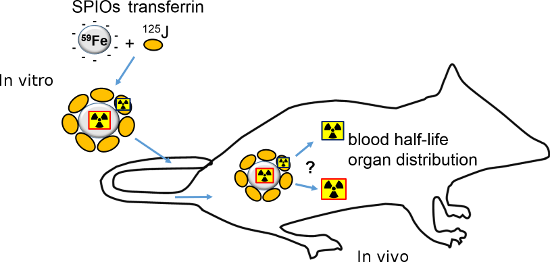
- phagocytes such as Kupffer cells in the liver. We found earlier by electron microscopy of murine liver tissues after i.v. injection of the polymer coated SPIO that these monodisperse iron cores are present in endosomal structures of Kupffer cells and liver sinusoidal endothelial cells [38]. These negative


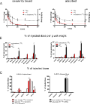
Functionalized polystyrene nanoparticles as a platform for studying bio–nano interactions
Beilstein J. Nanotechnol. 2014, 5, 2403–2412, doi:10.3762/bjnano.5.250
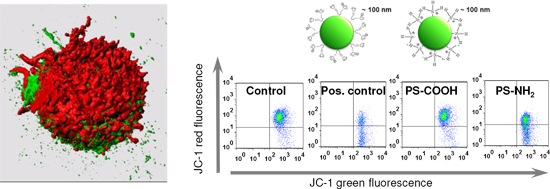
- over positively charged ones may be unique. Thus, non-phagocytic cells, such as fibroblasts and endothelial cells, took up significantly more positively charged Au NPs than negatively charged Au NPs [47]. This emphasizes that the uptake of nanoparticles is highly cell type-dependent and the expression
- THP-1 after longer incubation time (Figure 4 and [41]). Similarly, other authors did observe no cytotoxicity of PS-COOH in ovarian cancer and endothelial cells [48][49]. PS-NH2 particles not only inhibited the proliferation of THP-1 cells but after three days of induced exposure of phosphatidyl serine


Coating with luminal gut-constituents alters adherence of nanoparticles to intestinal epithelial cells
Beilstein J. Nanotechnol. 2014, 5, 2308–2315, doi:10.3762/bjnano.5.239
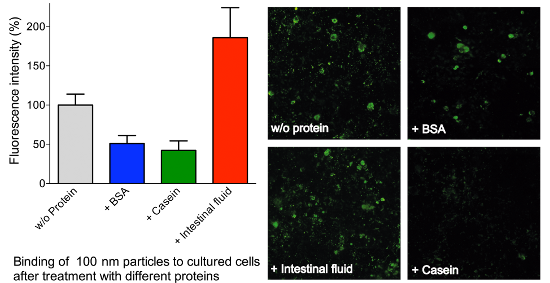
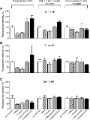
- of three experiments). Schematic model of possible interaction mechanisms between differently sized NPs and endothelial cell surface. A: Non-specific binding of “naked” small NPs to outer surface structures and membrane components; B: Decreased non-specific binding of small NPs after “passivation



Biocompatibility of cerium dioxide and silicon dioxide nanoparticles with endothelial cells
Beilstein J. Nanotechnol. 2014, 5, 1795–1807, doi:10.3762/bjnano.5.190
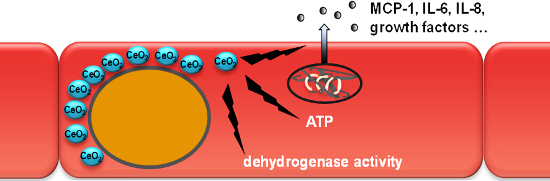
- markedly exposed to them in their everyday life. Once passing biological barriers, these nanoparticles are expected to interact with endothelial cells, leading to systemic alterations with distinct influences on human health. In the present study we observed the metabolic impact of differently sized CeO2
- (8 nm; 35 nm) and SiO2 nanoparticles (117 nm; 315 nm) on immortalized human microvascular (HMEC-1) and primary macrovascular endothelial cells (HUVEC), with particular focus on the CeO2 nanoparticles. The characterization of the CeO2 nanoparticles in cell culture media with varying serum content
- detectable. In general, the effects of the investigated nanoparticles on endothelial cells were rather insignificant, since the alterations on the metabolic cell activity became visible at a nanoparticle concentration that is by far higher than those expected to occur in the in vivo situation (CeO2


Precise quantification of silica and ceria nanoparticle uptake revealed by 3D fluorescence microscopy
Beilstein J. Nanotechnol. 2014, 5, 1616–1624, doi:10.3762/bjnano.5.173
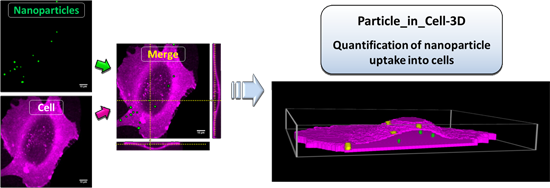
- combines the advantages of confocal fluorescence microscopy with fast and precise semi-automatic image analysis. In this work we present how this method was applied to investigate the impact of 310 nm silica nanoparticles on human vascular endothelial cells (HUVEC) in comparison to a cancer cell line
- with human microvascular endothelial cells (HMEC-1). These small nanoparticles formed agglomerates in biological medium, and the particles that were in effective contact with cells had a mean diameter of 417 nm and 316 nm, respectively. A significant particle size-dependent effect was observed after 48
- [21]. Next, the nanoparticles will be in contact with endothelial cells lining the inner surface of our blood vessel system [22][23]. Endothelial cells play a crucial role in many physiological processes and an altered endothelial cell function can be found in innumerous diseases of the cardiovascular


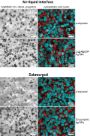
Silica nanoparticles are less toxic to human lung cells when deposited at the air–liquid interface compared to conventional submerged exposure
Beilstein J. Nanotechnol. 2014, 5, 1590–1602, doi:10.3762/bjnano.5.171
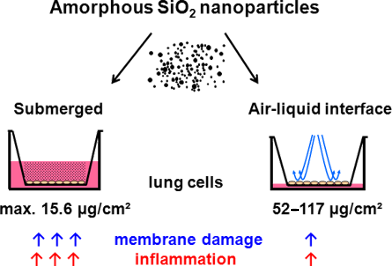
- A549, THP-1, mast and endothelial cells reacted more sensitive under classical submerged conditions with respect to release of IL-8 and production of ROS [10]. Therefore, more NPs with different chemistries and sizes as well as different cell culture models need to be assessed in order to either


Current state of laser synthesis of metal and alloy nanoparticles as ligand-free reference materials for nano-toxicological assays
Beilstein J. Nanotechnol. 2014, 5, 1523–1541, doi:10.3762/bjnano.5.165
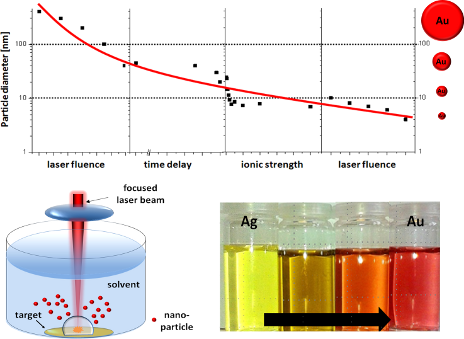
- reported to be cytotoxic [123][124], NiTi alloy nanoparticles tend to show no significant adverse effects. This was reported for endothelial and smooth muscle cells where nanoparticle concentrations of less than 10 µM were non-toxic [11]. On the contrary, NiTi coatings are even reported to improve the


The cell-type specific uptake of polymer-coated or micelle-embedded QDs and SPIOs does not provoke an acute pro-inflammatory response in the liver
Beilstein J. Nanotechnol. 2014, 5, 1432–1440, doi:10.3762/bjnano.5.155
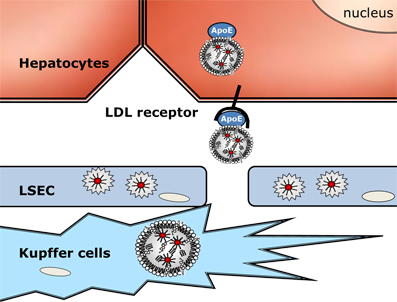
- type mice, we show that 30 min after injection polymer-coated nanocrystals are primarily taken up by liver sinusoidal endothelial cells. In contrast, by using wild type, Ldlr-/- as well as Apoe-/- mice we show that nanocrystals embedded within lipid micelles are internalized by Kupffer cells and, in a
- pro-inflammatory pathways. In conclusion, internalized nanocrystals at least in mouse liver cells, namely endothelial cells, Kupffer cells and hepatocytes are at least not acutely associated with potential adverse side effects, underlining their potential for biomedical applications. Keywords
- : hepatocytes; inflammation; Kupffer cells; liver sinusoidal endothelial cells; nanoparticle toxicity; nanoparticle uptake; quantum dots; superparamagnetic iron-oxide nanocrystals; Introduction The superior optical properties of QDs compared to organic dyes render them promising candidates for the demands of


Mimicking exposures to acute and lifetime concentrations of inhaled silver nanoparticles by two different in vitro approaches
Beilstein J. Nanotechnol. 2014, 5, 1357–1370, doi:10.3762/bjnano.5.149
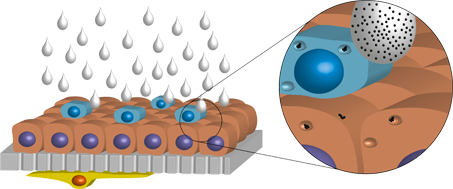
- proliferation and migration (chemotaxis) both decreased, and the release of cytokines was affected. Increased IL-8 and decreased IL-6 and vascular endothelial growth factor (VEGF) levels were detected at high Ag NP concentrations [65]. These studies however, were obtained with human mesenchymal stem cells



Antimicrobial nanospheres thin coatings prepared by advanced pulsed laser technique
Beilstein J. Nanotechnol. 2014, 5, 872–880, doi:10.3762/bjnano.5.99
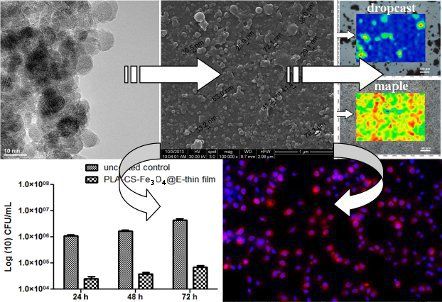
- ) bacteria strains. Moreover, the obtained nano-coatings showed a good biocompatibility and facilitated the normal development of human endothelial cells. These nanosystems may be used as efficient alternatives in treating and preventing bacterial infections. Keywords: antimicrobial; chitosan; magnetite
- secondary electron beams with energies of 30 keV on samples covered with a thin gold layer. Cell viability Human endothelial cells (EAhy926 cell line, ATCC, USA) were grown in Dulbecco's Modified Eagle Medium (DMEM) culture medium containing 10% Fetal Bovine Serum (FBS), and 1% penicillin and neomycin
- (Sigma Aldrich, St. Louis, MO, USA). For cell proliferation and viability CellTiter96 Non-Radioactive Cell Proliferation Assay, (Promega, Madison, USA) was used. Endothelial cells were seeded in a 96-well plate at a density of 5 × 10³ cells/well in DMEM medium, supplemented with 10% FBS, and incubated




Manipulation of isolated brain nerve terminals by an external magnetic field using D-mannose-coated γ-Fe2O3 nano-sized particles and assessment of their effects on glutamate transport
Beilstein J. Nanotechnol. 2014, 5, 778–788, doi:10.3762/bjnano.5.90
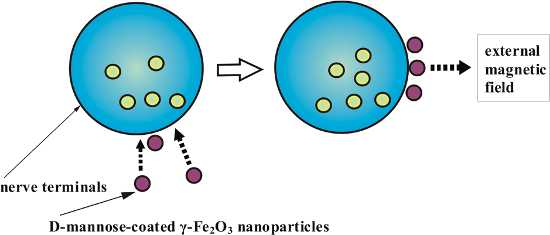
- cells possess receptors for D-mannose on their membranes, that is, MMR on dendritic cells subsets, macrophages, lymphatic and hepatic endothelium, Endo 180 on subsets of endothelial cells, DC-SIGNR on hepatic and lymphatic endothelial cells as well as serum contains mannose binding lectines (MBL) [10
- nanoparticles to penetrate the blood–brain barrier increased significantly in the presence of an external magnetic force. Therefore, particles can be transported through the blood–brain barrier and taken up by astrocytes, while they do not affect the viability of the endothelial cells [26]. On the cellular



Near-infrared dye loaded polymeric nanoparticles for cancer imaging and therapy and cellular response after laser-induced heating
Beilstein J. Nanotechnol. 2014, 5, 313–322, doi:10.3762/bjnano.5.35
- hyperthermia (HT). HT is currently used in clinical trials for cancer therapy in combination with radiotherapy and chemotherapy. One of the potential problems of HT is that it can up-regulate hypoxia-inducible factor-1 (HIF-1) expression and enhance vascular endothelial growth factor (VEGF) secretion. Results
- of both transcription factors. Keywords: hypoxia-inducible factor-1; IR820; nanoparticle; poly(glycerol malate co-dodecanedioate) (PGMD); vascular endothelial growth factor; Introduction The synthesis and development of novel polymers and their use for nanoparticle (NP) synthesis has been an
- endothelial growth factor (VEGF), and poor lymphatic clearance from tumor sites [4]. Because of these advantages, we synthesized a new formulation of polymeric NPs for image-guided therapy based on the polymer poly(glycerol malate co-dodecanedioate) (PGMD) developed in our lab. The work described in this


Effect of spherical Au nanoparticles on nanofriction and wear reduction in dry and liquid environments
Beilstein J. Nanotechnol. 2012, 3, 759–772, doi:10.3762/bjnano.3.85
- diffuses into the diseased cell resulting in cell death. Several factors need to be considered for the successful use of nanoparticles in targeted drug delivery. Biological barriers, including physical surfaces and the reticulo-endothelial system (RES), which detects and sequesters blood-borne particles