


Search results
Search for "gas sensing" in Full Text gives 82 result(s) in Beilstein Journal of Nanotechnology.
In situ growth optimization in focused electron-beam induced deposition
Beilstein J. Nanotechnol. 2013, 4, 919–926, doi:10.3762/bjnano.4.103
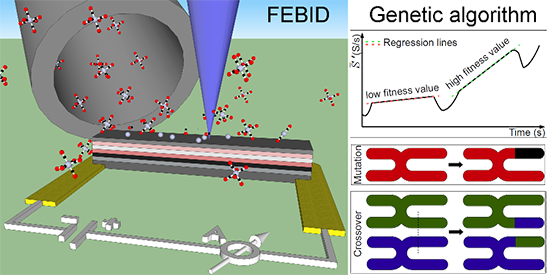
- are used in highly miniaturized magnetic field [1][2], strain/force [3][4] and gas sensing [5] applications, as well as in micromagnetic studies on domain wall nucleation and propagation [6][7]. On the basis of the in situ, electron irradiation-induced tunability of metallic FEBID-structures


Plasmonics-based detection of H2 and CO: discrimination between reducing gases facilitated by material control
Beilstein J. Nanotechnol. 2012, 3, 712–721, doi:10.3762/bjnano.3.81
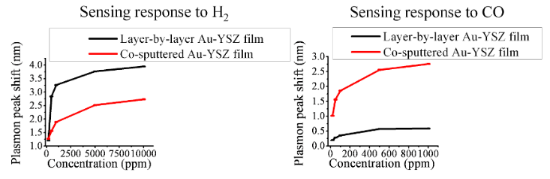
- , and particularly for plasmonics-based gas sensing. The extremely high sensitivity of the plasmon resonance peak to changes in the free-electron density of gold nanoparticles or a change in the dielectric function of the metal-oxide host material due to adsorbate reactions on surfaces makes this a
- through studies using infra-red spectroscopy [26]. A significant difference between this previous study and practical studies of emission-gas sensing is that the measurements were not done in the presence of background oxygen. However, if H2 were to react in the presence of an oxygen background, (such as





Zeolites as nanoporous, gas-sensitive materials for in situ monitoring of DeNOx-SCR
Beilstein J. Nanotechnol. 2012, 3, 667–673, doi:10.3762/bjnano.3.76
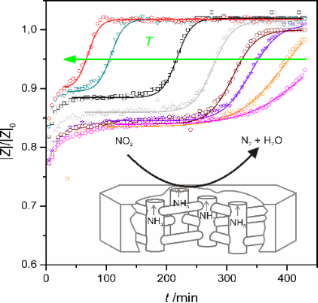
- elementary catalytic process promoting a full description of the NH3-SCR reaction system. Keywords: DeNOx-SCR; gas sensing; in situ; impedance spectroscopy; zeolite; Introduction Zeolites are crystalline, nanoporous aluminosilicates composed of [TO4] tetrahedra (T = Si, Al). In H-form zeolites protons
- sensitivity and catalytic activity renders zeolites as interesting materials for the study of the correlation of gas-sensing and catalytic properties in situ. This is of fundamental academic and technological interest, as it will potentially afford knowledge about the elementary reaction mechanisms [27]. For


Distribution of functional groups in periodic mesoporous organosilica materials studied by small-angle neutron scattering with in situ adsorption of nitrogen
Beilstein J. Nanotechnol. 2012, 3, 428–437, doi:10.3762/bjnano.3.49
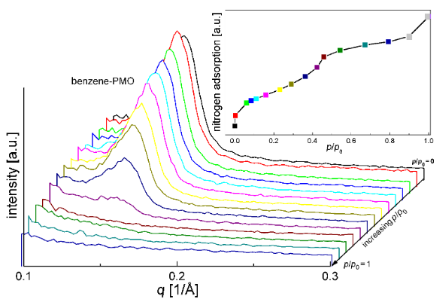
- and hence a variety of reactions are possible for the further modification of the PMO with a large array of desired groups. This expands the range of applications in, for example, optical gas sensing, catalysis, chromatography, separation and nanotechnology [9]. As is typical for mesoporous materials


Conducting composite materials from the biopolymer kappa-carrageenan and carbon nanotubes
Beilstein J. Nanotechnol. 2012, 3, 415–427, doi:10.3762/bjnano.3.48
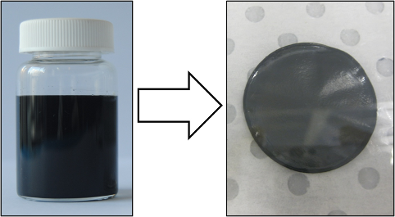
- these CNTs. The electrical and mechanical characteristics of free-standing composite films prepared by evaporative casting and vacuum filtration were assessed, including the effect of incorporating the plasticizer glycerin. The gas-sensing ability of these composite films is demonstrated. Results and


Functionalised zinc oxide nanowire gas sensors: Enhanced NO2 gas sensor response by chemical modification of nanowire surfaces
Beilstein J. Nanotechnol. 2012, 3, 368–377, doi:10.3762/bjnano.3.43
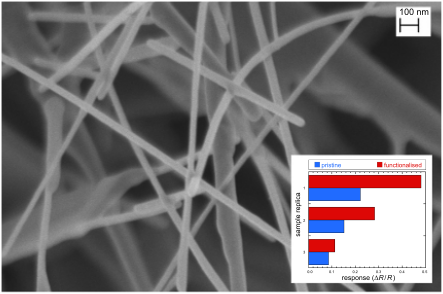
- innovations in the semiconductor gas-sensing field are still in demand [1][2][3]. Impedance-semiconductor gas sensors typically operate at temperatures greater than 200 °C [4][5]. High operating temperatures are generally required to maximise the sensor response to target gases, either to activate the
- nanostructured forms, such as nanowires, nanoribbons, nanobelts and as tetrapods [11], and their potential use in NO2 gas sensing in these forms is well known [12][13]. In this study we investigated the effects that two very different types of organic ligands imposed on the sensitivity and response of
- ultrahigh vacuum rather than in dry air. Taking the TG results into account, a sensor operating temperature of 190 °C was chosen for all gas-response tests. Gas sensing measurements for the various ZnO samples with different morphologies and compositions were performed for the gases ammonia, nitrous oxide


Investigation on structural, thermal, optical and sensing properties of meta-stable hexagonal MoO3 nanocrystals of one dimensional structure
Beilstein J. Nanotechnol. 2011, 2, 585–592, doi:10.3762/bjnano.2.62
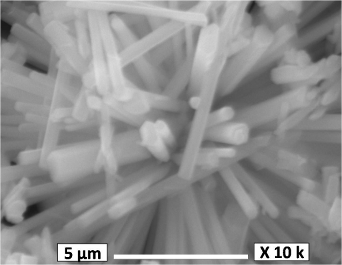
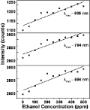
- counts/ppm for λmax = 684, 764 and 935 nm, respectively. From the plot, the maximum sensitivity is seen for λmax = 684 nm. Here, it is proposed that the gas sensing mechanism follows the changes in the refractive index and evanescent wave absorption. For h-MoO3, the oxygen vacancies and interstitial
- molybdenum atoms play a major role in gas sensing operation. The reaction between ethanol gas and the chemisorbed oxygen (O2−, O− and O2−) at the surface of the MoO3 material changes the refractive index of the clad structure. Due to this change, the light wave travelling through the removed and coated
- linearly as a function of ethanol concentration in the range of 0 to 500 ppm. In the present study, changes in the refractive index and the evanescent wave absorption phenomenon were proposed to explain the gas sensing mechanism. The reaction between ethanol gas and the chemisorbed oxygen (O2−, O− and O2


Other Beilstein-Institut Open Science Activities



