


Search results
Search for "nanomaterials" in Full Text gives 614 result(s) in Beilstein Journal of Nanotechnology. Showing first 200.
Graphene oxide–chloroquine conjugate induces DNA damage in A549 lung cancer cells through autophagy modulation
Beilstein J. Nanotechnol. 2025, 16, 316–332, doi:10.3762/bjnano.16.24
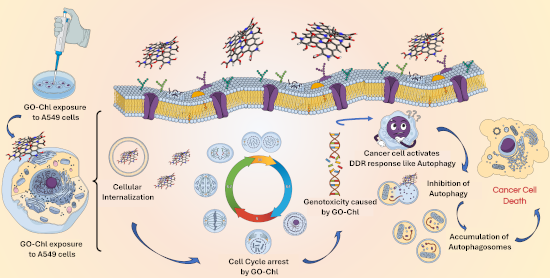
- pharmacokinetics, and reduced side effects. Nanomaterials can directly target DNA or inhibit the DDR and sensitize cancer cells to chemotherapeutics in multidrug resistant tumors [8][9][10]. Satapathay reported DNA damage and apoptotic cell death in HCT116 cells, human colorectal epithelial carcinoma cells, after
- hydrophobicity, and C/O ratio) GO is internalized via clathrin or caveolae-mediated endocytosis and micropinocytosis [53]. The exposure to nanomaterials is known to affect plasma membrane integrity, which in turn initiates various metabolic processes, such as ineffective nutrient transport, unspecific molecular
- activate the autophagy machinery as a survival mechanism [63]. However, accumulating evidence supports the fact that inhibition of autophagy by exposure to either nanomaterials or pharmacological inhibitors could potentially inhibit the activation of DNA-damage response mechanisms in different cancer cells



Enhancing mechanical properties of chitosan/PVA electrospun nanofibers: a comprehensive review
Beilstein J. Nanotechnol. 2025, 16, 286–307, doi:10.3762/bjnano.16.22

- PVA fiber mat failed at approximately 100% elongation, while the breaking strain increased to about 220% with the addition of chitosan and silk in the composite fibrous mat. Another technique for improving mechanical properties is the addition of fillers, such as nanomaterials. Reinforced polymeric


Emerging strategies in the sustainable removal of antibiotics using semiconductor-based photocatalysts
Beilstein J. Nanotechnol. 2025, 16, 264–285, doi:10.3762/bjnano.16.21
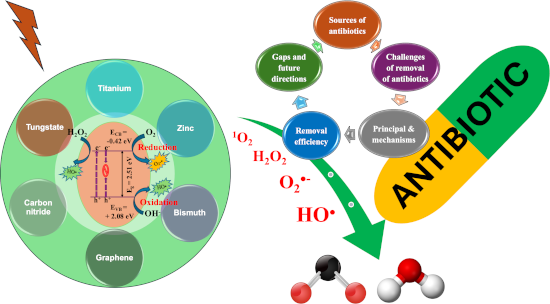
- to human health and ecological balance, requiring immediate and novel intervention techniques. Regarding this, semiconductor-based photocatalysts have appeared as promising candidates, providing a sustainable and efficient way to remove antibiotics from aquatic ecosystems. Nanomaterials can



Preferential enrichment and extraction of laser-synthesized nanoparticles in organic phases
Beilstein J. Nanotechnol. 2025, 16, 254–263, doi:10.3762/bjnano.16.20
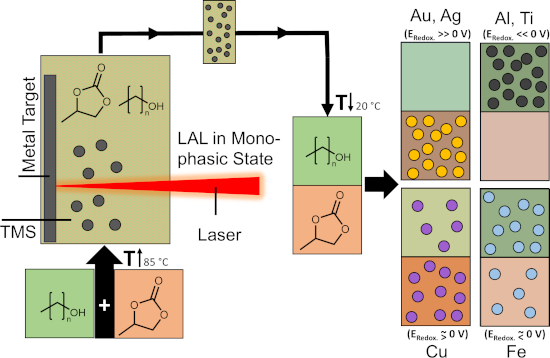
- modify the nanomaterials in situ via chemical reactions of the nanoparticles with the molecules or solutes of the liquid. Particularly when organic solvents are used as liquids, photothermally induced C–C cleavage, addition or dehydrogenation reactions of the solvents, as well as (carbon




Radiosensitizing properties of dual-functionalized carbon nanostructures loaded with temozolomide
Beilstein J. Nanotechnol. 2025, 16, 229–251, doi:10.3762/bjnano.16.18
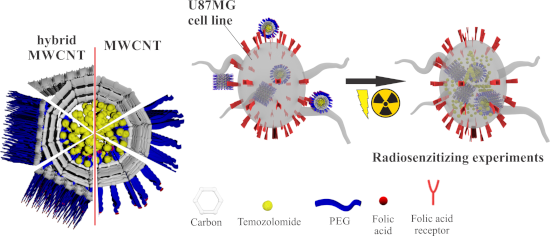
- incorporation of TMZ in organic and inorganic nanomaterials and their hybrids, designed in a wide variety of shapes such as nanoparticles (NPs), conjugates, dendrimers, and liposomes [35]. With various bioengineering techniques, the nanomaterials’ size, shape, and surface properties were modified to improve
- ; MWCNTs interact with tubulin and actin, causing cell apoptosis, which was confirmed in vitro [71][72] and in vivo [73][74]. In addition, genotoxic effects of CNTs have been identified by direct interaction with DNA [68]. For the G-family nanomaterials, induction of cell death, including apoptosis and




Synthesis and the impact of hydroxyapatite nanoparticles on the viability and activity of rhizobacteria
Beilstein J. Nanotechnol. 2025, 16, 216–228, doi:10.3762/bjnano.16.17
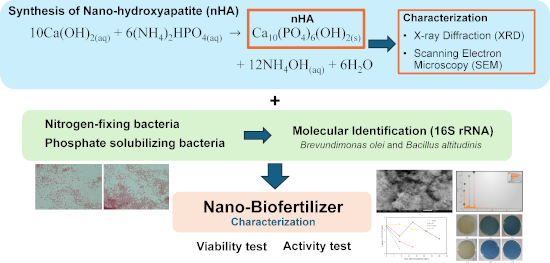
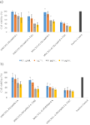
- microorganisms. Nanomaterials, particularly nanohydroxyapatite (nHA), have garnered attention for sustaining rhizobacterial viability, high loading capacity, high biodegradability, and biocompatibility, which facilitate microbial interactions. In this study, nHA was synthesized using a hydrothermal method and
- viable alternative to reduce the dependence on chemical fertilizers [5]. In recent years, there has been a notable increase in interest regarding the utilization of nanomaterials as carrier materials. Nanometer-sized carriers offer a substantial surface area and demonstrate exceptional compatibility
- application and storage [7]. Nanomaterials have gained significant attention in the development of rhizobacterial carrier materials, as their effective utilization can provide protective benefits to plants, assist in nutrient absorption, and, when in gel form, significantly improve water management efficiency


Recent advances in photothermal nanomaterials for ophthalmic applications
Beilstein J. Nanotechnol. 2025, 16, 195–215, doi:10.3762/bjnano.16.16
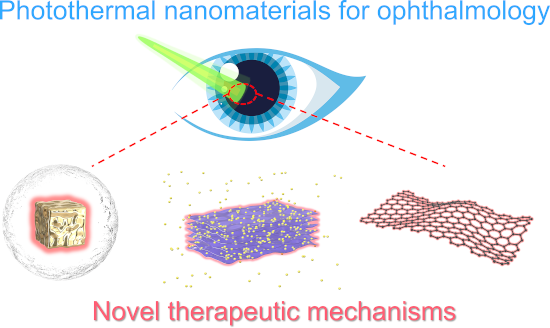
- nanomaterials, particularly well-suited for the transparent tissues of the eye, have emerged as a potential game changer. These materials enable precise and controllable photothermal therapy by effectively manipulating the distribution of the thermal field. Moreover, they extend beyond the conventional
- the photothermal properties of these nanomaterials and their innovative therapeutic mechanisms. We review the latest research on photothermal nanomaterial-based treatments for various eye diseases. Additionally, we discuss the current challenges and future perspectives in this field, with a focus on
- treatments pose significant barriers [5]. The evolution of nanotechnology has catalyzed the development of novel therapeutic technologies, with a plethora of nanomaterials exhibiting significant potential for nanotherapeutic applications [6][7][8]. Among these, photothermal nanomaterials hold promise in


Nanocarriers and macrophage interaction: from a potential hurdle to an alternative therapeutic strategy
Beilstein J. Nanotechnol. 2025, 16, 97–118, doi:10.3762/bjnano.16.10
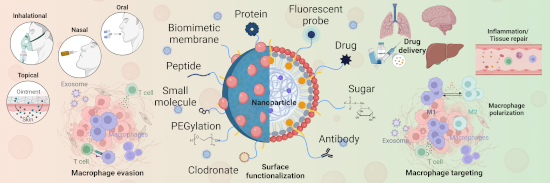
- affect NP internalization. They actively engulf NCs and accelerate their clearance, acting differentially in a time-dependent manner and altering the fate of nanomaterials [26]. In addition to immune-related barriers, the physicochemical properties of the nanomaterial itself can impair the NCs’ ability
- production, effectively reducing collagen type I deposition and mitigating fibrosis. Additional nanomaterials such as superparamagnetic iron oxide nanoparticles (SPIONs) and chitosan-based NPs are engineered with liver-cell-specific ligands like lactose or galactose, enhancing their specificity for treating


Modeling and simulation of carbon-nanocomposite-based gas sensors
Beilstein J. Nanotechnol. 2025, 16, 90–96, doi:10.3762/bjnano.16.9
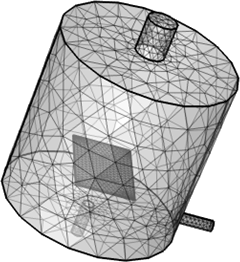
- nanomaterials, such as carbon nanotubes (CNTs), graphene, and carbon black, embedded within a polymer matrix [1]. The distinctive properties of carbon nanocomposites have positioned them as promising candidates for various applications, particularly in the development of advanced sensors. The small amounts of


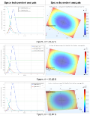

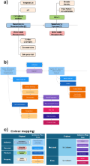
Instance maps as an organising concept for complex experimental workflows as demonstrated for (nano)material safety research
Beilstein J. Nanotechnol. 2025, 16, 57–77, doi:10.3762/bjnano.16.7

- , Accessible, Interoperable and Re-usable) data and the everyday practice of experimental researchers. Instance maps are most effective when applied at the study design stage to associate the workflow with the nanomaterials, environmental conditions, method descriptions, protocols, biological and computational
- characterisation, over (ii) assessment of a nanomaterial’s transformations in complex media, (iii) description of the culturing of ecotoxicity model organisms Daphnia magna and their use in standardised tests for nanomaterials ecotoxicity assessment, and (iv) visualisation of complex workflows in human
- properties can be tailored by changing their size, shape, surface chemistry, and functionality, have led to the designation of nanomaterials as a key enabling technology and to their subsequent inclusion in the broader categorisation of advanced materials [1][2]. Applications of nanomaterials derive in many


Fabrication of hafnium-based nanoparticles and nanostructures using picosecond laser ablation
Beilstein J. Nanotechnol. 2024, 15, 1639–1653, doi:10.3762/bjnano.15.129
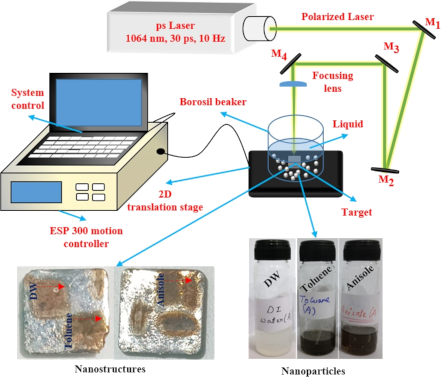
- desired morphology is essential for a given application. Generally, practical techniques for obtaining nanomaterials are sol–gel method, chemical and physical vapour deposition, hydrothermal method, ball milling, grinding, lithography, etching, and laser ablation [14][15][16][17][18]. The morphology
- determines the electrical and optical properties, which can vary depending on the synthesis technique [19]. Among the methods mentioned above, laser ablation in liquids (LAL) is a clean and single-step synthesis method used for obtaining nanomaterials from a bulk source [11][16][17][18][20]. It produces NPs




Biomimetic nanocarriers: integrating natural functions for advanced therapeutic applications
Beilstein J. Nanotechnol. 2024, 15, 1619–1626, doi:10.3762/bjnano.15.127

- differences in key characteristics. The National Nanotechnology Initiative (NNI) emphasizes that nanomaterials hold promising potential across various fields of knowledge [1][5]. Materials such as liposomes, nanoparticles, polymer–drug conjugates, inorganic noble metals, and quantum dots may improve


Natural nanofibers embedded in the seed mucilage envelope: composite hydrogels with specific adhesive and frictional properties
Beilstein J. Nanotechnol. 2024, 15, 1603–1618, doi:10.3762/bjnano.15.126
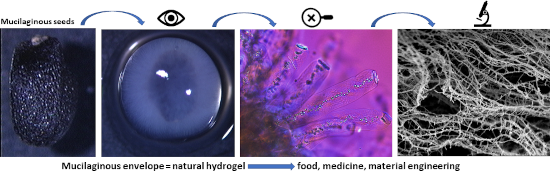
- mucilage produced by plant diaspores became of high interest in diverse sectors, such as medicine, cosmetics, food, biomedicine, pharmaceutics, nanomaterials, and bioinspired nanotechnology [11][17][18][19][20]. Mucilage is a natural, biodegradable, non-toxic plant product, odourless, colourless, and


Liver-targeting iron oxide nanoparticles and their complexes with plant extracts for biocompatibility
Beilstein J. Nanotechnol. 2024, 15, 1593–1602, doi:10.3762/bjnano.15.125
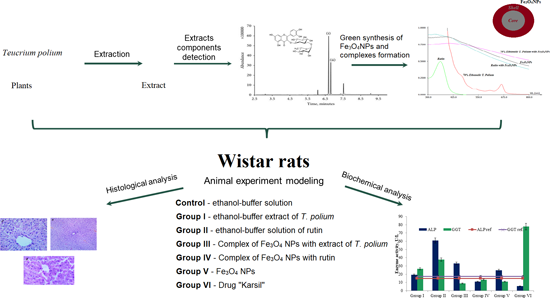
- interdisciplinary approach is to integrate advances in biotechnology, nanomaterials, biomedical robotics, and genetic engineering into the broader field of nanomedicine. On a larger scale, the application of nanotechnology in medicine enhances efficiency, accelerates processes, and improves functional performance


Facile synthesis of size-tunable L-carnosine-capped silver nanoparticles and their role in metal ion sensing and catalytic degradation of p-nitrophenol
Beilstein J. Nanotechnol. 2024, 15, 1576–1592, doi:10.3762/bjnano.15.124
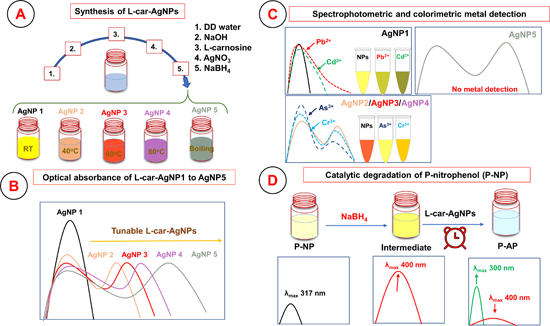
- degradation of P-NP and the formation of P-AP as a model reaction. This transformation, catalyzed by noble metal nanoparticles in the presence of NaBH4 as reducing agent, is widely utilized to assess the catalytic performance of nanomaterials [14]. All catalytic experiments were performed in a standard quartz




Green synthesis of silver nanoparticles derived from algae and their larvicidal properties to control Aedes aegypti
Beilstein J. Nanotechnol. 2024, 15, 1566–1575, doi:10.3762/bjnano.15.123
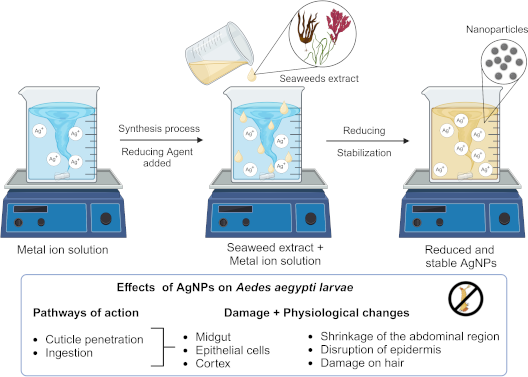
- nanomaterials in non-target species is discussed. Keywords: bioassay; inorganic nanoparticles; mosquito vector; nanotechnology; physicochemical; tropical neglected diseases; Introduction Arboviroses are diseases caused by the pathogens transmitted by arthropods, and their transmission to humans occurs through
- vectors are nanomaterials or nanomaterial-based formulations as so-called nanopesticides, providing new, modern, and low-cost formulations [9][10] with the ability to penetrate through the exoskeleton into mosquito cells, causing mortality after binding to proteins or DNA [11]. Nanomaterials provide
- the green synthesis of nanomaterials from seaweed extracts is an environmentally friendly option for the control and prevention of vector-borne diseases. These nanomaterials are potential candidates for replacing commercially available toxic chemicals. Despite the proven formation of silver


The round-robin approach applied to nanoinformatics: consensus prediction of nanomaterials zeta potential
Beilstein J. Nanotechnol. 2024, 15, 1536–1553, doi:10.3762/bjnano.15.121
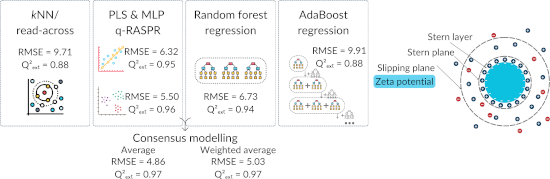
- “modelling equivalent” of a RR. We demonstrate here a novel approach to evaluate the performance of different models for the same endpoint (nanomaterials’ zeta potential) trained using a common dataset, through generation of a consensus model, leading to increased confidence in the model predictions and
- of metal and metal oxide-nanomaterials (NMs) in aqueous media. The individual models were integrated into a consensus modelling scheme, enhancing their predictive accuracy and reducing their biases. The consensus models outperform the individual models, resulting in more reliable predictions. We
- ; read-across; QSPR; round-robin test; zeta potential; Introduction Nanotechnology, defined as the ability to manipulate matter at the nanoscale, has opened an array of possibilities for multiple applications that take advantage of the unique properties of nanomaterials (NMs). From targeted drug


Integrating high-performance computing, machine learning, data management workflows, and infrastructures for multiscale simulations and nanomaterials technologies
Beilstein J. Nanotechnol. 2024, 15, 1498–1521, doi:10.3762/bjnano.15.119
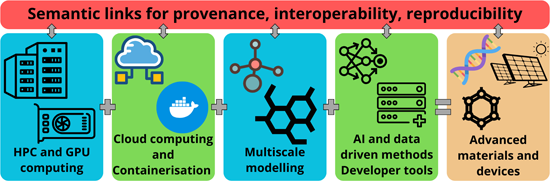
- objective is to enhance the accessibility of multiscale simulations and their integration with other computational techniques, thereby advancing the field of nanomaterials technologies. The proposed approach relies on key strategies and digital technologies employed to achieve efficient and innovative
- across a diverse range of tools. The paper explores the distinctive features of digital and data-centric approaches and technologies for materials development. It highlights the role of digital twins in research, particularly in the realm of nanomaterials development and examines the impact of knowledge
- digital methodologies in advanced research. Keywords: artificial intelligence; high-performance computing; HPC; machine learning; materials modelling; multiscale modelling; nanomaterials; semantic data management; Introduction Digital technologies have ushered in a new era of materials science, enabling


Effect of radiation-induced vacancy saturation on the first-order phase transformation in nanoparticles: insights from a model
Beilstein J. Nanotechnol. 2024, 15, 1453–1472, doi:10.3762/bjnano.15.117

- /bjnano.15.117 Abstract By employing a model of nanomaterials with polymorphic phase transitions and using a thermodynamic approach to describe the effects of vacancy saturation, irradiation dose, powder dispersion, and surface energies, we demonstrate the possibility of radiation-induced phase
- . Ceramic nanomaterials, which possess high vacancy migration energy, will have their behavior significantly influenced by radiation doses. In contrast, most metals exhibit small vacancy migration energy and demonstrate better resistance to irradiation, making them recommended candidates for nuclear
- nanomaterials with phase change and reduction in surface tension serve as suitable systems for elucidation and comparison. In summary, there is a competition among various energetic factors influencing phase stability and transformations in HDCMs during irradiation. These factors include (i) the bulk


Various CVD-grown ZnO nanostructures for nanodevices and interdisciplinary applications
Beilstein J. Nanotechnol. 2024, 15, 1390–1399, doi:10.3762/bjnano.15.112
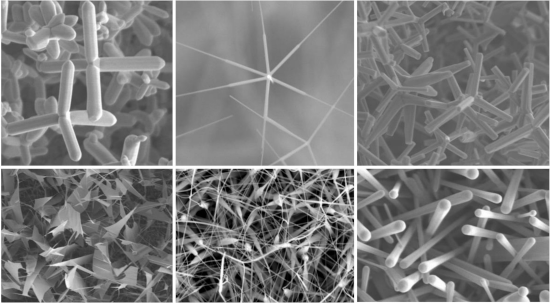
- nanostructures; Introduction In recent decades, nanomaterials whose diameters are in the range of 1–100 nm have been of intensive interest because they exhibit dimension-dependent intriguing behaviours that are different from their bulk counterparts. These special behaviours come from quantum confinement and
- surface effects dependent on the surface-to-volume ratio, which directly influences the electronic structure and the crystal structure symmetry. Thus, the study and fabrication of nanomaterials not only aim at exploring novel approaches of quantum physics, but also at realizing new multifunctional



Interaction of graphene oxide with tannic acid: computational modeling and toxicity mitigation in C. elegans
Beilstein J. Nanotechnol. 2024, 15, 1297–1311, doi:10.3762/bjnano.15.105
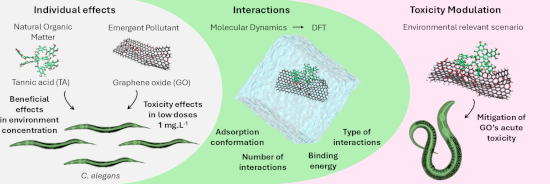
- toxicity and highlight the potential of tannic acid for the synthesis and surface functionalization of graphene-based nanomaterials, offering insights into safer nanotechnology development. Keywords: biodistribution; density functional theory; ecotoxicity; molecular dynamics; surface interactions
- Agency (EPA), herein named EPA medium, in absence and presence of TA. Atomic force microscopy AFM has been extensively used to characterize the distribution and morphology of biomolecules on the surface of nanomaterials, especially 2D materials [37]. Figure 1a and Figure 1b show AFM images of GO sheets
- is well known that in more diluted suspensions, nanomaterials tend to present better dispersibility, and it is expected that GO remains stable in EPA medium for a longer time. Computational simulation of GO–TA interactions To analyze the surface modification of GO by TA and gain insights into the


Mn-doped ZnO nanopowders prepared by sol–gel and microwave-assisted sol–gel methods and their photocatalytic properties
Beilstein J. Nanotechnol. 2024, 15, 1283–1296, doi:10.3762/bjnano.15.104
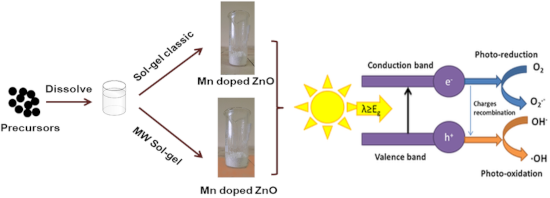
- distribution of the resulting nanomaterials [7][8][9]. Recently, the use of microwave energy for synthesizing functional nanomaterials has garnered significant interest [10][11]. The microwave-assisted sol–gel technique (MW) has been reported to be simpler, faster, more cost-effective, and more energy
- catalyst is generally associated with low photocatalytic activity. Accordingly, various modifiers of semiconductor nanomaterials are used to enhance separation of the photogenerated charges, causing a corresponding decrease of PL emission. The correlation between photoluminescence and photocatalytic
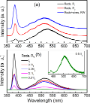
- activity of the modified nanomaterials can be modulated by the dopant concentration. Figure 9 shows for both investigated samples a main emission peak at 420 nm and a smaller one at 480 nm. According to the literature data, both maxima correspond to the excitonic PL related to surface oxygen vacancies and


New design of operational MEMS bridges for measurements of properties of FEBID-based nanostructures
Beilstein J. Nanotechnol. 2024, 15, 1273–1282, doi:10.3762/bjnano.15.103
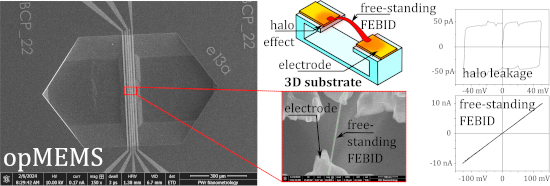
- multipoint measurements of nanomaterials in search of their electrical or mechanical properties. Visualisation of the halo effect under a freestanding nanostructure on a solid and 3D substrate. MEMS bridge shown (a) schematically with RoI formed (left) and RoI distance geometry (right), (b) on a SEM image as
- European Cooperation in Science and Technology (COST) Action “Focused Ion Technology for Nanomaterials – fit4nano” (grant number CA19140).


Dual-functionalized architecture enables stable and tumor cell-specific SiO2NPs in complex biological fluids
Beilstein J. Nanotechnol. 2024, 15, 1238–1252, doi:10.3762/bjnano.15.100
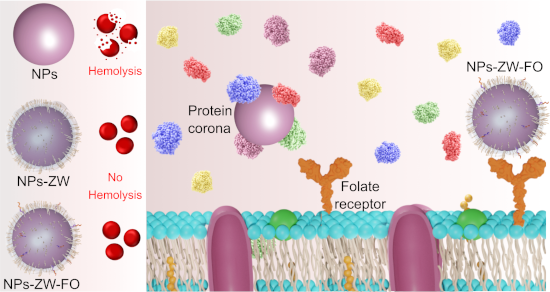
- corona formation in cell culture medium and human plasma To verify the adsorption of proteins on the functionalized SiO2NPs, sodium dodecyl sulfate polyacrylamide gel electrophoresis (SDS-PAGE) experiment was performed. For this, the nanomaterials (in concentrations of 2 to 5 mg·mL–1) were incubated in


Synthesis, characterization and anticancer effect of doxorubicin-loaded dual stimuli-responsive smart nanopolymers
Beilstein J. Nanotechnol. 2024, 15, 1189–1196, doi:10.3762/bjnano.15.96
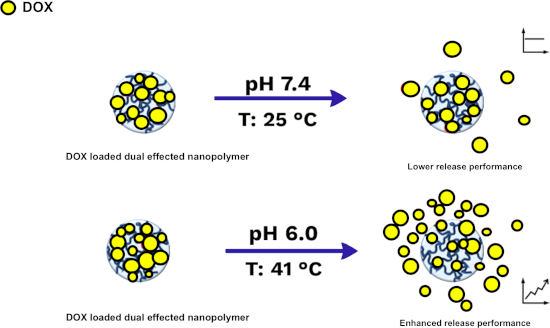
- Belarus, Minsk, Belarus Faculty of Arts and Science, Chemistry Department, Aksaray University, Aksaray, Turkey 10.3762/bjnano.15.96 Abstract Nanopolymers represent a significant group of delivery vehicles for hydrophobic drugs. In particular, dual stimuli-responsive smart polymer nanomaterials might be
- their transition to the active phase of reproduction. The nanomaterials were added to the cell suspension in the wells. For this, complexes of DOX-SNPs were prepared as described in section “Preparation of DOX-SNPs” to equivalents of loaded DOX of 1, 3, and 5 µmol/L in 0.05 mol/L phosphate-buffered





