


Search results
Search for "sedimentation" in Full Text gives 84 result(s) in Beilstein Journal of Nanotechnology.
Silica nanoparticles are less toxic to human lung cells when deposited at the air–liquid interface compared to conventional submerged exposure
Beilstein J. Nanotechnol. 2014, 5, 1590–1602, doi:10.3762/bjnano.5.171
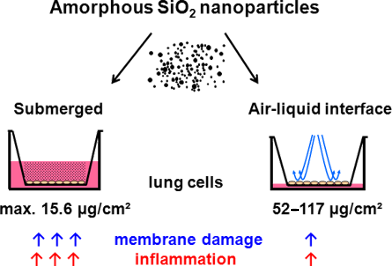
- nanoparticles (NPs) in the lung by in vitro studies are usually performed under submerged conditions where NPs are suspended in cell culture media. However, the behaviour of nanoparticles such as agglomeration and sedimentation in such complex suspensions is difficult to control and hence the deposited cellular
- collection and resuspension in medium may change their physico-chemical properties and the particle dose delivered to the cells under submerged conditions is often unclear due to differences in agglomeration and sedimentation of suspended NPs. In vitro experiments at the air–liquid interface (ALI) are
- treated with 50 µg·mL−1 NP suspensions in medium without FCS. The cellular dose was estimated according to the computational model of Hinderliter et al. [31]. The particle dose delivered to the cells is determined by diffusion and sedimentation processes, which are dependent on the particle sizes [31


Mimicking exposures to acute and lifetime concentrations of inhaled silver nanoparticles by two different in vitro approaches
Beilstein J. Nanotechnol. 2014, 5, 1357–1370, doi:10.3762/bjnano.5.149
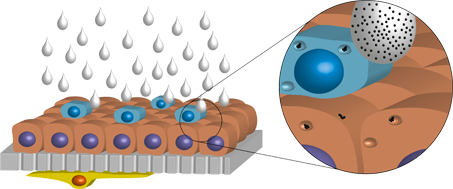
- , the amount of Ag NPs delivered to the cell over time was estimated with a recently developed in vitro sedimentation, diffusion, and dosimetry (ISDD) model [47] and was compared with the result of the ALI exposures. According to the ISDD model, for submerged exposures over 4 h with Ag NP concentrations
- vitro sedimentation, diffusion and dosimetry model (ISDD) according to Hinderliter et al. was used [47] to estimate the effective Ag NP dose delivered to the cells. This model estimates the NP dose delivered to cells as a function of time, by using parameters such as the size, density and aggregation



Topology assisted self-organization of colloidal nanoparticles: application to 2D large-scale nanomastering
Beilstein J. Nanotechnol. 2014, 5, 1203–1209, doi:10.3762/bjnano.5.132
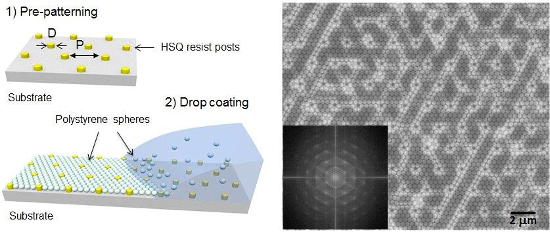
- sedimentation and water evaporation. The particles come closer and form a hexagonal lattice. Previous studies have shown that these deposited particles (PS beads) are very sensitive to different physico-chemical parameters such as the nature of the solvent, the concentration of the solution, temperature, the


Manipulation of isolated brain nerve terminals by an external magnetic field using D-mannose-coated γ-Fe2O3 nano-sized particles and assessment of their effects on glutamate transport
Beilstein J. Nanotechnol. 2014, 5, 778–788, doi:10.3762/bjnano.5.90
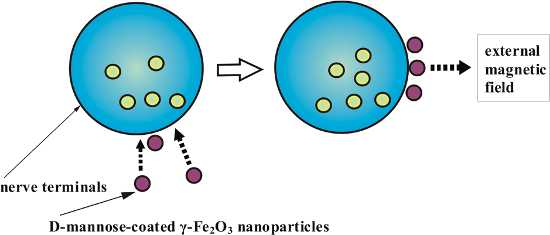
- L-[14C]glutamate the aliquots of synaptosomal suspension in the vicinity of application of magnetic field was determined after rapid sedimentation by using a microcentrifuge (20 s at 10,000g). Total synaptosomal L-[14C]glutamate content was equal to 200,000 ± 15,000 cpm/mg protein. Data are means



Applicability and costs of nanofiltration in combination with photocatalysis for the treatment of dye house effluents
Beilstein J. Nanotechnol. 2014, 5, 476–484, doi:10.3762/bjnano.5.55
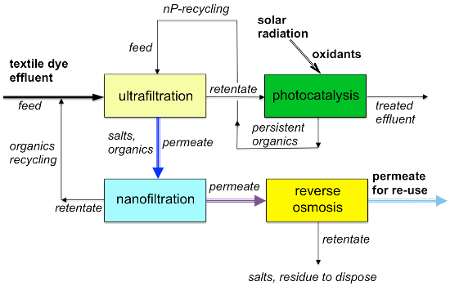
- Conventional concepts of effluent treatment and NF In the conventional treatment of effluent of the textile industries separation methods like coagulation, flocculation, flotation or sedimentation are used. Process variants concerning the separation of dyes are numerous, but all of them require a final


Structural, optical and photocatalytic properties of flower-like ZnO nanostructures prepared by a facile wet chemical method
Beilstein J. Nanotechnol. 2013, 4, 763–770, doi:10.3762/bjnano.4.87
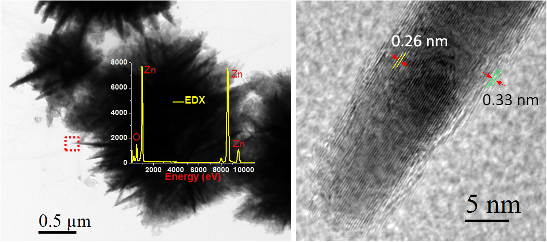
- treatment, these azo dyes may generate carcinogenic compounds such as aromatic amines. Because of this, purification and detoxification of industrial waste water has been one of the major challenges. Several methods such as adsorption, filtration, sedimentation and photocatalysis are used for the removal of


Colloidal lithography for fabricating patterned polymer-brush microstructures
Beilstein J. Nanotechnol. 2012, 3, 397–403, doi:10.3762/bjnano.3.46
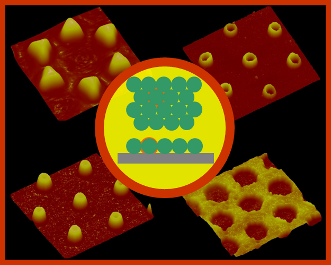
- patterning of colloidal microspheres for the fabrication of polymer-brush microstructures. We first assembled a SMM of polystyrene latex (diameter ≈ 10 µm) on a silica substrate by gravity-induced sedimentation combined with solvent evaporation [26], and subsequently we deposited gold into the interstices
- -induced sedimentation combined with solvent evaporation [1][26]. Deposition of gold on SMM-coated silica substrate: The procedure of gold coating on SMM covered silica wafers was similar to that used for the gold coating of the silicon wafers. A subsequent sonication was used to remove the polystyrene
- redispersed in ethanol (0.5 mL) for subsequent pipetting onto a slightly tilted initiator-coated gold substrate wafer. Upon drying at room temperature the microspheres self-assembled to form regions of hexagonally close-packed monolayers by gravity-induced sedimentation combined with solvent evaporation. SI


Plasmonic nanostructures fabricated using nanosphere-lithography, soft-lithography and plasma etching
Beilstein J. Nanotechnol. 2011, 2, 448–458, doi:10.3762/bjnano.2.49

- , 500 nm, 900 nm, 1000 nm, 1100 nm and 3 μm diameter were used. The suspensions conform the NIST Standards and have sharp size distributions of 1.0% to 2.5%. According to the supplier some proprietary surfactants may be added to the suspension. Volumes of 1 mL were centrifuged until full sedimentation


Review and outlook: from single nanoparticles to self-assembled monolayers and granular GMR sensors
Beilstein J. Nanotechnol. 2010, 1, 75–93, doi:10.3762/bjnano.1.10
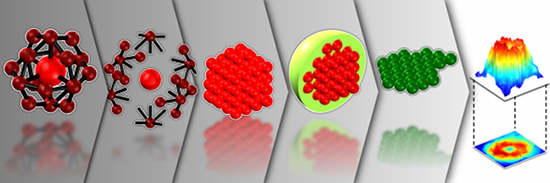
- mentioned in the preliminary section, bottom-up synthesis methods are well suited for these requirements. In addition, particle size distributions can be further refined via sedimentation or by magnetic separation subsequent to chemical synthesis [15]. 2.1 Driving forces to self-assemblies The organization




Other Beilstein-Institut Open Science Activities



