


Search results
Search for "swelling" in Full Text gives 103 result(s) in Beilstein Journal of Nanotechnology.
Direct formation of gold nanorods on surfaces using polymer-immobilised gold seeds
Beilstein J. Nanotechnol. 2016, 7, 809–816, doi:10.3762/bjnano.7.72
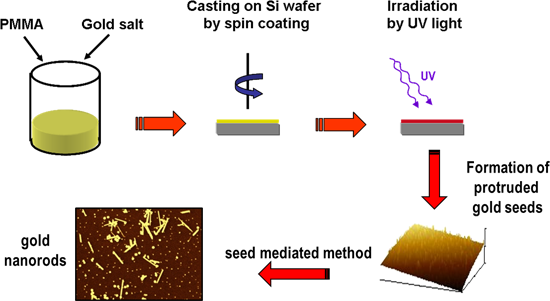
- higher Mw, shown in Figure 1b, exhibits a different morphology with micro-roughening and larger swelling domains than P1, caused by UV exposure. It is known that Mw can influence the PMMA surface morphology after UV irradiation [36]. All these chemical and physical changes in the polymer surface induced


Cantilever bending based on humidity-actuated mesoporous silica/silicon bilayers
Beilstein J. Nanotechnol. 2016, 7, 637–644, doi:10.3762/bjnano.7.56
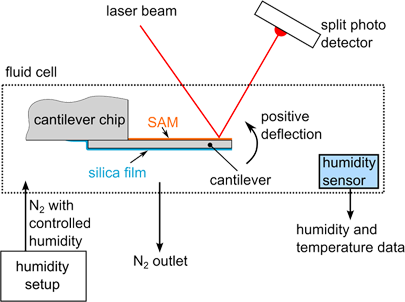
- structures that swell anisotropically and differently between the two layers upon the change of relative humidity (RH) [8]. This bilayer principle has been used to build simple artificial actuators based on the swelling of paper–plastic bilayers [9], and also more general routes have been proposed to create
- directional movement by using swelling of polymers in combination with controllable anisotropy [10]. However, to our knowledge such concepts have not been used so far to create ceramic or metallic bilayer structures, which would have the advantage of their applicability at higher temperatures and in harsh


Hydration of magnesia cubes: a helium ion microscopy study
Beilstein J. Nanotechnol. 2016, 7, 302–309, doi:10.3762/bjnano.7.28
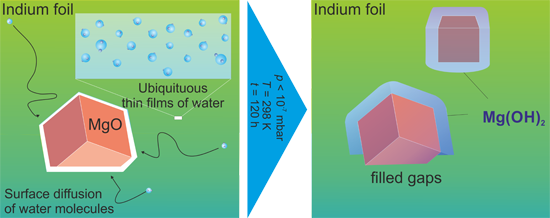
- morphologically well-defined MgO particle systems was investigated. We observed unexpected transformations ranging from swelling of the metal oxide nanostructure core to dissolution–recrystallization steps that give rise to the formation of hydroxides with entirely different microstructures [21]. Experimental All
- that were not in contact with the substrate did not show any swelling after the four day period (see arrows in Figure 4), and second, no morphological changes were observed when the cubes were pressed into the vacuum-annealed indium foil (Figure S3, Supporting Information File 1) and imaged with


3D solid supported inter-polyelectrolyte complexes obtained by the alternate deposition of poly(diallyldimethylammonium chloride) and poly(sodium 4-styrenesulfonate)
Beilstein J. Nanotechnol. 2016, 7, 197–208, doi:10.3762/bjnano.7.18
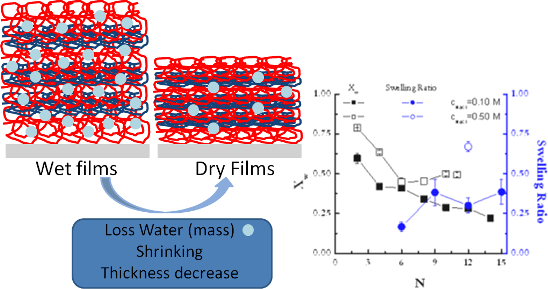
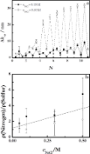
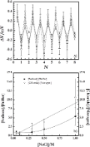
- modify the multilayer growth, but it contributes to the total adsorbed mass of the film. The water associated with the polyelectrolyte films leads to their swelling and plastification. The use of X-ray photoelectron spectroscopy has allowed for deeper insights on the internal structure and composition of
- the polyelectrolyte multilayers. Keywords: charge compensation; hydration; polyelectrolyte multilayers; stratification; swelling; Introduction The new requirements of science and technology have created an increasing interest for the fabrication of materials with reduced dimensionality for their
- interactions occurring in the system and the polymer conformation, without effects due to the hydration/swelling phenomena associated with the uptake/release of water. Even though the N dependence of the adsorbed mass is not changed by the drying process, other aspects are strongly modified by the film drying



pH-Triggered release from surface-modified poly(lactic-co-glycolic acid) nanoparticles
Beilstein J. Nanotechnol. 2015, 6, 2504–2512, doi:10.3762/bjnano.6.260
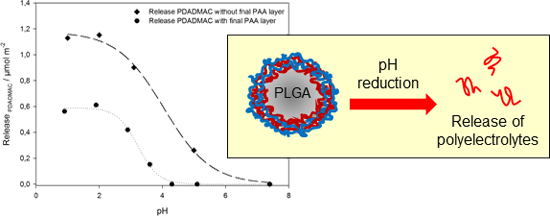
- contrast, measurements performed in sodium hydroxide solution (pH 11), show a drastic swelling behaviour for PAA adsorbed at pH 3, but only a slight increase in particle size for PAA adsorbed at pH 5 and pH 7, respectively. This observation can be attributed to different chain conformations of PAA during
- adsorbs in a coiled conformation to yield a thick film. In ultrapure water (pH approx. 6), the degree of dissociation in the outermost PAA layer is increasing, causing a layer swelling due to electrostatic self-repulsion. Particularly noteworthy is the massive increase in hydrodynamic radius by more than
- 100 nm, see Table 1. This implies a significant stretching of single chains after adsorption rather than a swelling of a compact film, as schematically depicted in Figure 1. This behaviour is in agreement with earlier work, where it was shown that particle radii can increase by values on the order of


Nanoscale rippling on polymer surfaces induced by AFM manipulation
Beilstein J. Nanotechnol. 2015, 6, 2278–2289, doi:10.3762/bjnano.6.234
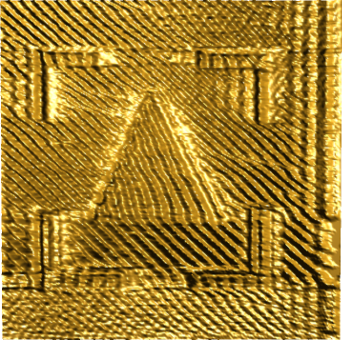
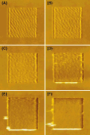
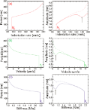
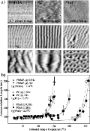
- residual solvent molecules is responsible for weakening the mechanical properties. This phenomenon is known by the name of ‘plasticization’ [42]. It depends on the fact that solvent molecules are intercalated into the polymer molecules and the final result is a film swelling depending on the amount of




Fabrication of hybrid nanocomposite scaffolds by incorporating ligand-free hydroxyapatite nanoparticles into biodegradable polymer scaffolds and release studies
Beilstein J. Nanotechnol. 2015, 6, 2217–2223, doi:10.3762/bjnano.6.227
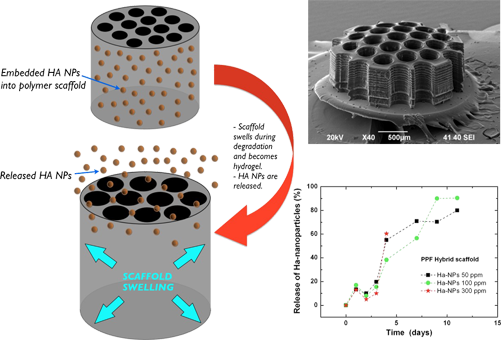
- illustrates the degradation, the scaffold swelling, and HA NPs release during degradation in Dulbecco's Modified Eagle's Medium (DMEM). In order to test the release of HA NPs from the bulk scaffolds, 20 layer of 3 mm diameter porous (400 μm pore size) scaffolds were fabricated from HA NPs–PPF resins


Nanofibers for drug delivery – incorporation and release of model molecules, influence of molecular weight and polymer structure
Beilstein J. Nanotechnol. 2015, 6, 1939–1945, doi:10.3762/bjnano.6.198
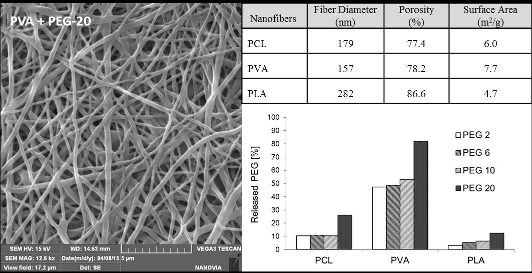
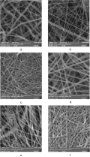
- variable water content between nanofibers, which is the result of their variable swelling. The release experiments revealed two trends – the release rate depends on the molecular weight of model PEGs as well as on the type of nanofibrous carrier. Although we expected that long molecules will be anchored in



In situ observation of biotite (001) surface dissolution at pH 1 and 9.5 by advanced optical microscopy
Beilstein J. Nanotechnol. 2015, 6, 665–673, doi:10.3762/bjnano.6.67
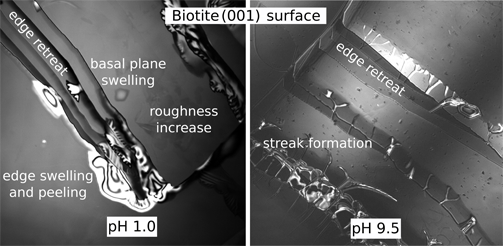
- used to study the mechanisms controlling the biotite (001) surface dissolution at pH 1 (11 and 25 °C) and pH 9.5 (50 °C). Step edges are the preferential sites of dissolution and lead to step retreat, regardless of the solution pH. At pH 1, layer swelling and peeling takes place, whereas at pH 9.5
- visible terrace limits. The darker the outline (i.e., contrast), the higher the step. The same surface reacted for ca. 17 h at pH 1 and 25 °C shows edge retreat, layer swelling and peeling (Figure 1b), the latter processes being a consequence of biotite dissolution. Aldushin et al. [10] suggested that the
- the dissolution rate is similar in all crystallographic directions. Interestingly, new dissolution fronts break away from slower moving step edges (white arrows, Figure 2b), indicating that upper layers move faster than lower ones. Basal plane swelling and a general increase of roughness were also


Conformal SiO2 coating of sub-100 nm diameter channels of polycarbonate etched ion-track channels by atomic layer deposition
Beilstein J. Nanotechnol. 2015, 6, 472–479, doi:10.3762/bjnano.6.48
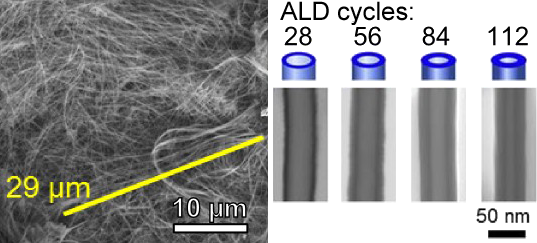
- properties such as diameter and conformation variations due to dangling bonds, swelling, or surface charge variations from pH changes of the solution, are to a large extent unknown but can influence ion transport and the control of surface modification steps in a crucial manner. A homogeneous conformal


Multifunctional layered magnetic composites
Beilstein J. Nanotechnol. 2015, 6, 134–148, doi:10.3762/bjnano.6.13
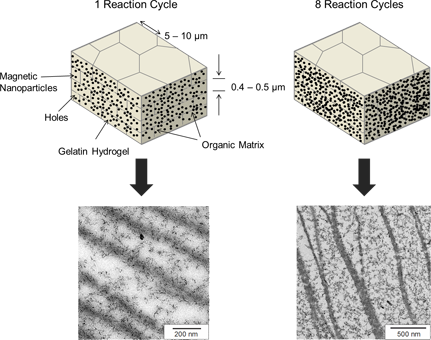
- protocol to the layered organic matrix does not affect the magnetic nature of the material. Swelling studies In order to probe structural changes of the nanocomposite during gelatin infiltration as well as during magnetite synthesis, swelling studies were performed. The swelling capacity of the insoluble
- nacre matrix, the gelatin infiltrated chitin matrix and the magnetic nanocomposite are shown in Figure 8. The swelling degree, Sd, is defined as: where Ws stands for the weight of the swollen sample after swelling equilibrium was reached and Wd stands for the dry weight before water uptake. In the case
- of nacre matrix infiltrated with gelatin a distinct increase in swelling can be observed as compared to the insoluble matrix alone. This effect is not surprising as gelatin alone shows a higher swelling capacity as the insoluble organic matrix. The gravimetric water uptake of the gelatin–chitin





Materials and characterization techniques for high-temperature polymer electrolyte membrane fuel cells
Beilstein J. Nanotechnol. 2015, 6, 68–83, doi:10.3762/bjnano.6.8
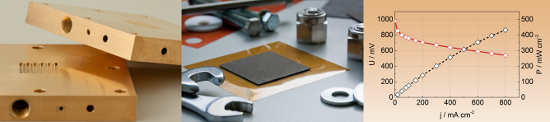
- further increase in current density to 300 mA/cm2 and 500 mA/cm2 did not lead to a significant additional swelling of the membrane. After returning to zero current, the membrane thickness was restored to the original value before the load cycle. The swelling of the membrane can be explained by hydration




Intake of silica nanoparticles by giant lipid vesicles: influence of particle size and thermodynamic membrane state
Beilstein J. Nanotechnol. 2014, 5, 2468–2478, doi:10.3762/bjnano.5.256
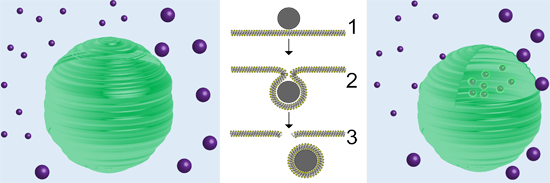
- Angelova et al. [55]. In short, lipids in the desired ratio and 0.05 mol % of the fluorescent marker DiOC14 were mixed in chloroform and spread onto indium tin oxide (ITO)-coated glass slides. The solvent is thoroughly removed through vacuum evaporation. For the swelling procedure, a chamber was assembled


Functionalized polystyrene nanoparticles as a platform for studying bio–nano interactions
Beilstein J. Nanotechnol. 2014, 5, 2403–2412, doi:10.3762/bjnano.5.250
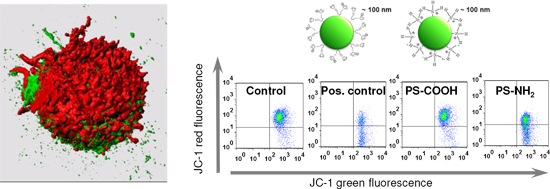
- show signs of apoptosis at this time point [41]. These data are in agreement with the previously proposed ‘‘proton-sponge’’ hypothesis, which refers to a continuous activation of the lysosomal proton pump, lysosomal swelling and rupture by particles carrying amino groups on their surface [20][41][50


Imaging the intracellular degradation of biodegradable polymer nanoparticles
Beilstein J. Nanotechnol. 2014, 5, 1905–1917, doi:10.3762/bjnano.5.201
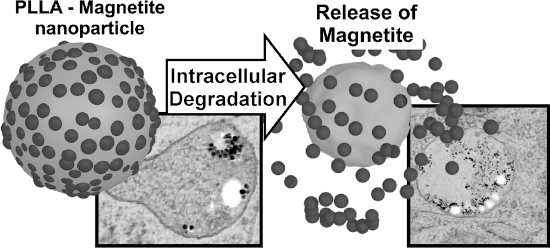
- with residence time compared to the pristine particles (Figure 8A). However, for the largest residence time (336 h = 14 days), the mean PLLA diameter increased to a value way above the average pristine value. Any explanation for this is highly speculative. Swelling of the PLLA nanoparticles due to the


Experimental techniques for the characterization of carbon nanoparticles – a brief overview
Beilstein J. Nanotechnol. 2014, 5, 1760–1766, doi:10.3762/bjnano.5.186
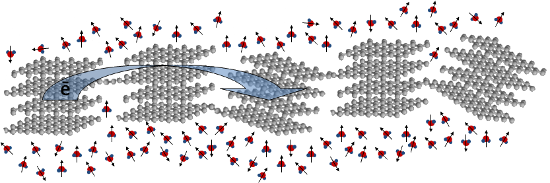
- pure ACFs) to 3.33 Å and 3.30 Å for CCl4- and water-filled fibers, respectively. Such significant changes appear due to the so-called quasi-high pressure effect, which appear in confined liquids (e.g., adsorbed inside small pores). This causes swelling of pores of a certain width due to the decrease of


Non-covalent and reversible functionalization of carbon nanotubes
Beilstein J. Nanotechnol. 2014, 5, 1675–1690, doi:10.3762/bjnano.5.178
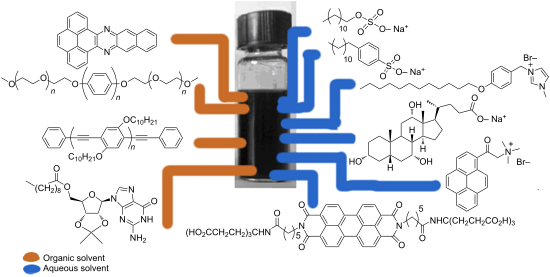
- , makes CNTs bundles precipitation more difficult, dehydrate the CNT interface and reduce water ordering around the CNTs [71] (see Figure 4). Unlikely, in none of our simulations we have observed hydrophilic chains extending and swelling in the aqueous environment. Nevertheless, our simulations considered



Liquid fuel cells
Beilstein J. Nanotechnol. 2014, 5, 1399–1418, doi:10.3762/bjnano.5.153
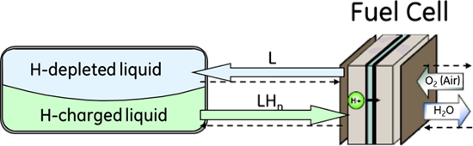
- current densities (10 mA/cm2) [91]. The crossover of neat IPA through the SPEEK PEM was about the same as for the 1 M solution due to lower swelling [91]. A similar LFC operating on 2 M IPA at 90 °C exhibited a high OCV (0.86 V) and achieved a peak power density of 128 mW/cm2 [89]. The cell voltage was ca

Surface topography and contact mechanics of dry and wet human skin
Beilstein J. Nanotechnol. 2014, 5, 1341–1348, doi:10.3762/bjnano.5.147
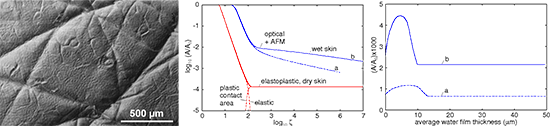
- cellulose fibers. In fact, cellulose fibers exhibit elastoplastic properties very similar to the stratum corneum: Both absorb water strongly and swell by wetting, both have elastic moduli of the order of 10 MPa in the wet state and of the order of 1 GPa in the dry state [11]. The swelling (and elastic


Model systems for studying cell adhesion and biomimetic actin networks
Beilstein J. Nanotechnol. 2014, 5, 1193–1202, doi:10.3762/bjnano.5.131
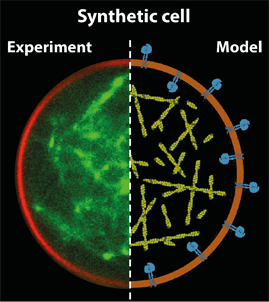
- bilayers, which are only 4 nm thick [46]. For the preparation of GUVs several methods exist, amongst which are electroformation on platinum wires or indium tin oxide (ITO) electrodes as well as spontaneous swelling. The specifics of GUVs, their detailed preparation methods and wide ranging applications are
- embedded into GUV membranes either by mixing protein-reconstituted liposomes of 0.1 to 0.2 μm diameter with a lipid-containing oil phase (lipid cosolvent method) [49] or by swelling of a tissue-like giant vesicle film [50]. For the first time, Dezi et al. recently incorporated different transmembrane
- [55]. Sackmann and co-workers later studied GUVs with enclosed actin networks, which were formed by spontaneous swelling in a buffer containing actin monomers. They also observed shape transitions in these model cells following actin polymerisation, but osmotic effects due to the addition of MgCl2


Manipulation of isolated brain nerve terminals by an external magnetic field using D-mannose-coated γ-Fe2O3 nano-sized particles and assessment of their effects on glutamate transport
Beilstein J. Nanotechnol. 2014, 5, 778–788, doi:10.3762/bjnano.5.90
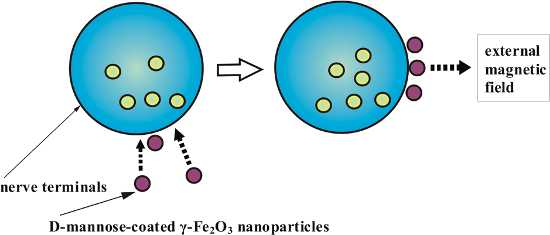
- through swelling-activated anion channels, cysteine/glutamate exchange, trans-membrane diffusion and volume-sensitive Cl− channels [19][20][21]. In this set of experiments, the extracellular level and unstimulated release of glutamate from nerve terminals in the presence of D-mannose-coated γ-Fe2O3



Fabrication of carbon nanomembranes by helium ion beam lithography
Beilstein J. Nanotechnol. 2014, 5, 188–194, doi:10.3762/bjnano.5.20
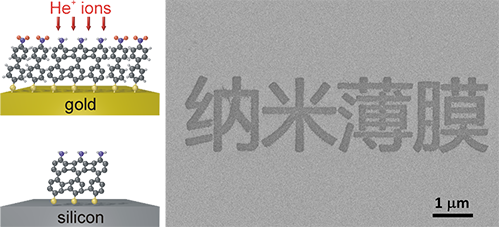
- that an excessive exposure to He+ ions (>4000 µC/cm2) leads to a damage of the CNMs, which is attributed to the swelling of the Au substrate from ion implantation [24]. A complete cross-linking of NBPT SAMs by He+ ion irradiation requires an exposure dose of approximately 850 µC/cm2, which is roughly


Digging gold: keV He+ ion interaction with Au
Beilstein J. Nanotechnol. 2013, 4, 453–460, doi:10.3762/bjnano.4.53
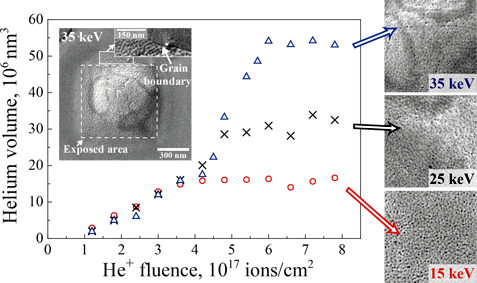
- swelling of several materials (Er, Nb and Ni) under helium irradiation is compared. The general trend of the expansion is similar to the one described in this work. The initial linear expansion was found to be energy-independent as well. In the work of Terreault et al. [31], the authors studied helium


Directed deposition of silicon nanowires using neopentasilane as precursor and gold as catalyst
Beilstein J. Nanotechnol. 2012, 3, 535–545, doi:10.3762/bjnano.3.62
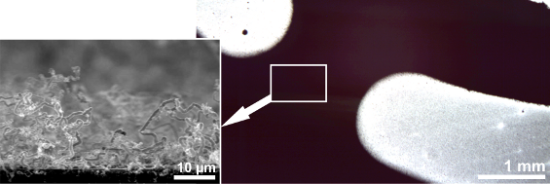
- deposition of polymer films is microcontact printing [47], which is generally considered advantageous since it is an “additive” method. In this particular case the need for dichloromethane or a similar solvent makes this process unsuitable due to the well-known swelling of the stamp material with these


Micro- and mesoporous solids: From science to application
Beilstein J. Nanotechnol. 2011, 2, 774–775, doi:10.3762/bjnano.2.85

- adsorption sites and dynamics, a theoretical understanding, e.g., employing state of the art theoretical modeling techniques, is certainly necessary. The development of synthetic concepts for the formation of two-dimensional, layered, porous structures, e.g., by swelling and delamination followed by film




