


Search results
Search for "SERS" in Full Text gives 107 result(s) in Beilstein Journal of Nanotechnology.
Assessing the plasmonics of gold nano-triangles with higher order laser modes
Beilstein J. Nanotechnol. 2012, 3, 674–683, doi:10.3762/bjnano.3.77
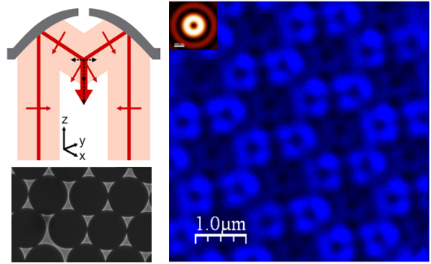
- thirdly with the employed substrate. Moreover, we obtained strongly enhanced Raman spectra of an adenine (sub-)monolayer on gold Fischer patterns on glass. We thus showed that gold Fischer patterns are promising surface-enhanced Raman scattering (SERS) substrates. Keywords: Fischer pattern; higher order
- arrays are long known to yield particle-enhanced Raman spectra [13][14][15]. Hence, there have also been several works [16][17][18] using the near field of Fischer patterns for surface-enhanced Raman scattering (SERS [19][20]). However, to our knowledge, no investigations of Fischer patterns by higher
- polystyrene spheres of different diameters. For the SERS investigations, we prepared a solution of 10−6 M adenine (Sigma-Aldrich) in triple distilled water. A 30 µL droplet was then put on the sample and after one hour of incubation gently soaked off with a lint-free tissue without touching the surface


The morphology of silver nanoparticles prepared by enzyme-induced reduction
Beilstein J. Nanotechnol. 2012, 3, 404–414, doi:10.3762/bjnano.3.47
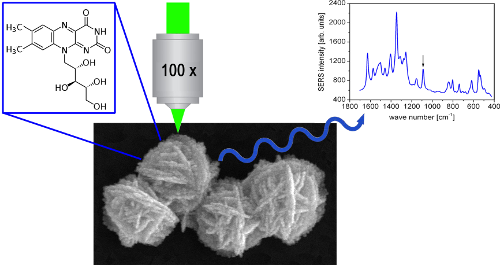
- silver nanoparticles consist of single-crystalline plates of pure silver. The surface-enhanced Raman spectroscopic (SERS) activity of the EGNP structures is promising due to the exceptionally rough surface structure of the silver nanoparticles. SERS measurements of the vitamin riboflavin incubated on the
- silver nanoparticles are shown as an exemplary application for quantitative analysis. Keywords: EGNP; enzymatically grown silver nanoparticles; enzyme-induced deposition; nanoflower; SERS; Introduction The application of metal nanoparticles in the field of bioanalytics extends the possibilities of
- . Consequently, these nanostructures enable the realization of spectroscopic detection schemes, such as surface-enhanced Raman spectroscopy (SERS) [21]. The SERS activity of these enzymatically grown metallic nanostructures has been characterized with the help of a simple conductivity measurement [7]. Of course


Distinction of nucleobases – a tip-enhanced Raman approach
Beilstein J. Nanotechnol. 2011, 2, 628–637, doi:10.3762/bjnano.2.66
- a sequencing procedure with TERS is the fact that the four nucleobases reveal remarkably different Raman scattering cross sections. It was shown that in SERS experiments on an equimolar mixture of the bases, the intensities of the ring breathing modes of the distinct bases are as follows: Poly
- -adenine > poly-cytosine >> poly-guanine > poly-thymine [24]. Furthermore, in a comparison of the SERS spectra of two DNA molecules with different adenine contents (15.5% and 44.3%), the adenine signals dominated [25]. Hence it was predicted that signals from adenine only are likely to be detected when
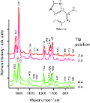
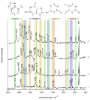
- assignment the spectral features were compared with those of SERS and Raman spectra of adenine derivates (deoxyadenosine (dA) [27], deoxyadenosine monophosphate (AMP) [28] and single stranded adenine homopolymer (poly(dA)) [29]). A comparison of TERS and SERS spectra of adenine (or any other molecule) must



Tip-enhanced Raman spectroscopic imaging of patterned thiol monolayers
Beilstein J. Nanotechnol. 2011, 2, 509–515, doi:10.3762/bjnano.2.55
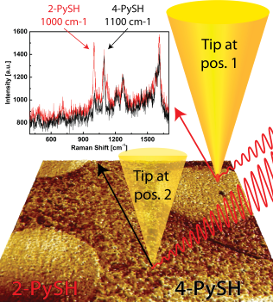
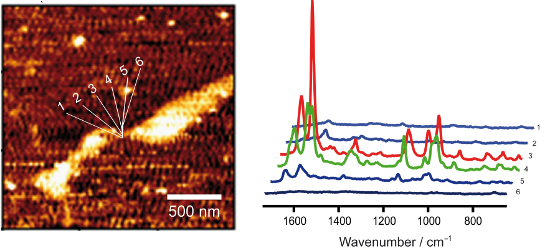
- molecular monolayers, an enhanced Raman technique is necessary to determine the chemical identity of the molecules. In surface-enhanced Raman spectroscopy (SERS) experiments (with a rough Ag film as a substrate, produced by vapor coating with randomly located enhancement hot-spots), the necessary
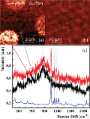
- enhancement can in principle be reached. An attempt was made to visualize the distribution of molecules using SERS, but this did not yield satisfactory results. However, the large signal-to-noise ratio in every pixel of a TERS image allows one to obtain enough information to distinguish a full monolayer from
- decomposition products (carbonaceous decomposition products usually scatter strongly) leads to the conclusion that the SAM was not destroyed by the high laser power, but that the intensity of Raman signals from the intact monolayer was too weak to be detected. In experiments on Ag SERS substrates (nominal




Towards multiple readout application of plasmonic arrays
Beilstein J. Nanotechnol. 2011, 2, 501–508, doi:10.3762/bjnano.2.54
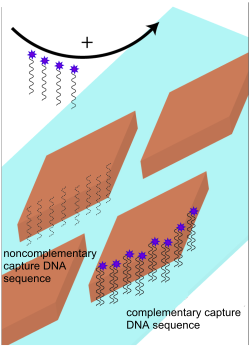
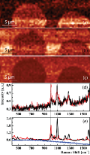
- , Albert-Einstein-Straße 9, 07745 Jena, Germany 10.3762/bjnano.2.54 Abstract In order to combine the advantages of fluorescence and surface-enhanced Raman spectroscopy (SERS) on the same chip platform, a nanostructured gold surface with a unique design, allowing both the sensitive detection of
- fluorescence light together with the specific Raman fingerprint of the fluorescent molecules, was established. This task requires the fabrication of plasmonic arrays that permit the binding of molecules of interest at different distances from the metallic surface. The most efficient SERS enhancement is
- article, the simultaneous application of SERS and fluorescence, through the use of various gold nanostructured arrays, is demonstrated by the realization of a DNA detection scheme. The results shown open the way to more flexible use of plasmonic arrays in bioanalytics. Keywords: fluorescence; multiple


Plasmonic nanostructures fabricated using nanosphere-lithography, soft-lithography and plasma etching
Beilstein J. Nanotechnol. 2011, 2, 448–458, doi:10.3762/bjnano.2.49

- as surface enhanced Raman spectroscopy (SERS) [28][29][30][31] and, more recently, in studies of fluorescence lifetime [32][33] and the enhancement of the Purcell rate [34] (achieved mainly by confinement of light in small mode volumes rather than by very large Q-values of the resonances). The strong


Manipulation of gold colloidal nanoparticles with atomic force microscopy in dynamic mode: influence of particle–substrate chemistry and morphology, and of operating conditions
Beilstein J. Nanotechnol. 2011, 2, 85–98, doi:10.3762/bjnano.2.10
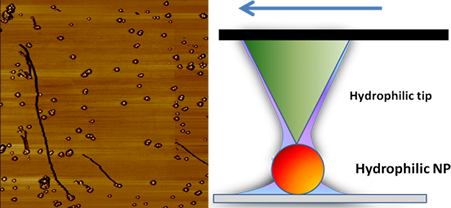
- detection (colorimetric and surface enhanced Raman spectroscopy (SERS)). For different reasons gold particles are particularly attractive in this field. For instance, they are ideal electrodes for molecular electronics [22]. Gold clusters below 5 nm in size deposited onto thin metal oxides also exhibit


Other Beilstein-Institut Open Science Activities



