


Search results
Search for "adsorption sites" in Full Text gives 105 result(s) in Beilstein Journal of Nanotechnology.
Micro- and mesoporous solids: From science to application
Beilstein J. Nanotechnol. 2011, 2, 774–775, doi:10.3762/bjnano.2.85

- adsorption sites and dynamics, a theoretical understanding, e.g., employing state of the art theoretical modeling techniques, is certainly necessary. The development of synthetic concepts for the formation of two-dimensional, layered, porous structures, e.g., by swelling and delamination followed by film

Towards a scalable and accurate quantum approach for describing vibrations of molecule–metal interfaces
Beilstein J. Nanotechnol. 2011, 2, 427–447, doi:10.3762/bjnano.2.48
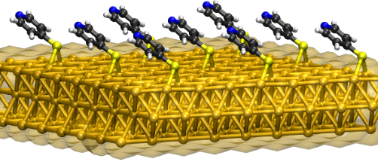
- next section. The results obtained are in a good agreement with experiment [4] and allow the identification of possible adsorption sites for 4-mercaptopyridine using vibrational data alone, thus leading to a new type of structure determination for adsorbed organic molecules. Description of adsorbate


Influence of water on the properties of an Au/Mpy/Pd metal/molecule/metal junction
Beilstein J. Nanotechnol. 2011, 2, 384–393, doi:10.3762/bjnano.2.44
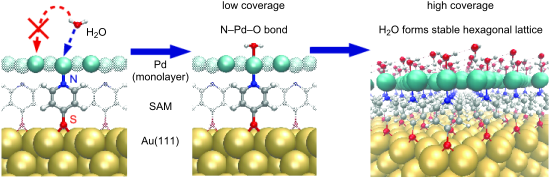
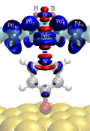
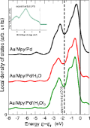
- isolated water molecule, as well as of a water layer arranged in a hexagonal bilayer, at the preferential adsorption sites on the densely packed palladium monolayer of the Au/Mpy/Pd system. In addition, we concentrate on the structural and electronic modification of the Au/Mpy/Pd complex upon water

![[Graphic 1]](/bjnano/content/inline/2190-4286-2-44-i1.png?max-width=637&scale=0.945456) )R3...
)R3...


![[Graphic 2]](/bjnano/content/inline/2190-4286-2-44-i2.png?max-width=637&scale=1.18182) = 1/3 ML. Plott...
= 1/3 ML. Plott...
Intermolecular vs molecule–substrate interactions: A combined STM and theoretical study of supramolecular phases on graphene/Ru(0001)
Beilstein J. Nanotechnol. 2011, 2, 365–373, doi:10.3762/bjnano.2.42
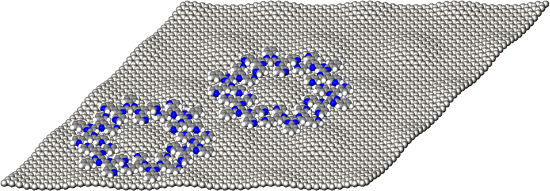
- positions” - V). These are taken as representative for the different adsorption sites on the graphene/Ru(0001) surface. Recently, we demonstrated, for the adsorption of 2-phenyl-4,6-bis(6-(pyridin-2-yl)-4-(pyridin-4-yl)pyridin-2-yl)pyrimidine (2,4’-BTP) molecules on a Ru(0001) supported graphene film, that
- limitation to specific adsorption sites in combination with the distinct positions of the hydrogen bond donors and acceptors within the molecule results in the formation of 1D chain structures (Figure 3b), similar to findings recently reported for the adsorption of PTCDI molecules on graphene/Rh(111) [18
- corrugated surface without any disturbance due to the different adsorption sites [37]. Calculations To determine the corrugation of the adsorption potential, we summed up the different contributions to the adsorption energy (molecule–graphene and molecule–Ru interaction) and subtracted the adsorption energy


Defects in oxide surfaces studied by atomic force and scanning tunneling microscopy
Beilstein J. Nanotechnol. 2011, 2, 1–14, doi:10.3762/bjnano.2.1
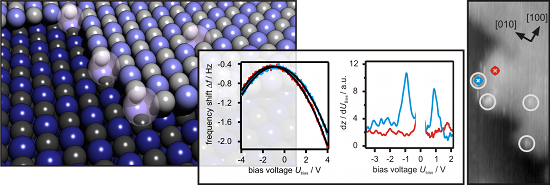
- example, defects are often preferred adsorption sites and hence are particularly chemically active. Electrically charged defects may enable electron transfer processes, which play an important role in chemical reactions in general and in heterogeneous catalysis in particular. A sketch of a binary oxide
- on the MgO surface are investigated in detail and classified by their charge state. From calculations it has been proposed that color centers are directly involved in chemical reactions [23][24], e.g., as adsorption sites due to more attractive defect-adsorbate interactions compared with the pristine
- above the oxygen atoms [27], the maxima in the NC-AFM image are thought to correspond to the positions of the oxygen atoms. Furthermore, electron paramagnetic resonance (EPR) spectra have shown that the preferred adsorption sites for Au atoms are on top of the oxygen ions on the terrace of the MgO


Other Beilstein-Institut Open Science Activities



