


Search results
Search for "automated" in Full Text gives 109 result(s) in Beilstein Journal of Nanotechnology.
Towards precise defect control in layered oxide structures by using oxide molecular beam epitaxy
Beilstein J. Nanotechnol. 2014, 5, 596–602, doi:10.3762/bjnano.5.70
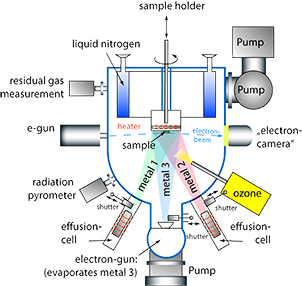
- scattering and recoil spectroscopy (TOF-ISARS), X-ray photoelectron spectroscopy (XPS) or any other, according to demands. Each chamber has a vertical design, which allows for the substrate transfer system to be fully automated. The substrate transfer between the load lock, the storage and each growth


Synthesis of boron nitride nanotubes from unprocessed colemanite
Beilstein J. Nanotechnol. 2013, 4, 843–851, doi:10.3762/bjnano.4.95
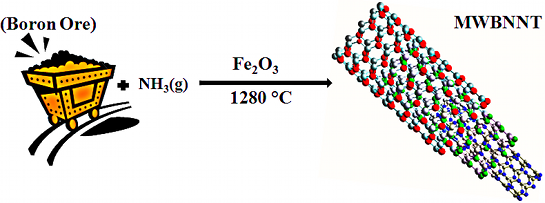
- by a completely automated Renishaw InVia Reflex Raman Microscopy system (Renishaw Plc., New Mills, Wotton-under-Edge, UK) equipped with a 514 nm Ar lasers. The laser power was set at 30 mW, and the exposure time was 10 s. A 50× objective was used. The wavelength of the instrument was automatically


Deformation-induced grain growth and twinning in nanocrystalline palladium thin films
Beilstein J. Nanotechnol. 2013, 4, 554–566, doi:10.3762/bjnano.4.64
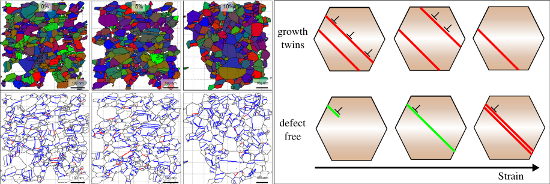
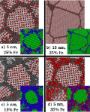
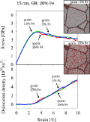
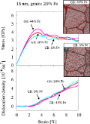
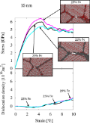
- deformation processes in the material, several samples were strained to defined straining states, up to a maximum engineering strain of 10%, and prepared for post-mortem analysis. The nanocrystalline structure was investigated by quantitative automated crystal orientation mapping (ACOM) in a transmission
- active in ncPd films deposited by magnetron sputtering onto compliant substrates. The microstructural analysis is mainly performed by quantitative automated crystal orientation mapping TEM (ACOM-TEM) [23][24] and supplemented with grain size measurement using dark-field TEM (DF-TEM) and conventional X


Plasticity of nanocrystalline alloys with chemical order: on the strength and ductility of nanocrystalline Ni–Fe
Beilstein J. Nanotechnol. 2013, 4, 542–553, doi:10.3762/bjnano.4.63
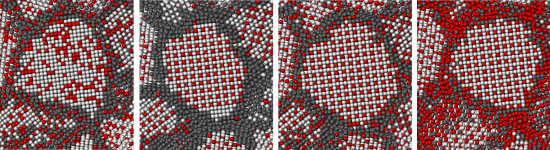
- microstructure was done by a novel algorithm, which allows for the extraction and analysis of dislocations from simulation data in a fully automated way [26]. The local atomic volume of each atom was calculated by means of the Voronoi tessellation method [27]. We define the free volume of the GB atoms as the



Large-scale analysis of high-speed atomic force microscopy data sets using adaptive image processing
Beilstein J. Nanotechnol. 2012, 3, 747–758, doi:10.3762/bjnano.3.84
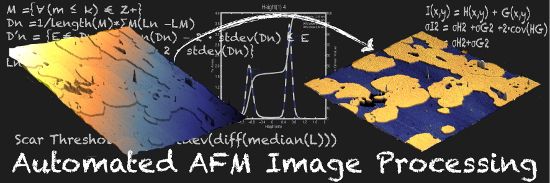
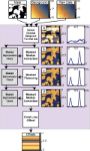
- obtain a true representation of the sample and its changes over time. This paper presents an automated, adaptive algorithm for the required processing of AFM images. The algorithm adaptively corrects for both common one-dimensional distortions as well as the most common two-dimensional distortions. This
- . This amount of data creates a significant increase in the amount of image processing needed to extract the true sample topography, which can no longer be performed by the user on an image-by-image basis [15][17]. In HS-AFM, there is a real need for an automated processing routine that optimizes the
- [30][31]. Automated, AFM quality-control check in semiconductors and other nanotechnologies [32][33][34] also creates large data sets, which would also benefit from reliable automated image processing. In order to automate the image processing, it is important to define a metric by which the success




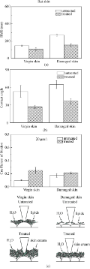
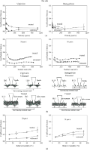
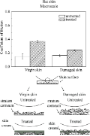
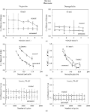
Friction and durability of virgin and damaged skin with and without skin cream treatment using atomic force microscopy
Beilstein J. Nanotechnol. 2012, 3, 731–746, doi:10.3762/bjnano.3.83
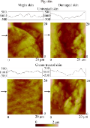
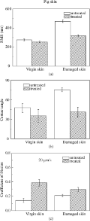
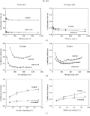
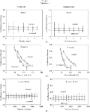
- reciprocating tribometer with a velocity 1 mm/s and at a normal load of 50 mN for 3000 cycles. Contact-angle measurements The apparent contact angles were measured for various samples. Measurements were made with a Rame-Hart automated goniometer model 290-F4, where 5 μL water droplets were deposited onto the





Combining nanoscale manipulation with macroscale relocation of single quantum dots
Beilstein J. Nanotechnol. 2012, 3, 324–328, doi:10.3762/bjnano.3.36
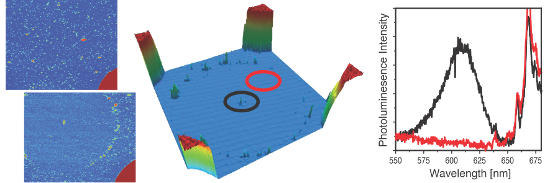
- experiments on a single particle. Automated nanoparticle manipulation and imaging routines have been developed so as to facilitate the rapid assembly of specific nanoparticle arrangements. Keywords: automation; nanoscale manipulation; nanotechnology; quantum dots; single molecule spectroscopy; Introduction
- [13]. The gold nanoparticle was shown to dramatically quench the optical lifetime of the QD and to completely suppress its blinking. Experimental In this work, we position a single fluorophore, a CdSe QD, with nanometre precision on a macroscopic registration template, using automated atomic force


Distinction of nucleobases – a tip-enhanced Raman approach
Beilstein J. Nanotechnol. 2011, 2, 628–637, doi:10.3762/bjnano.2.66
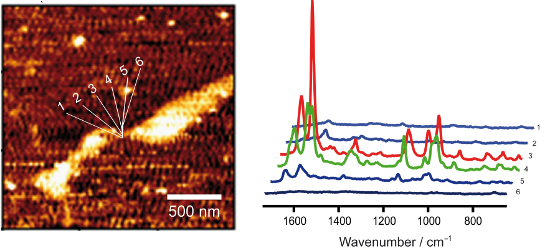
- first sequencing methods were published in 1977 by Maxam and Gilbert [1], and Sanger et al. [2]. Since then the sequencing technology has been refined and automated, and current advances show a tendency towards single-molecule sequencing, which eventually results in the development of sequencing systems



Self-organizing bioinspired oligothiophene–oligopeptide hybrids
Beilstein J. Nanotechnol. 2011, 2, 525–544, doi:10.3762/bjnano.2.57
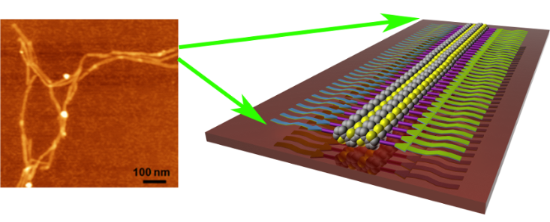
- deprotection conditions, the switch ester segment is preserved at low pH. Reestablishment of the native α-amide peptide backbone can be achieved by an increase in the pH to neutral or even slightly basic conditions. The peptide segment was obtained by a semi-automated solid-phase supported peptide synthesis




Other Beilstein-Institut Open Science Activities



