


Search results
Search for "biosensing" in Full Text gives 103 result(s) in Beilstein Journal of Nanotechnology.
Microfluidic anodization of aluminum films for the fabrication of nanoporous lipid bilayer support structures
Beilstein J. Nanotechnol. 2011, 2, 104–109, doi:10.3762/bjnano.2.12
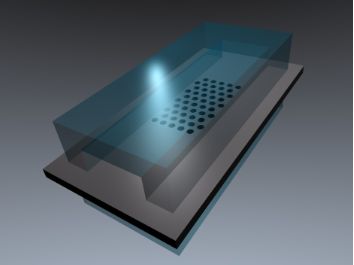
- as template structures in nanofabrication technology [9][10][11][12][13][14][15][16][17][18][19][20] to their direct use as functional interfaces for controlled release of molecules [21][22][23], co-culture development [24], or biosensing [25]. For example, Steinem et al. have demonstrated the


Magnetic nanoparticles for biomedical NMR-based diagnostics
Beilstein J. Nanotechnol. 2010, 1, 142–154, doi:10.3762/bjnano.1.17
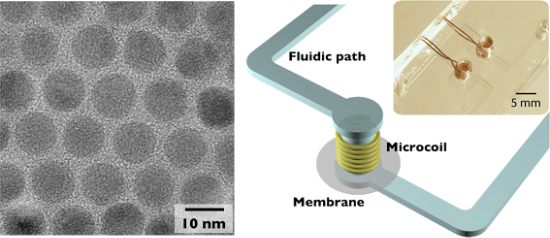
- medicine. In general, biological samples have only negligible magnetic susceptibility. Thus, using magnetic nanoparticles for biosensing not only enhances sensitivity but also effectively reduces sample preparation needs. This review focuses on the use of magnetic nanoparticles for in vitro detection of
- molecular measurements into clinical settings, however, an assay would need to 1) provide high sensitivity and specificity, 2) minimize sample preparation and sample volume, and 3) ideally allow concurrent detection of diverse target moieties through multiplexed measurements. Biosensing strategies based on
- their longitudinal relaxivities (r1), T2 is used for NMR-based biosensing applications. With a higher r2 relaxivity, fewer numbers of nanoparticles are required to produce detectable T2 changes. Within an ensemble of MNPs, magnetic relaxation properties depend on more than simply the particles


Electrochemical behavior of dye-linked L-proline dehydrogenase on glassy carbon electrodes modified by multi-walled carbon nanotubes
Beilstein J. Nanotechnol. 2010, 1, 135–141, doi:10.3762/bjnano.1.16
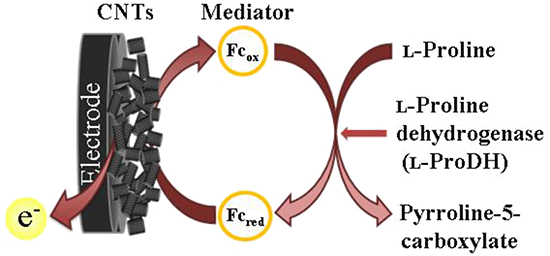
- require considerable time for analysis. In recent years, researchers have paid much more attention to the construction of electrochemical enzyme biosensors for the analysis of amino acids [5][6][7], and several electrochemical biosensing systems for L-proline and D-proline determination have been reported


Other Beilstein-Institut Open Science Activities



