


Search results
Search for "energy dissipation" in Full Text gives 107 result(s) in Beilstein Journal of Nanotechnology.
Repulsive bimodal atomic force microscopy on polymers
Beilstein J. Nanotechnol. 2012, 3, 456–463, doi:10.3762/bjnano.3.52
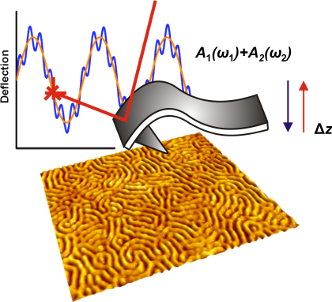
- establishing a method to separate attractive and repulsive contributions to the interaction force. To this end, it has to be proven whether such low setpoint ratios lead to stable imaging conditions. Bimodal APD curves may also give further insight into the various modes of energy dissipation because bimodal



Wavelet cross-correlation and phase analysis of a free cantilever subjected to band excitation
Beilstein J. Nanotechnol. 2012, 3, 294–300, doi:10.3762/bjnano.3.33
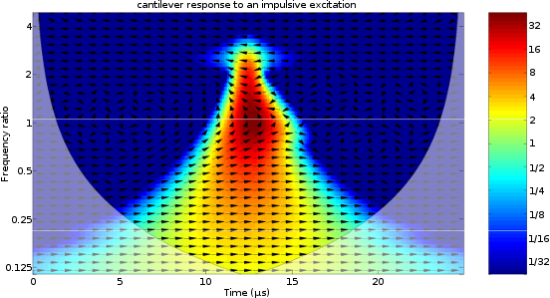
- response and the driving signal under reasonable assumptions [15]. In the last few years, the investigation of phase-analysis techniques [16][17] contributed to the understanding of energy-dissipation processes and elastic response in heterogeneous samples, an important topic in biological research, where


A measurement of the hysteresis loop in force-spectroscopy curves using a tuning-fork atomic force microscope
Beilstein J. Nanotechnol. 2012, 3, 207–212, doi:10.3762/bjnano.3.23
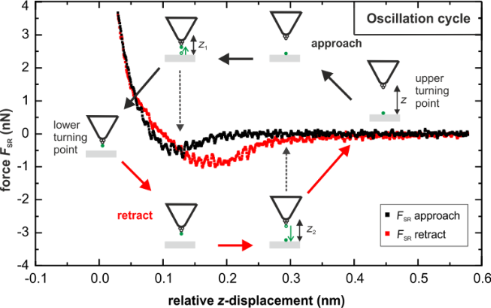
- about 0.22 eV/cycle. Keywords: atomic force microscopy; energy dissipation; force spectroscopy; hysteresis loop; PTCDA/Ag/Si(111) √3 × √3; Introduction Noncontact atomic force microscopy (NC-AFM) is a powerful tool for the study of surface properties. The invention of the frequency-modulation mode (FM
- signal is found during the retraction. (b) Dissipation signal for the retraction together with the calculated force–distance curves. Acknowledgements Financial support from the Deutsche Forschungsgemeinschaft through SFB616 ‘Energy dissipation at surfaces’ is gratefully acknowledged. The authors would


Molecular-resolution imaging of pentacene on KCl(001)
Beilstein J. Nanotechnol. 2012, 3, 186–191, doi:10.3762/bjnano.3.20
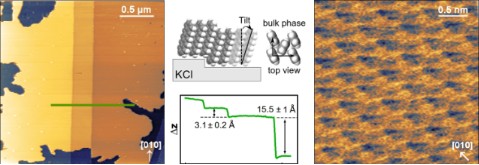
- the molecules on the surface. Another possibility is that the line defect results from a twinned growth. The line defect also has a profound effect on the energy dissipation (Figure 2b). The dissipated energy per oscillation cycle can be estimated by Ediss ≈ E0(Aexc − Aexc,0)/Aexc,0 with E0 = πkA2/Q
- oscillation cycle. The increased energy dissipation could be due to extra uncompensated electrostatic charge that induces currents in the tip in each oscillation cycle. In this case, we would expect to see strong effects from this charge in the topographic image,which we do not observe. Another possibility is
- that in the first part of the defect (B) mobile molecules are clamped due to the locally occurring strain, thus resulting in a row of reduced energy dissipation. This would imply that the defect also contains rows of more loosely bound molecules (C), which cause enhanced energy dissipation compared to


Manipulation of gold colloidal nanoparticles with atomic force microscopy in dynamic mode: influence of particle–substrate chemistry and morphology, and of operating conditions
Beilstein J. Nanotechnol. 2011, 2, 85–98, doi:10.3762/bjnano.2.10
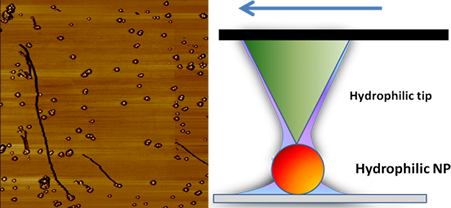
- RH%, are presented and discussed. The dependency of the energy dissipation during the manipulation was particularly studied as a function of size, coating of particles, substrate and temperature. Finally, interpretation of the physico-chemical mechanisms involved at both interfaces – tip–particle and
- nanoparticles or nanoparticles and surface, and independent of the size of the spherical particles, the logarithm of the dissipated power during the manipulation systematically decreases linearly, when the scan velocity increases. This linear dependence is generally attributed to a decrease of the energy
- dissipation in the contact as the velocity increases, in a way similar to the velocity (frequency)-dependent viscoelastic and/or plastic dissipation in polymers (as well as metals), as is described for instance through the time-temperature superposition principle for polymers [50][51][52]. However, from this


Tip-sample interactions on graphite studied using the wavelet transform
Beilstein J. Nanotechnol. 2010, 1, 172–181, doi:10.3762/bjnano.1.21
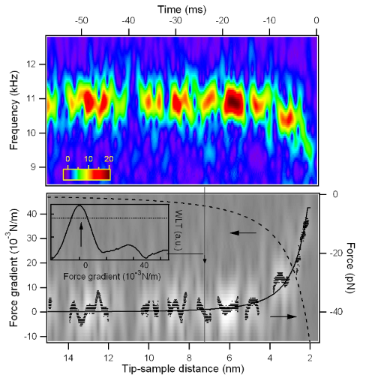
- force, and Q to the energy dissipation [2][6]. The thermal motion (or Brownian motion) of the cantilever’s tip is connected to the local mechanical compliance via the fluctuation-dissipation theorem. The cantilever thermal fluctuations are modified by the tip-surface interaction forces: monitoring these




The description of friction of silicon MEMS with surface roughness: virtues and limitations of a stochastic Prandtl–Tomlinson model and the simulation of vibration-induced friction reduction
Beilstein J. Nanotechnol. 2010, 1, 163–171, doi:10.3762/bjnano.1.20
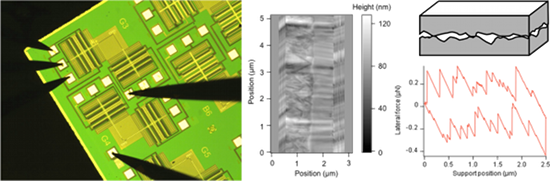
- in this study. The area enclosed by the friction loop corresponds to the energy dissipated during the friction process. To obtain an accurate measure for the energy dissipation, we have cut off the side lobes of the friction loop, where the device becomes stuck in one direction, taking the average
- rise to the energy dissipation) it is able to predict the important features of the typical motion observed of a polycrystalline silicon MEMS slider as it slides against an on-chip counter-surface of same material. This proves that the overall sliding behaviour is governed by the mechanical locking


Other Beilstein-Institut Open Science Activities



