


Search results
Search for "grafting" in Full Text gives 106 result(s) in Beilstein Journal of Nanotechnology.
Self-assembled monolayers and titanium dioxide: From surface patterning to potential applications
Beilstein J. Nanotechnol. 2011, 2, 845–861, doi:10.3762/bjnano.2.94
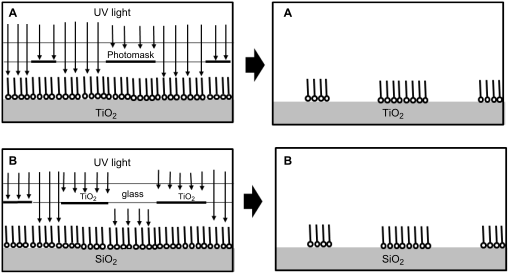
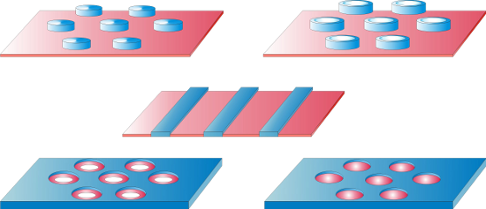
- condensation reaction is faster than on SiO2, and as a consequence the grafting of octadecyl trichlorosilane (OTS) on TiO2 is faster [16]. To some extent this is related to the known ability of Ti(OR)4 to catalyze silanol condensation in TiO2–SiO2 sol–gel systems. Since island formation of OTS molecules
- requires lateral mobility, which may be hindered if the grafting is too strong, one may expect the OTS islands on TiO2 to be smaller than on SiO2. There are several indications (most of them based on the FTIR signal of the C–H stretch envelope) that the amount of chemisorbed trichlorosilane molecules is
- grafting density with respect to chemisorption by conventional methods (2.8–3.0 molecules per nm2 versus 4.3–4.8 molecules per nm2). It is worth mentioning that a study on organosilane monolayers formed on the surfaces of zirconia and titania (anatase and rutile), by a gas–phase process employing



Synthesis and catalytic applications of combined zeolitic/mesoporous materials
Beilstein J. Nanotechnol. 2011, 2, 785–801, doi:10.3762/bjnano.2.87
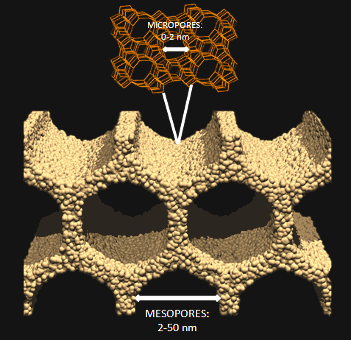
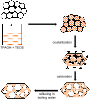
- can be obtained by grafting of titanocene complexes. These turn out to be excellent catalysts for the epoxidation of olefins [95]. 1.2.2 Templating approach In templating approaches, combined zeolitic/mesoporous materials are obtained by using appropriate templates. Strictly speaking, the term




Surface induced self-organization of comb-like macromolecules
Beilstein J. Nanotechnol. 2011, 2, 569–584, doi:10.3762/bjnano.2.61
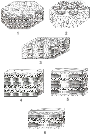
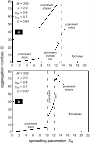
- organic nanotubes that are soluble in water [16][17]. There are three key methods for the synthesis of graft copolymers [1][5]. The first method involves grafting of previously prepared side chains onto the backbone (the so-called “grafting onto” method). Branch points are obtained by chemical
- “grafting from” method). The third approach is termed macromonomer (or “grafting through” method). This method consists of two steps. In the first stage macromonomers (future side chains) are synthesized. Then the copolymerization of the macromonomers and the monomers forming the backbone takes place. Each
- strategy enables control of different parameters such as grafting density, chemical composition, polymerization degree of side chains and the backbone, polydispersity, etc. Achievement of the desired set of these parameters is quite a complicated task, e.g., due to the steric repulsion of side chains in




Inorganic–organic hybrid materials through post-synthesis modification: Impact of the treatment with azides on the mesopore structure
Beilstein J. Nanotechnol. 2011, 2, 486–498, doi:10.3762/bjnano.2.52
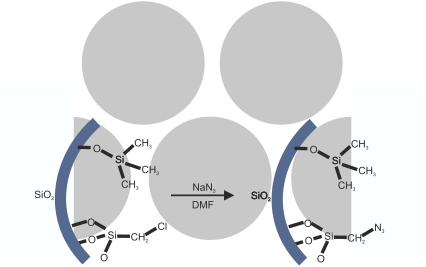
- even functional groups such as polymerizable moieties or metal-coordinating groups can be introduced [24]. These groups are typically incorporated either by post-synthetic grafting processes or by co-condensation reactions of different alkoxysilanes. The impact of these synthesis steps on the final


Manipulation of gold colloidal nanoparticles with atomic force microscopy in dynamic mode: influence of particle–substrate chemistry and morphology, and of operating conditions
Beilstein J. Nanotechnol. 2011, 2, 85–98, doi:10.3762/bjnano.2.10
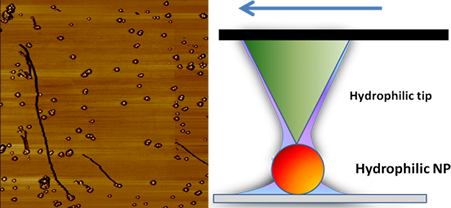
- . the shape, size and grafting of the NPs, as well as the surface chemistry and the patterning of the substrate, and finally the operating conditions (temperature, humidity and scan velocity). Whereas the operating conditions and substrate structure are shown to have a strong effect on the mobility of
- parameters of the AFM. Besides the shape and the size of the particles, the chemistry of the functional grafting surrounding the particle also strongly affects their movement and trajectory during nanomanipulation. 2. Influence of the chemistry of the particles on a flat substrate Because real surfaces are
- often heterogeneous in their chemical composition, functionalized nanoparticles provide good model systems to study and tune the mobility of nano-objects on these substrates. As a next step, the role of the hydrohilicity and hydrophobicity of the functional grafting on spherical Au nanoparticles is


Sensing surface PEGylation with microcantilevers
Beilstein J. Nanotechnol. 2010, 1, 3–13, doi:10.3762/bjnano.1.2
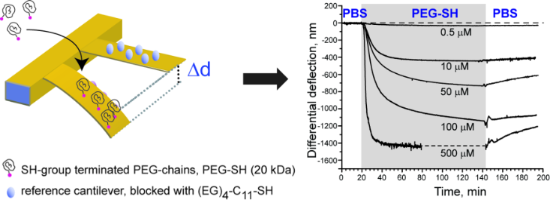
- example is polyethylene glycol (PEG), which is widely used as a protein-resistant coating given its low toxicity and biocompatibility. We report here a microcantilever-based sensor for the in situ characterization of PEG monolayer formation on Au using the “grafting to” approach. Moreover, we demonstrate
- ][26], DNA [27] or lipid bilayers [28]. Recently, Bumbu et al. [29] applied the static mode technique to study the behavior of poly(methyl methacrylate) brushes that had been polymerized from the silicon surface of a microcantilever sensor, i.e., using a “grafting from” approach. While this allowed the
- surface PEGylation, and (2) conformational changes in the PEG layer over a timescale of tens of minutes in situ. Specifically, thiol-terminated PEG (mPEG–SH, 20 kDa) chains have been covalently tethered onto Au-coated microcantilever surfaces by the “grafting to” approach. When switching between good



Other Beilstein-Institut Open Science Activities



