


Search results
Search for "indentation" in Full Text gives 109 result(s) in Beilstein Journal of Nanotechnology.
Digging gold: keV He+ ion interaction with Au
Beilstein J. Nanotechnol. 2013, 4, 453–460, doi:10.3762/bjnano.4.53
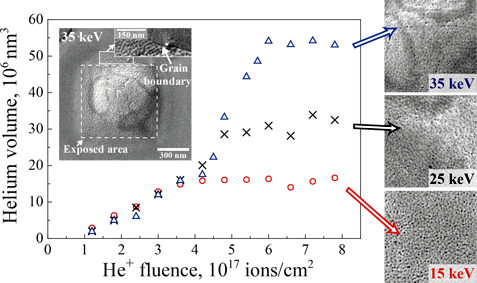
- respect to the nonirradiated surface. This is the result of sputtering of a few gold layers. The signature of this sputtering-related indentation remains discernible in all subsequent images. After doubling the dose to 1.2 × 1017 cm−2, helium implantation has a noticeable effect: the surface of the


Growth behaviour and mechanical properties of PLL/HA multilayer films studied by AFM
Beilstein J. Nanotechnol. 2012, 3, 778–788, doi:10.3762/bjnano.3.87
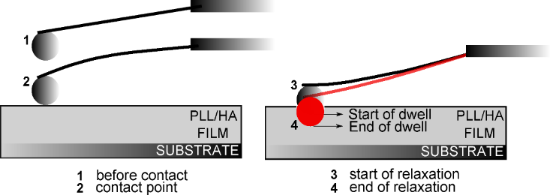
- Institute of Colloids and Interfaces, Am Mühlenberg 1, 14476 Potsdam-Golm, Germany 10.3762/bjnano.3.87 Abstract Scanning- and colloidal-probe atomic force microscopy were used to study the mechanical properties of poly(L-lysine)/hyaluronan (PLL/HA)n films as a function of indentation velocity and the
- number of polymer deposition steps n. The film thickness was determined by two independent AFM-based methods: scratch-and-scan and newly developed full-indentation. The advantages and disadvantages of both methods are highlighted, and error minimization techniques in elasticity measurements are addressed
- measurements show that PLL/HA films have a viscoelastic behaviour, regardless of their thickness. If indentation is performed several times at the same lateral position on the film, a viscous/plastic deformation takes place. Keywords: atomic force microscopy; polyelectrolyte multilayers; stress relaxation


Friction and durability of virgin and damaged skin with and without skin cream treatment using atomic force microscopy
Beilstein J. Nanotechnol. 2012, 3, 731–746, doi:10.3762/bjnano.3.83
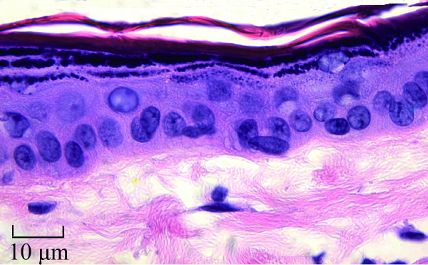
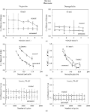
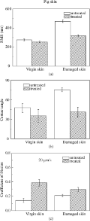
- , the maximum indentation displacement was controlled to be 1000 nm [6]. The method for the hardness (H) and the elastic modulus (E) determination was based on established methods [37][38]. Briefly, H was calculated from where Pmax is the maximum imposed load, and A is the projected contact area. The

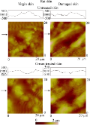
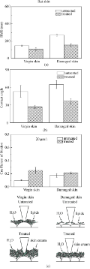

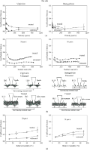

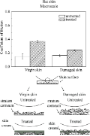


The memory effect of nanoscale memristors investigated by conducting scanning probe microscopy methods
Beilstein J. Nanotechnol. 2012, 3, 722–730, doi:10.3762/bjnano.3.82
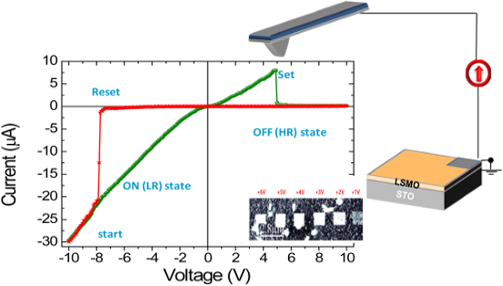
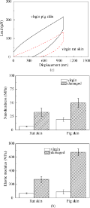
- modify (writing/erasing) or to characterize (reading) the electrical properties of the sample under study. Current images were acquired in a noninvasive manner (no sample indentation) by using the contact operation mode at the lowest possible applied load while still obtaining stable signals. The


Mapping mechanical properties of organic thin films by force-modulation microscopy in aqueous media
Beilstein J. Nanotechnol. 2012, 3, 464–474, doi:10.3762/bjnano.3.53
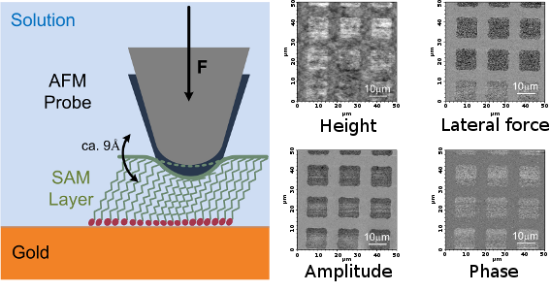
- apparent stiffness of the EG3 layer (see Supporting Information File 1 for details) [65]. The apparent Young’s modulus of the thiols on the surface is around 30 GPa, consistent with moduli of short alkanethiol chains obtained by using SEM and nano-indentation [66][67]. The approach to deconvolute these
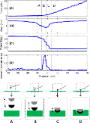
- four regimes: (A) free oscillation, (B) partial contact, (C) soft contact, and (D) hard contact. To highlight the differences in cantilever bending and the level of indentation in the four regimes, the schematic is not drawn to scale. FMM images of SpA-N B-domain protein patterns on a gold surface



Mechanical characterization of carbon nanomembranes from self-assembled monolayers
Beilstein J. Nanotechnol. 2011, 2, 826–833, doi:10.3762/bjnano.2.92
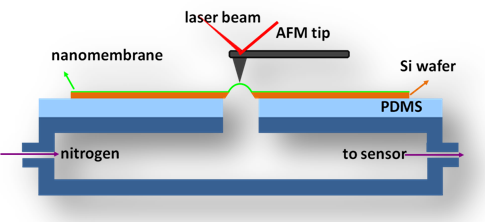
- resolution in the range of hundreds of nanometers. Atomic force microscopy (AFM) has also been used for indentation studies on soft [14] as well as stiff [15] membranes. In addition, it was recently reported that the curvature of a bulged membrane was determined by AFM, while its deflection was measured with
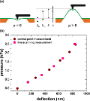
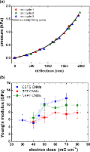
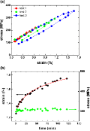
- a pressure–deflection curve. This force corresponds to an indentation depth δ0, which appears as a step height in topographic AFM images of nonpressurized membranes. The indentation depth δ of pressurized membranes was evaluated in order to correct the measured deflection, as described previously
- [10]. In this system, the tension of the CNM is assumed to be the main contribution balancing the AFM tip force. The force contributed by the bending stiffness and the adhesion between the tip and the membrane was neglected. For a pressurized membrane, the indentation depth δ decreases with increasing

The effect of surface anisotropy in the slippery zone of Nepenthes alata pitchers on beetle attachment
Beilstein J. Nanotechnol. 2011, 2, 302–310, doi:10.3762/bjnano.2.35
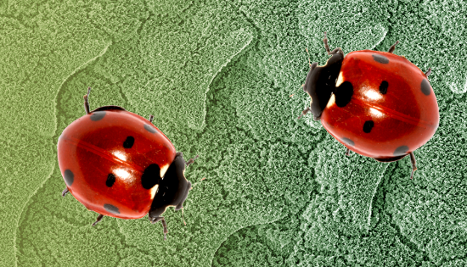
- surfaces than on their replicas may be explained by the different mechanical and physicochemical properties of both substrates. We surmise that the softer and more compliant material of the plant tissue promotes insect interlocking due to easier indentation of claw tips into a softer substrate. This effect



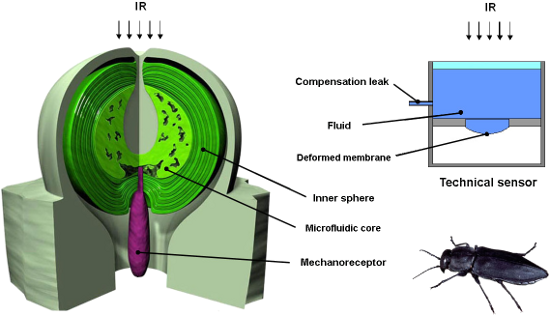
Infrared receptors in pyrophilous (“fire loving”) insects as model for new un-cooled infrared sensors
Beilstein J. Nanotechnol. 2011, 2, 186–197, doi:10.3762/bjnano.2.22
- ). Indentation tests were performed by using a three-sided Berkovich diamond tip with a total included angle of 142.3°. A proper area function was established by indenting in a poly(methyl methacrylate) (PMMA) test specimen with known hardness and modulus. Contact depths range from 250 to 1100 nm. The maximum
- load during indentation was 1,000 µN with loading and unloading rates of 100 µN/s, and a 10 s hold time at peak load to compensate for material creeping and to make sure that most of the plastic deformation was completed. It was repeatedly checked to ensure that longer holding times did not result in


Tip-sample interactions on graphite studied using the wavelet transform
Beilstein J. Nanotechnol. 2010, 1, 172–181, doi:10.3762/bjnano.1.21
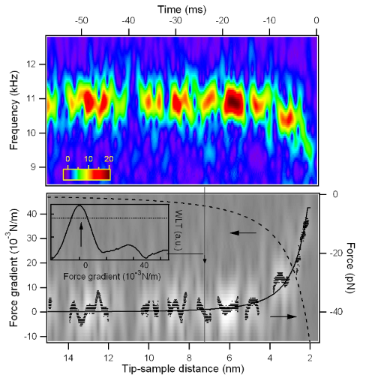
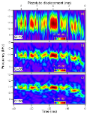
- spectroscopy curves on the hard HOPG surface, assuming a negligible indentation and thus equal distances spanned by the cantilever tip and the piezotube. The obtained sensitivity is in the range of 50–200 nm/V, depending on the cantilever type, beam position, and laser light power level. The cantilever has a




Other Beilstein-Institut Open Science Activities



