Search results
Search for "oxygen vacancies" in Full Text gives 110 result(s) in Beilstein Journal of Nanotechnology.
Evolution of microstructure and related optical properties of ZnO grown by atomic layer deposition
Beilstein J. Nanotechnol. 2013, 4, 690–698, doi:10.3762/bjnano.4.78
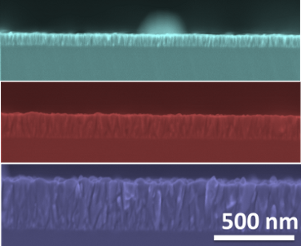
- ]. Crystallinity and stochiometry of the film determine the concentration of point defects (zinc and oxygen vacancies, interstitial zinc and oxygen) [20]. The band gap of ZnO nanostructures decreases from 3.29 to 3.23 eV with an increase of the grain size [21]. The electrical conductivity of ZnO is affected by a
- ]. According to Wang et al. [18], emission bands at 1.9–2.0 eV of ZnO ALD ultrathin films are due to doubly ionized oxygen vacancies (V(O)++) [48]. The PL spectra correlate with the absorption spectra. Absorption spectra have tails and peaks in the 3.2–1.78 eV range matching the optical transitions defect
- interstitials at 2.21–2.25 eV identified in PL spectra of oxygen-rich samples correlate well with the EDX results. Doubly ionized oxygen vacancies show up in the PL spectra of all samples at 1.9–2.0 eV pointing to the active role of surface effects in the emission spectra. An increasing thickness during the


Characterization of electroforming-free titanium dioxide memristors
Beilstein J. Nanotechnol. 2013, 4, 467–473, doi:10.3762/bjnano.4.55
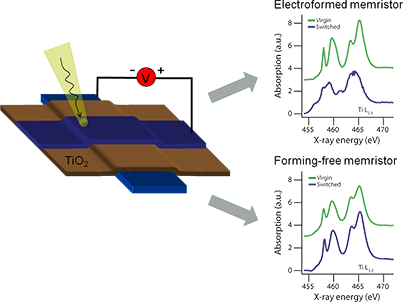
- , which can be considered an ordered array of oxygen vacancies in a TiO2 rutile phase, is a thermodynamically stable and metallic (at room temperature) Magnéli phase. In the unipolar switching mode [25], this conductive channel is created and destroyed during ON and OFF switching, respectively, and spans
- eV). While not as distinct as the heavily reduced phase found in the electroformed layer (Figure 3a, blue curve), the trend is the same, showing that indeed the as-grown film for forming-free devices contains a substantial concentration of reduced valence titanium atoms and therefore oxygen vacancies



Photoresponse from single upright-standing ZnO nanorods explored by photoconductive AFM
Beilstein J. Nanotechnol. 2013, 4, 208–217, doi:10.3762/bjnano.4.21
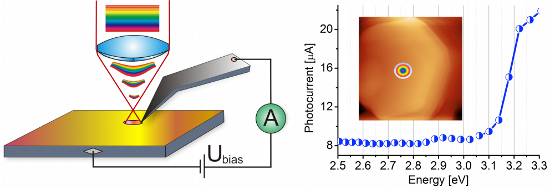
- properties is negligible. It has been shown recently that the phenomenon of persistent photoconductivity in ZnO can also be attributed to the presence of oxygen vacancies in the bulk [25]. Thus, more precise confirmation of the origin of this phenomenon is required and the characterization of single
- carriers from defect-localized states. The experimental findings are in good agreement with previous theoretical predictions based on density functional theory calculations [42] and will be discussed on the basis of the presence of oxygen vacancies. Experimental ZnO nanorods were grown by thermal
- commonly attributed to the presence of oxygen vacancies [17]. The crystalline quality can be estimated by a simple comparison of the intensities of the exciton peak and defect band. From the PL measurements we conclude that the generation of electron–hole pairs at room temperature becomes possible with a



Plasmonics-based detection of H2 and CO: discrimination between reducing gases facilitated by material control
Beilstein J. Nanotechnol. 2012, 3, 712–721, doi:10.3762/bjnano.3.81
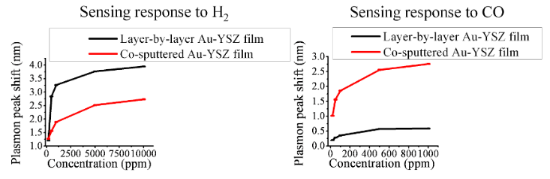
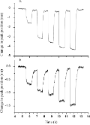
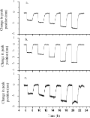
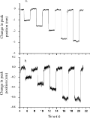
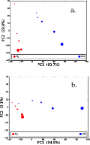
- overcoat has a crucial role in restricting the growth of the Au NPs during long-term high-temperature exposures, and its thickness has a direct impact on the number of oxygen vacancies in the film. The vacancies are introduced into the film through the yttria dopant in zirconia. YSZ is an excellent oxygen
- , and the number of oxygen vacancies that would be formed due to the yttria dopant level. Calculation of the number of oxygen vacancies per square centimeter led to the following numbers for the films: 8.16 × 10¹⁵/cm2 for the small-particle sample and the thinner gold sample, 2.04 × 10¹⁵/cm2 for the
- H2 adsorption, coupled with the smaller-diameter Au particles. Although the thinner Au sample has the same thickness of YSZ and hence essentially the same number of oxygen vacancies as the small-particle sample, the smaller Au particles in the latter case lead to an increased response. This may be





Paper modified with ZnO nanorods – antimicrobial studies
Beilstein J. Nanotechnol. 2012, 3, 684–691, doi:10.3762/bjnano.3.78
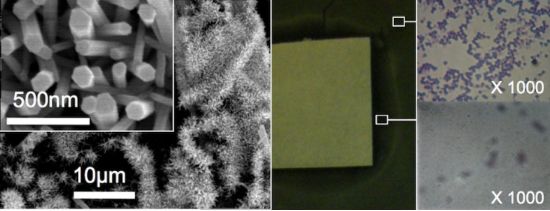
- offer large surface-to-volume ratios. Hydrothermally grown ZnO nanorods possess inherent defects in the form of oxygen vacancies and zinc interstitials, which shift its optical absorption from the ultraviolet to the visible region [20]. We previously reported the visible-light photocatalytic degradation


Functionalised zinc oxide nanowire gas sensors: Enhanced NO2 gas sensor response by chemical modification of nanowire surfaces
Beilstein J. Nanotechnol. 2012, 3, 368–377, doi:10.3762/bjnano.3.43
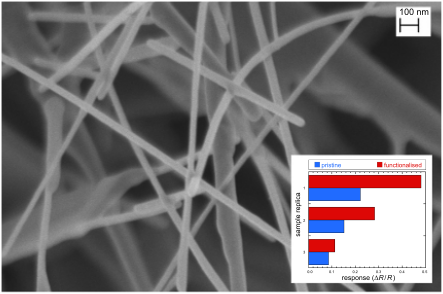
- approach to the use of organic SAMs to enhance gas response is to use them to generate extra oxygen vacancies and defects in the MOx sensor surface. This has been successfully demonstrated previously for the case of a ZnO nanobelt oxygen gas sensor, by heating the sensor to temperatures at which desorption


Ultraviolet photodetection of flexible ZnO nanowire sheets in polydimethylsiloxane polymer
Beilstein J. Nanotechnol. 2012, 3, 353–359, doi:10.3762/bjnano.3.41
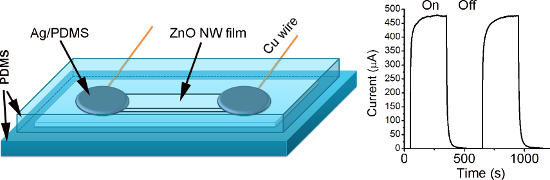
- expected. Oxygen vacancies and antisite oxygen give contributions to the green PL emission around 520 nm; zinc vacancies and interstitial oxygen contribute to the blue PL emission (450–470 nm) [17]. We made devices based on the strap-shaped nanowire sheets (width 2 mm). To make electrode contacts, silver


Investigation on structural, thermal, optical and sensing properties of meta-stable hexagonal MoO3 nanocrystals of one dimensional structure
Beilstein J. Nanotechnol. 2011, 2, 585–592, doi:10.3762/bjnano.2.62
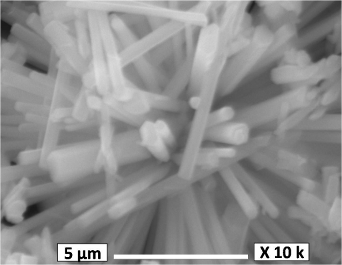
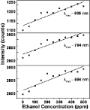
- counts/ppm for λmax = 684, 764 and 935 nm, respectively. From the plot, the maximum sensitivity is seen for λmax = 684 nm. Here, it is proposed that the gas sensing mechanism follows the changes in the refractive index and evanescent wave absorption. For h-MoO3, the oxygen vacancies and interstitial


Defects in oxide surfaces studied by atomic force and scanning tunneling microscopy
Beilstein J. Nanotechnol. 2011, 2, 1–14, doi:10.3762/bjnano.2.1
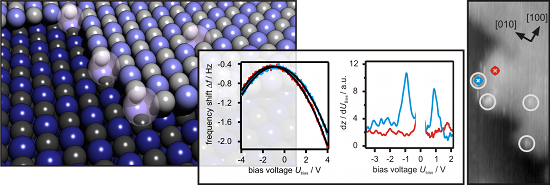
- single point defects or single adsorbates, instead of integrating over a square millimeter range. However, absolute values of the work function cannot be measured directly, only work function differences. Point defects Oxygen vacancies, also known as color centers, are electron trapping point defects and


Enhanced visible light photocatalysis through fast crystallization of zinc oxide nanorods
Beilstein J. Nanotechnol. 2010, 1, 14–20, doi:10.3762/bjnano.1.3
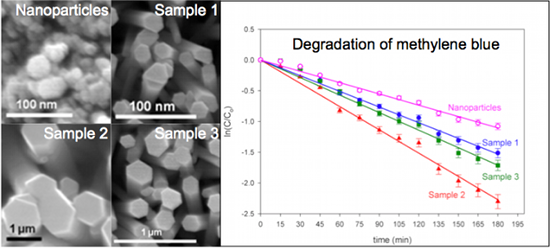
- Abstract Hydrothermally grown ZnO nanorods have inherent crystalline defects primarily due to oxygen vacancies that enhance optical absorption in the visible spectrum, opening up possibilities for visible light photocatalysis. Comparison of photocatalytic activity of ZnO nanorods and nanoparticle films on