Search results
Search for "photocurrent" in Full Text gives 110 result(s) in Beilstein Journal of Nanotechnology.
Photoresponse from single upright-standing ZnO nanorods explored by photoconductive AFM
Beilstein J. Nanotechnol. 2013, 4, 208–217, doi:10.3762/bjnano.4.21
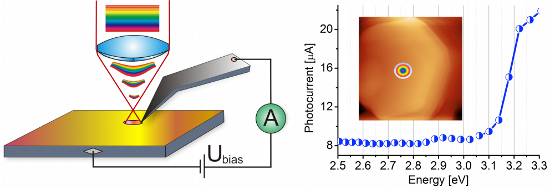
- properties. Here, photoconductive atomic force microscopy (PC-AFM) has been applied to investigate transient photoconductivity and photocurrent spectra of upright-standing ZnO nanorods (NRs). With a view to evaluate the electronic properties of the NRs and to get information on recombination kinetics, we
- have also performed time-resolved photoluminescence measurements macroscopically. Results: Persistent photoconductivity from single ZnO NRs was observed for about 1800 s and was studied with the help of photocurrent spectroscopy, which was recorded locally. The photocurrent spectra recorded from single
- ZnO NRs revealed that the minimum photon energy sufficient for photocurrent excitation is 3.1 eV. This value is at least 100 meV lower than the band-gap energy determined from the photoluminescence experiments. Conclusion: The obtained results suggest that the photoresponse in ZnO NRs under ambient



Functionalization of vertically aligned carbon nanotubes
Beilstein J. Nanotechnol. 2013, 4, 129–152, doi:10.3762/bjnano.4.14
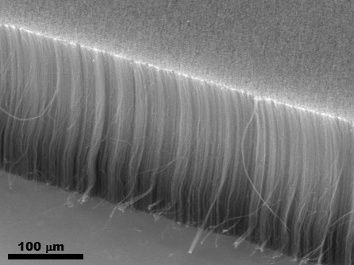
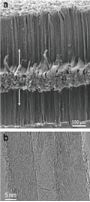
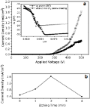
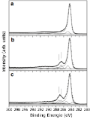
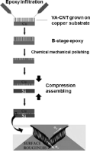
- et al. [120] carried electrophoretic coating of VA-CNTs with TiO2 NPs in order to create coaxial nanowires. In parallel, they synthesized aligned TiO2 nanotubes and nanomembranes, using the VA-CNT film as a template. All these products have novel photocurrent and photoinduced properties. More








Reduced electron recombination of dye-sensitized solar cells based on TiO2 spheres consisting of ultrathin nanosheets with [001] facet exposed
Beilstein J. Nanotechnol. 2012, 3, 378–387, doi:10.3762/bjnano.3.44
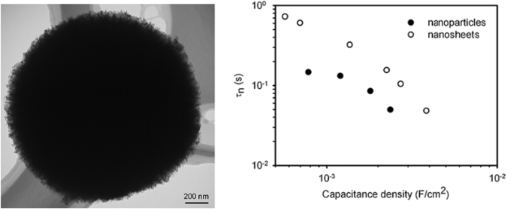
- ), respectively. Transmission electron microscopy (TEM, Philips CM 200) was used to monitor the detailed structure of the TiO2 powder. The thickness of the TiO2 films for the DSCs was determined by a profilometer (Dektak 150). The photocurrent density–voltage (J–V) characteristics of the DSCs were obtained by
- -transfer and charge-transport process in DSCs can be measured by small-perturbation-based transient methods, such as electrochemical impedance spectroscopy (EIS) or intensity modulated photocurrent spectroscopy (IMPS) and intensity modulated photovoltage spectroscopy (IMVS) [13][15]. Compared to IMPS and


Structural, electronic and photovoltaic characterization of multiwalled carbon nanotubes grown directly on stainless steel
Beilstein J. Nanotechnol. 2012, 3, 360–367, doi:10.3762/bjnano.3.42
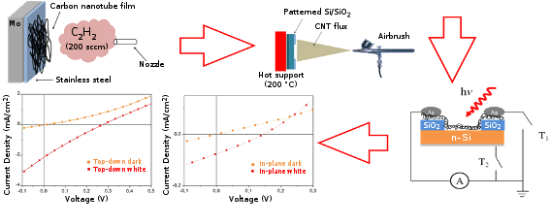
- highly oriented pyrolytic graphite (HOPG). Notably, a broadening of the π-plasmon peak in the case of MWCNTs is evident. In addition, a photocurrent was measured when MWCNTs were airbrushed onto a silicon substrate. External quantum efficiency (EQE) and photocurrent values were reported both in planar
- and in top-down geometry of the device. Marked differences in the line shapes and intensities were found for the two configurations, suggesting that two different mechanisms of photocurrent generation and charge collection are in operation. From this comparison, we are able to conclude that the
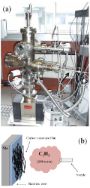
- geometry gives a photocurrent intensity and an external quantum efficiency (EQE) value much higher than those measured in the in-plane configuration. Results and Discussion In Figure 1 the chemical vapour deposition chamber used to grow the CNTs is displayed. The stainless-steel substrate is mounted on a


Ultraviolet photodetection of flexible ZnO nanowire sheets in polydimethylsiloxane polymer
Beilstein J. Nanotechnol. 2012, 3, 353–359, doi:10.3762/bjnano.3.41
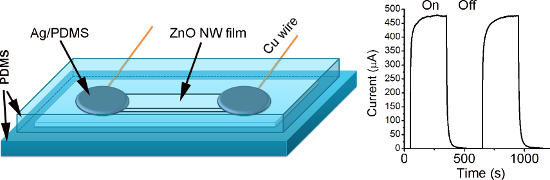
- device with Ag electrodes. Previously, we studied the UV photoconduction of ZnO nanowire films with different PL properties, i.e., defect contents. The UV photocurrent of those ZnO nanowire films (2 mm wide and 10 mm long) with vacuum deposited Ag electrodes was in the range of 13–90 μA at 8 V when
- measured in air [10]. In this work, the UV photocurrent of the device with Ag paste electrodes, embedded in PDMS, exceeds 400 μA at 8 V. Even at a reverse bias of −8 V, the current is 160 μA, much higher than that of the device without PDMS. In the dark, the current values of the device in PDMS are 110 nA
- nanowire film can be enhanced by PDMS coating. The responsivity of the device, defined as the photocurrent per unit of incident optical power, is determined by the UV photoconductivity of the ZnO nanowires. From the I–V curves we can deduce that the PDMS coating over ZnO nanowires results in an


Junction formation of Cu3BiS3 investigated by Kelvin probe force microscopy and surface photovoltage measurements
Beilstein J. Nanotechnol. 2012, 3, 277–284, doi:10.3762/bjnano.3.31
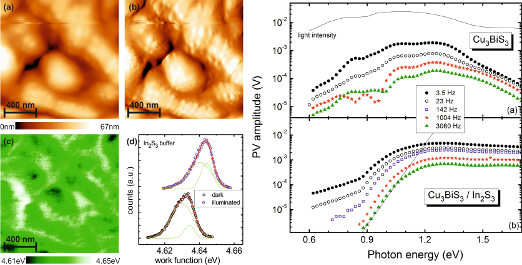
- frequency. For the Cu3BiS3 sample signatures of the three relatively broad, deep defect levels were observed at all frequencies. We remark that dips in the amplitude spectra could appear, for example, when the sign of SPV signals changed. For better interpretation a correlation of SPV with photocurrent


Self-assembled monolayers and titanium dioxide: From surface patterning to potential applications
Beilstein J. Nanotechnol. 2011, 2, 845–861, doi:10.3762/bjnano.2.94
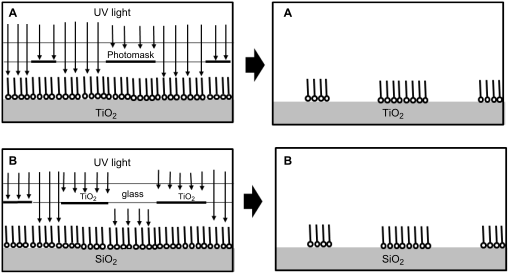
- of a modified C60 [87]. An agreement between the measured photocurrent action spectrum and the absorption spectrum of the modified fullerene served as an indication that the photoactive species was the modified fullerene. A photon-to-current conversion efficiency as high as 15% was measured
- force may compensate to some extent for the lack of chemical bonding between the quantum dots and the terminating groups of the monolayer, thus, enabling the high photocurrent response measured for this system. Another study on charge transport between SAMs and TiO2 was based on a mixed-monolayer



Highly efficient ZnO/Au Schottky barrier dye-sensitized solar cells: Role of gold nanoparticles on the charge-transfer process
Beilstein J. Nanotechnol. 2011, 2, 681–690, doi:10.3762/bjnano.2.73
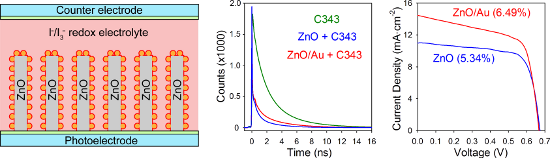
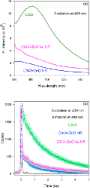
- barrier at the ZnO/Au interface and not due to the faster electron injection from dye to ZnO. The effect of Au nanoparticles on the generation of photocurrent in the ZnO/Au-nanocomposite-based DSSC was studied for small- (0.1 cm2) as well as large-area (1 cm2) solar cells and the results are compared to
- sensitizer dye molecules, the photoexcited electrons in the Au nanoparticles are transferred to the conduction band (CB) of ZnO, and then diffuse through the ZnO nanorods towards the conducting fluorine-doped tin oxide (FTO) substrate resulting in higher photocurrent and photovoltage, as observed. The
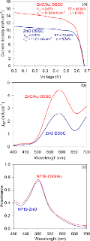
- illumination; the results are shown in Table 2. In Figure 3a, the best J–V characteristics obtained for both bare ZnO-nanorod and ZnO/Au-nanocomposite DSSCs are shown. It was found that the photocurrent of the ZnO-nanorod DSSC improved upon the incorporation of Au nanoparticles in the ZnO-nanorod



Simple theoretical analysis of the photoemission from quantum confined effective mass superlattices of optoelectronic materials
Beilstein J. Nanotechnol. 2011, 2, 339–362, doi:10.3762/bjnano.2.40
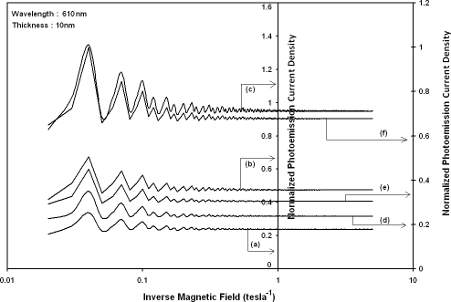
- photo-emitted current density from the said SLs as a function of normalized electron degeneracy, normalized intensity, wavelength and thickness, respectively, for all the cases of Figure 1. Using Equation 15 and Equation 16, the normalized photocurrent from QWW effective mass HgTe/Hg1−xCdxTe SL, whose
- normalized photoemission from QWW effective mass HgTe/Hg1−xCdxTe and InxGa1−xAs/InP SLs decreases with increasing thickness and exhibits large oscillations. From Figure 7, it appears that the normalized photocurrent for the said system increases with increasing carrier concentration, exhibiting a quantum
- jump for a particular value of the said variable, for all the models of both the SLs. From Figure 8 and Figure 9, it can be inferred that the normalized photocurrent in this case increases with decreasing intensity and wavelength in different manners. From Figure 10, it has been observed that the


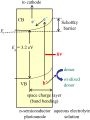
Schottky junction/ohmic contact behavior of a nanoporous TiO2 thin film photoanode in contact with redox electrolyte solutions
Beilstein J. Nanotechnol. 2011, 2, 127–134, doi:10.3762/bjnano.2.15
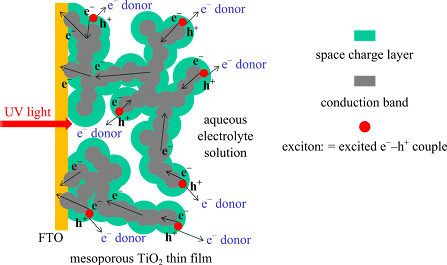
- redox waves in the dark due to the [Fe(CN)6]4−/3− couple. Further studies showed that multiple Schottky junctions/ohmic contact behavior inducing simultaneously both photocurrent and overlapped reversible redox waves was found in the CV of a nanoporous TiO2 photoanode soaked in an aqueous redox
- electrolyte solution containing methanol and [Fe(CN)6]4−. That is, the TiO2 nanosurface responds to [Fe(CN)6]4− to give ohmic redox waves overlapped simultaneously with photocurrents due to the Schottky junction. Additionally, a second step photocurrent generation was observed in the presence of both MeOH and
- potential; nanoporous TiO2 thin film; photocurrent; Schottky junction and ohmic contact; Introduction Photoelectrocatalytic reactions at semiconductor electrodes were investigated before the 1960s [1][2]. A semiconductor electrode forms a type of Schottky junction with liquid electrolytes called a liquid