


Search results
Search for "slip" in Full Text gives 103 result(s) in Beilstein Journal of Nanotechnology.
Biomimetics inspired surfaces for drag reduction and oleophobicity/philicity
Beilstein J. Nanotechnol. 2011, 2, 66–84, doi:10.3762/bjnano.2.9
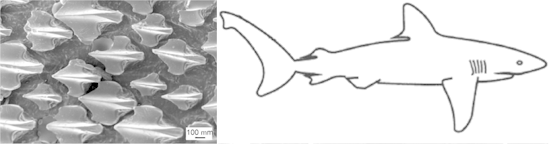
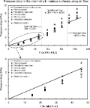
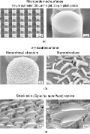
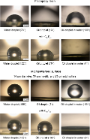
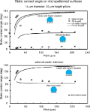
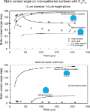
- inspired by the lotus leaf and shark skin and studied the influence of structure on pressure drop and fluid drag. One of the basic properties of interest in fluid flow is slip. The relative velocity between a solid wall and liquid is believed to be zero at the solid–liquid interface, which is the so called
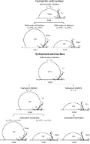
- no-slip boundary condition (Figure 2, left) [25][26]. However, for hydrophobic surfaces, fluid film exhibits a phenomenon known as slip, which means that the fluid velocity near the solid surface is not equal to the velocity of the solid surface (Figure 2, right) [27][28][29][30][31][32][33]. The
- degree of boundary slip at the solid–liquid interface is characterized by a slip length. The slip length b is defined as the length of the vertical intercept along the axis orthogonal to the interface when a tangent line is drawn along the velocity profile at the interface (Figure 2, right). Recent








The description of friction of silicon MEMS with surface roughness: virtues and limitations of a stochastic Prandtl–Tomlinson model and the simulation of vibration-induced friction reduction
Beilstein J. Nanotechnol. 2010, 1, 163–171, doi:10.3762/bjnano.1.20
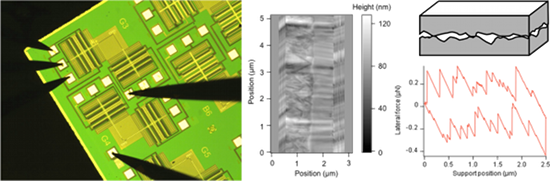
- with individual atoms or a small part of a crystal lattice on the Ångstrom scale. It was found that regular, repeatable stick-slip behaviour of a contacting highest point (asperity) over the lattice of the other surface forms the very basis of the frictional processes as previously described [2][3]. To
- physically describe the stick-slip behaviour observed, the theories of Prandtl [4] and Tomlinson [5] were used [6][7]. This Prandtl–Tomlinson model has proven to be remarkably effective in describing atomic-scale friction. Further research on atomic-scale friction has resulted in a wealth of information on
- and wear problems [12]. The question is now how to describe friction on the larger scale of actual MEMS devices, which pair micrometer features and nanometer-scale surface roughness with nano- to micro-Newton forces. This friction is characterized by irregular, but repeatable, stick-slip motion. Can


Scanning probe microscopy and related methods
Beilstein J. Nanotechnol. 2010, 1, 155–157, doi:10.3762/bjnano.1.18

- studied in great detail, where the main mechanism is related to atomic instabilities, which lead to the characteristic stick slip behaviour. The loading and velocitiy dependence were interpreted in terms of a thermally activated Prandtl–Tomlinson-model [5][6]. The transition into the superlubricity regime

Other Beilstein-Institut Open Science Activities



