


Search results
Search for "swelling" in Full Text gives 103 result(s) in Beilstein Journal of Nanotechnology.
Dynamics of capillary infiltration of liquids into a highly aligned multi-walled carbon nanotube film
Beilstein J. Nanotechnol. 2011, 2, 311–317, doi:10.3762/bjnano.2.36
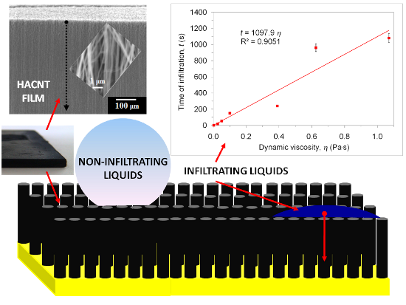
- specify the Hildebrand solubility parameter (δ) as crucial towards convenient three-modal classification: dispersion, swelling or precipitation [15][16][17][18]. For evaluation of wettability of HACNT arrays, an approach based on the direct measurement of contact angle between interfaces of nanotube film


Single-pass Kelvin force microscopy and dC/dZ measurements in the intermittent contact: applications to polymer materials
Beilstein J. Nanotechnol. 2011, 2, 15–27, doi:10.3762/bjnano.2.2
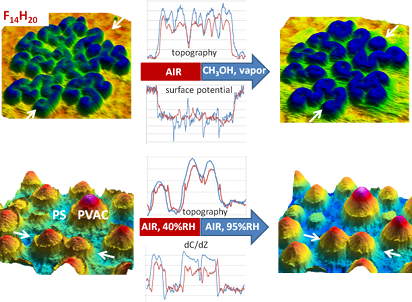
- selective swelling of components. Keywords: atomic force microscopy; fluoroalkanes; Kelvin force microscopy; surface potential; Introduction Atomic force microscopy (AFM) applications include high-resolution imaging, probing of local materials properties and compositional mapping of heterogeneous
- compositional mapping of organic materials and polymers. In the intermittent contact operation, proximity of the conducting probe to a sample helps in avoiding screening the sample’s electrical response by a water layer when measurements are performed at high humidity. A selective swelling of individual
- topography and surface potential changes of a thin PMMA film, Figure 7B. The study of swelling of PMMA film by different organic vapors [22] showed that methanol has a strong effect as shown by AFM. Indeed, swelling of PMMA with methanol induced changes not only in topography but also in surface potential





Sensing surface PEGylation with microcantilevers
Beilstein J. Nanotechnol. 2010, 1, 3–13, doi:10.3762/bjnano.1.2
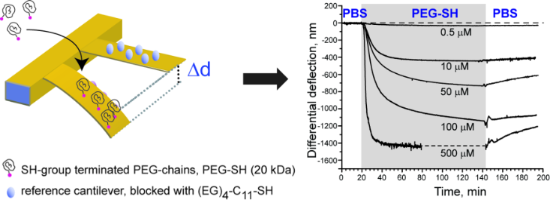
- authors to study the in situ swelling and collapse of poly(methyl methacrylate) brushes, the kinetics of brush formation could not be monitored in real-time. The driving impetus behind this work is to apply microcantilever sensors operated in static mode to study in real-time (1) the kinetic aspects of
- chains into their swelling state. Discussion We have studied the behavior of 20 kDa mPEG–SH “grafted to” Au surfaces using a microcantilever array-based sensor. Consistent with XPS [8], ellipsometry [8][34], QCM [35] and AFM [36] polymer “grafting to” studies, we find that the adsorption profile of mPEG
- -swelling) is described by a reproducible tensile surface stress change with a deflection of ~110–150 nm which equates into a generated stress of ~35–45 mN/m. These results were reproducible with respect to both in situ and external references, as well as surfaces consisting of either bare Au or a Au



Other Beilstein-Institut Open Science Activities



