


Search results
Search for "ultrasonication" in Full Text gives 108 result(s) in Beilstein Journal of Nanotechnology.
Selective surface modification of lithographic silicon oxide nanostructures by organofunctional silanes
Beilstein J. Nanotechnol. 2013, 4, 218–226, doi:10.3762/bjnano.4.22
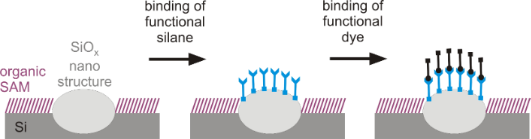
- ) substrates with a self-assembled monolayer (SAM) of 1-dodecene molecules as a surface coating. The monolayer preparation was carried out in three steps: cleaning, native-oxide removal, and monolayer formation (radical chain reaction); see also [25][44]. The substrates have been cleaned by ultrasonication in


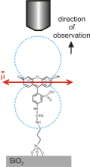
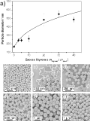
![[Graphic 2]](/bjnano/content/inline/2190-4286-4-22-i2.png?max-width=637&scale=1.18182) (red arrow) of FITC bound to a SiO2 surface.
(red arrow) of FITC bound to a SiO2 surface.
Nanoparticles of novel organotin(IV) complexes bearing phosphoric triamide ligands
Beilstein J. Nanotechnol. 2013, 4, 94–102, doi:10.3762/bjnano.4.11
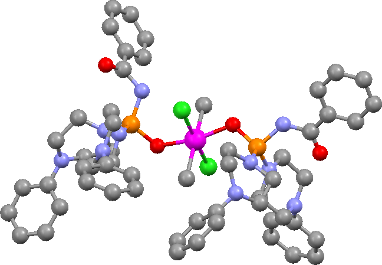
- octahedral configurations. The nanoparticles of the complexes were also prepared by ultrasonication, and their SEM micrographs indicated identical spherical morphologies with particles sizes about 20–25 nm. The fluorescence spectra exhibited blue shifts for the maximum wavelength of emission upon
- homogenous nanomaterials. Some investigations have proved that ultrasonication can be applied to prepare nanosized coordination compounds [26][27][28][29]. The synthesis of nanoplates of a cadmium(II) coordination polymer by a sonochemical process was reported [30]. It is notable that, as far as we know
- their related phosphoric triamide ligands 5, 6. The spherical nanoparticles of complexes 1–4 were obtained by ultrasonication with particle sizes of about 20–25 nm. Results and Discussion Spectroscopic study In this work, new organotin(IV) complexes 1–4 were synthesized from the reaction of SnClR3 with




Synthesis and electrical characterization of intrinsic and in situ doped Si nanowires using a novel precursor
Beilstein J. Nanotechnol. 2012, 3, 564–569, doi:10.3762/bjnano.3.65
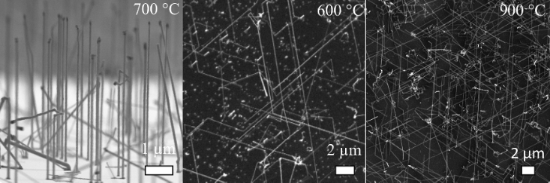
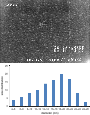
- . VLS-grown Si-NWs were then removed from their growth substrates by ultrasonication in propan-2-ol. Subsequently the NWs were randomly distributed by dropping the suspension onto the above mentioned Si(100) wafer with prepatterned Au pads. Finally the NWs were connected to the prepatterned Au pads by


Forming nanoparticles of water-soluble ionic molecules and embedding them into polymer and glass substrates
Beilstein J. Nanotechnol. 2012, 3, 267–276, doi:10.3762/bjnano.3.30
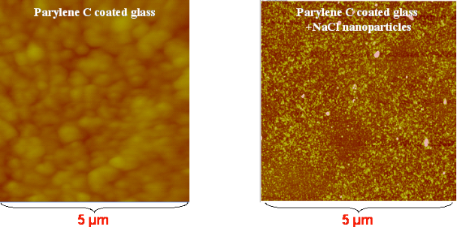
- temperature. The sonochemical treatment was carried out in the presence of glass/parylene-coated glass by immersion of the high-intensity Ti horn (20 kHz, 750 W) into the reaction vessel (Figure 1). The reaction time varied from 15 min to 90 min. The efficiency of the ultrasonication was in the range of 23–30




Surface functionalization of aluminosilicate nanotubes with organic molecules
Beilstein J. Nanotechnol. 2012, 3, 82–100, doi:10.3762/bjnano.3.10
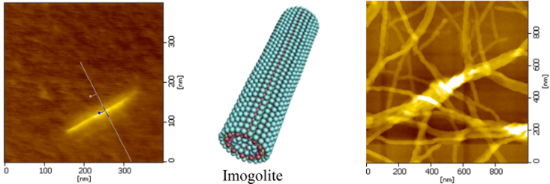
- be separated from imogolite by purification as described in the literature [31]. In the typical purification procedure, the imogolite mineral collected from Kitakami, Iwate, Japan is suspended in water by ultrasonication. Occluded organic contaminants are removed by treating the mineral with hot 1.8


Platinum nanoparticles from size adjusted functional colloidal particles generated by a seeded emulsion polymerization process
Beilstein J. Nanotechnol. 2011, 2, 459–472, doi:10.3762/bjnano.2.50
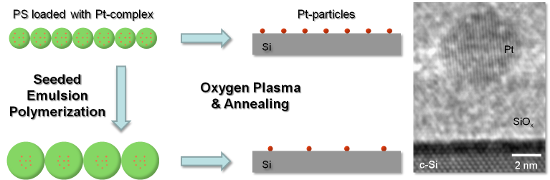
- nanoparticles [17][18][19][20]. Here, the monomer droplets are preformed by ultrasonication and critically stabilized against coagulation by the addition of surfactants. Ostwald ripening, the mechanism that leads to formation of bigger particles at the expense of smaller ones due to the higher Laplace pressure
- . To this phase, a mixture of water (milliQ quality) and SDS (60 mg) was added. After stirring for one hour at 1800 rpm and at room temperature, miniemulsification was achieved by ultrasonication of the mixture under ice-cooling for 120 s with a 1/2” tip at 90% amplitude, following a 10 s pulse-10 s



Dynamics of capillary infiltration of liquids into a highly aligned multi-walled carbon nanotube film
Beilstein J. Nanotechnol. 2011, 2, 311–317, doi:10.3762/bjnano.2.36
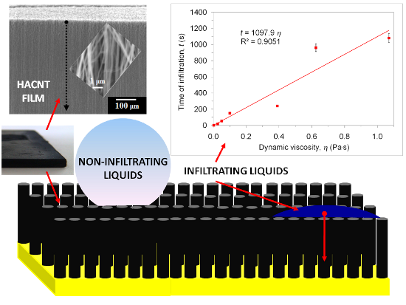
- , either in the stage of synthesis [9], or in a stage of separation of nanotube bundles, e.g., in a prolonged and vigorous ultrasonication (with frequent nanotube cutting as an accompanying process) [10], or (2) via chemical modification of the nanotube surface [11]. A simple chemical treatment of CNTs can


Electrochemical behavior of dye-linked L-proline dehydrogenase on glassy carbon electrodes modified by multi-walled carbon nanotubes
Beilstein J. Nanotechnol. 2010, 1, 135–141, doi:10.3762/bjnano.1.16
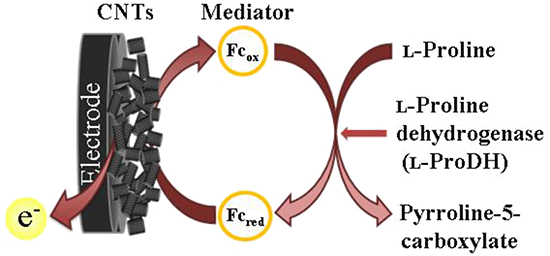
- long-time ultrasonication (30 min) used. Electrochemical behavior of L-proDH on MWCNTs–modified GC electrode The electrochemical properties of GC/MWCNTs were first investigated by cyclic voltammetry with K3Fe(CN)6 as the probe. Typical reversible cyclic voltammograms were observed for both the bare and
- electrode, a platinum wire as the counter electrode and Ag/AgCl (3 M NaCl) as the reference electrode. The GC electrodes were finely polished by 1.0 μm and 0.05 μm alumina, and cleaned by ultrasonication in Milli-Q water for 30 s before modification. Enzyme assay Recombinant dye-linked L-proDH, from
- calculated to be 1.8 units mg−1. Preparation of MWCNTs and L-proDH modified electrodes A MWCNTs solution was prepared by dispersing 1.0 mg of MWCNTs in 1.0 mL ethanol followed by ultrasonication for 30 min. A 10 μL aliquot of the MWCNTs dispersion solution was dropped onto the top of the pre-treated GC


Other Beilstein-Institut Open Science Activities



