


Search results
Search for "vesicles" in Full Text gives 104 result(s) in Beilstein Journal of Nanotechnology.
Nanoscopic surfactant behavior of the porin MspA in aqueous media
Beilstein J. Nanotechnol. 2013, 4, 278–284, doi:10.3762/bjnano.4.30
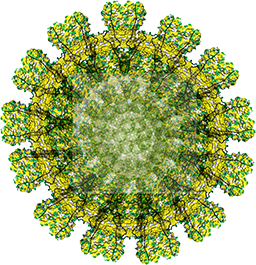
- Abstract The mycobacterial porin MspA is one of the most stable channel proteins known to date. MspA forms vesicles at low concentrations in aqueous buffers. Evidence from dynamic light scattering, transmission electron microscopy and zeta-potential measurements by electrophoretic light scattering indicate
- in aqueous phase. Engelhardt et al. have established by using high-resolution TEM that MspA forms micelles and linear aggregates on surfaces showing a zipper-like pattern in the absence of surfactants, and that MspA is able to reconstitute in dimyristoyl phosphatidylcholine (DMPC) vesicles in the
- behavior of MspA in aqueous buffers, further expanding the pioneering work of Engelhardt et al. In 1× PBS (phosphate-buffered saline), MspA is capable of forming vesicles in the absence of added surfactant. Owing to the great thermal stability of MspA [3], we were able to study the influence of ionic




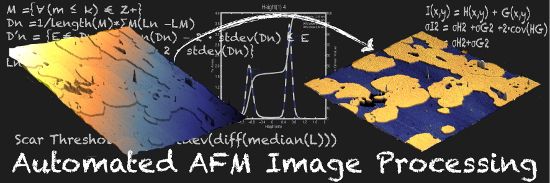
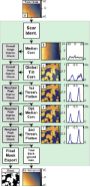
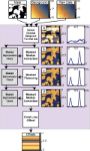
Large-scale analysis of high-speed atomic force microscopy data sets using adaptive image processing
Beilstein J. Nanotechnol. 2012, 3, 747–758, doi:10.3762/bjnano.3.84
- mass of lipid into glass vials and dissolved with chloroform. The chloroform was evaporated off with dry nitrogen gas, leaving a thin film on the glass vial. The film was hydrated with Milli-Q water (Millipore, Billerica, MA, USA), generating large multilaminar vesicles (LMVs). The LMVs were then
- sonicated with a probe sonicator (BioLogics Inc, Manassas, VA, USA) to generate small unilaminar vesicles (SUVs). The SUVs were centrifuged to remove metal particles left from the probe sonicator. A 35 µL amount of the lipid preparation was warmed to 37 °C and deposited onto freshly cleaved mica surfaces




Microfluidic anodization of aluminum films for the fabrication of nanoporous lipid bilayer support structures
Beilstein J. Nanotechnol. 2011, 2, 104–109, doi:10.3762/bjnano.2.12
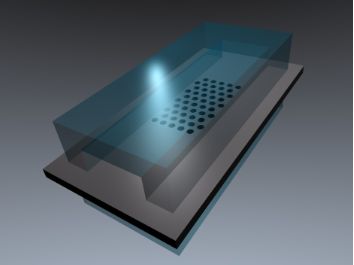
- . First, 5 mL of a lipid chloroform solution (5 mg/mL) were vacuum dried in a glass vessel. Then, a phosphate buffered saline (5 mL, 0.9% NaCl, 100 mM phosphate buffer, pH 7.2) was added to form multilamelar vesicles. Sonication and extrusion (Avanti Polar Lipids, U.S.A.) were performed to produce
- unilamellar small vesicles of approximate sizes between 60 and 80 nm as determined by dynamic light scattering (Dynapro, Wyatt Technology Corporation, U.S.A.). The vesicle solution was then injected into the microfluidic channel for the synthesis of the lipid bilayer on the modified alumina membrane. The
- impedance obtained before and after application of lipid vesicles to the front side of the silanized nanoporous membrane. The impedance measured at 10 Hz across the membrane increased by more than five orders of magnitude after vesicle application. We attribute this effect to the formation of a lipid


Review and outlook: from single nanoparticles to self-assembled monolayers and granular GMR sensors
Beilstein J. Nanotechnol. 2010, 1, 75–93, doi:10.3762/bjnano.1.10
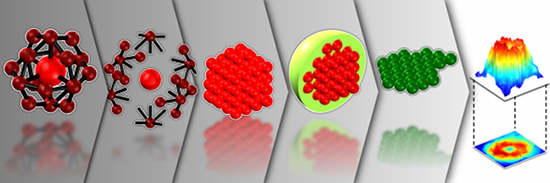
- understood. Recent studies indicate specific genes and proteins play a major role [22]. As shown in Figure 5, the growth dynamic is believed to be a multistep process [22][23]: Invagination of cytoplasmic membrane: The cytoplasmic membrane invaginates for vesicle formation. These vesicles later serve as
- within the vesicles is controlled by an oxidation–reduction system. Nucleation: Several proteins are believed to regulate the morphology. Mms5, Mms6, Mms7 and Mm13 are tightly bound to the magnetic nanoparticle. All these proteins are amphiphilic. Their N-terminal is hydrophilic while their C-terminal is




Other Beilstein-Institut Open Science Activities



