


Search results
Search for "wear" in Full Text gives 109 result(s) in Beilstein Journal of Nanotechnology.
Combining nanoscale manipulation with macroscale relocation of single quantum dots
Beilstein J. Nanotechnol. 2012, 3, 324–328, doi:10.3762/bjnano.3.36
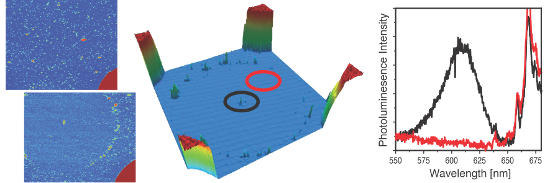
- , we can ascertain the minimum amount of surface–tip contact force required for the manipulation to take place; reducing tip wear and image degradation. Tip state also plays an important role in the manipulation process, and the automatic characterisation and optimization of the AFM tip apex would be


Direct-write polymer nanolithography in ultra-high vacuum
Beilstein J. Nanotechnol. 2012, 3, 52–56, doi:10.3762/bjnano.3.6
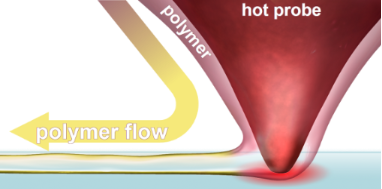
- silicon tip. Note that recent advances – where the tips remain sharp due to a coating of wear-resistant diamond – readily show line thicknesses of 40 nm [17]. The line width and heights were measured as a function of the probe speed (Figure 3). The heights of the deposited polymer structures roughly


Self-assembled monolayers and titanium dioxide: From surface patterning to potential applications
Beilstein J. Nanotechnol. 2011, 2, 845–861, doi:10.3762/bjnano.2.94



Self-assembly at solid surfaces
Beilstein J. Nanotechnol. 2011, 2, 824–825, doi:10.3762/bjnano.2.91

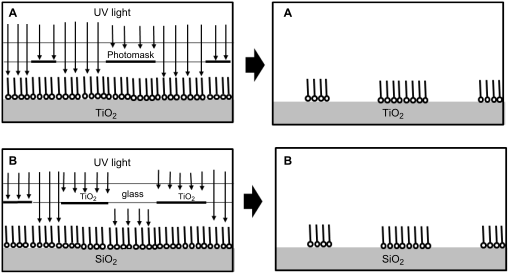
- examination, prevention of spreading of liquids, friction and wear reduction, and surface passivation and protection. Whereas the early study of such monolayers indeed attracted considerable attention over the years, perhaps their greatest impact was yet to come, in new directions of research that could not
Formation of SiC nanoparticles in an atmospheric microwave plasma
Beilstein J. Nanotechnol. 2011, 2, 665–673, doi:10.3762/bjnano.2.71
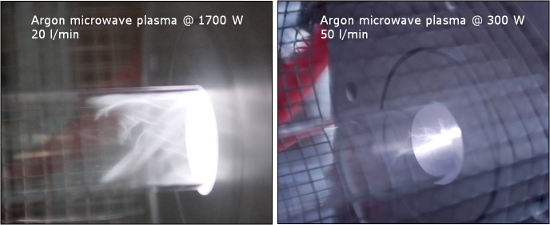
- size is mainly influenced by the concentration of the precursor material in the plasma. Keywords: atmospheric microwave plasma; nanoparticle; SiC; Introduction Silicon Carbide (SiC) is a solid with various applications in materials science. It is used, e.g., as a wear-resistant material, as a



Manipulation of gold colloidal nanoparticles with atomic force microscopy in dynamic mode: influence of particle–substrate chemistry and morphology, and of operating conditions
Beilstein J. Nanotechnol. 2011, 2, 85–98, doi:10.3762/bjnano.2.10
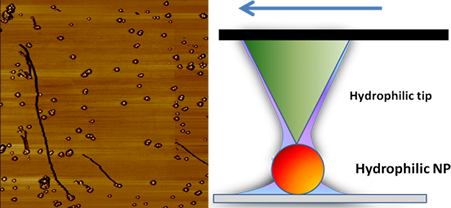
- different types of particle motion during manipulation, such as sliding, rolling, stick-slip and spinning, is crucial since the mode of motion of particles determines the energy loss and wear in the contacting surfaces. In this paper, the sensitivity of those critical parameters on the mobility of gold


Review of "Contact Mechanics and Friction: Physical Principles and Applications" by Valentin L. Popov
Beilstein J. Nanotechnol. 2011, 2, 57–58, doi:10.3762/bjnano.2.7
- ) nanomachines: micro and nano-actuators, (8) frictionally induced vibrations, (9) thermal effects in contacts, (10) lubricated systems, (11) viscoelastic properties and friction of elastomers, (12) wear. The book is an excellent example of interdisciplinary science because it uses approaches from physics
The description of friction of silicon MEMS with surface roughness: virtues and limitations of a stochastic Prandtl–Tomlinson model and the simulation of vibration-induced friction reduction
Beilstein J. Nanotechnol. 2010, 1, 163–171, doi:10.3762/bjnano.1.20
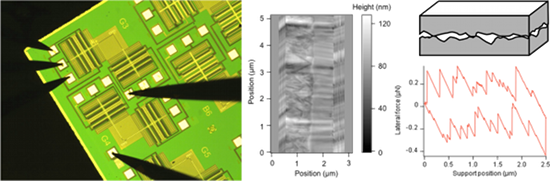
- and wear problems [12]. The question is now how to describe friction on the larger scale of actual MEMS devices, which pair micrometer features and nanometer-scale surface roughness with nano- to micro-Newton forces. This friction is characterized by irregular, but repeatable, stick-slip motion. Can
- surface asperities [26]. The static shear strength itself is determined by OH-bridging forces between the surfaces, direct chemical Si–O–Si bonds between the surfaces (the rupturing of these bonds leads to wear of the surfaces in the long run), and/or possibly liquid water meniscus strain or even gluing
- an average over 1000 scans. The fact that the slips appear sharp means that there was no significant change to their position over these 1000 scans and hence no surface changes (which would indicate wear). [Reprinted with permission from van Spengen, W. M.; Frenken, J. W. M. Tribol. Lett. 2007, 28


Scanning probe microscopy and related methods
Beilstein J. Nanotechnol. 2010, 1, 155–157, doi:10.3762/bjnano.1.18
- gives insight into fascinating phenomena, such as metal-superconductor transitions or metal-insulator transitions. Another important development is related to nanomechanics, where phenomena, such as friction, wear, elasticity and plasticity are studied on an atomic scale. Atomic friction has been
- information about the local bonding and to explore friction and wear mechanisms. Two different regimes were observed, which were related to the commensurability of the contacts [9]. The manipulation of a large number of particles gives also access to the size and shapes of the particles [10] and is discussed

Other Beilstein-Institut Open Science Activities



