


Search results
Search for "adsorbate" in Full Text gives 133 result(s) in Beilstein Journal of Nanotechnology.
Femtosecond time-resolved photodissociation dynamics of methyl halide molecules on ultrathin gold films
Beilstein J. Nanotechnol. 2011, 2, 618–627, doi:10.3762/bjnano.2.65
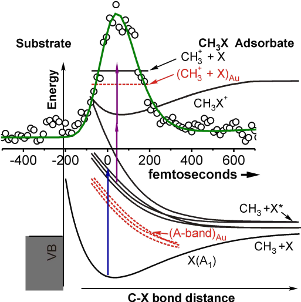
- the investigations of the photodissociation dynamics are presented for the three molecular-adsorbate systems investigated. The characterization of the ultrathin gold films on Mo(100) that have been employed as a substrate in the present study is detailed in Supporting Information File 1. Adsorption of
- observed for CH3I [10][18] and CH3Br [12] on MgO, CH3Br on LiF [19], and CH3Cl on Pd(100) [20], as well as for CH3Cl, CH3Br and CH3I on GaAs(110) [21][22], and the coverage dependence is attributed to the adsorbate–adsorbate repulsion that results from the interaction between the static dipole moments of
- adsorbed molecules. Due to this lateral repulsion between the adsorbate molecules, the activation energy for desorption decreases with increasing coverage and, hence, the desorption temperature decreases. The completion of the first monolayer of CD3I molecules appears for doses just below 4.75 L, in


Nanostructured, mesoporous Au/TiO2 model catalysts – structure, stability and catalytic properties
Beilstein J. Nanotechnol. 2011, 2, 593–606, doi:10.3762/bjnano.2.63
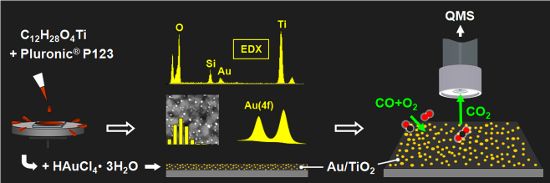
- the site-blocking adsorbate, however, is not clear from these experiments. It is likely that, similar to previous findings based on combined in situ IR and reaction measurements on dispersed Au/TiO2 catalysts [23], surface carbonates are mainly responsible for the deactivation [24][38][45][46






Inorganic–organic hybrid materials through post-synthesis modification: Impact of the treatment with azides on the mesopore structure
Beilstein J. Nanotechnol. 2011, 2, 486–498, doi:10.3762/bjnano.2.52
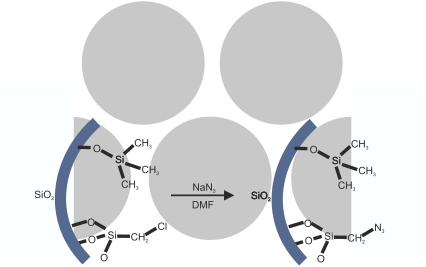
- methyl-spacer samples and in the range of 270 cm3 g−1 for propyl-spacer samples (Table 1). The decreasing C-value, indicative of the adsorbent–adsorbate interactions, for gels prepared from a silica-precursor solution containing 3.0–6.0 mmol CMTMS follows the trend expected for gels with increasing


Towards a scalable and accurate quantum approach for describing vibrations of molecule–metal interfaces
Beilstein J. Nanotechnol. 2011, 2, 427–447, doi:10.3762/bjnano.2.48
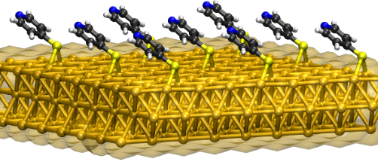
- adsorbate frequencies from first principles. We give a detailed account of our local implementation of the vibrational self-consistent field approach and its correlation corrections. We show that our approach is both robust, accurate and can be easily deployed on computational grids in order to provide an
- corresponding oscillation frequencies of this set of atoms are usually known as group frequencies and are characteristic of a particular structural motif. In heterogeneous catalysis, for example, the shift of the adsorbate vibrational frequencies allows us to follow the progress of surface reactions and
- provides important information on the bond strength and location of the adsorbate. A typical example is carbon monoxide, which can be used as a surface probe, as the C=O stretch frequency is very sensitive to the adsorption site of the molecule. This property was identified very early on, and was used by


Septipyridines as conformationally controlled substitutes for inaccessible bis(terpyridine)-derived oligopyridines in two-dimensional self-assembly
Beilstein J. Nanotechnol. 2011, 2, 405–415, doi:10.3762/bjnano.2.46
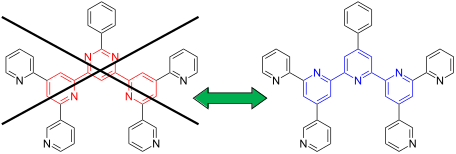
- for 2,2'-BTP (5) at the HOPG/TCB solution interface. To further support the experimental results, force field calculations of the square symmetric adsorbate layers of 2,4'-BTP (2) and 2,2'-BTP (5) were performed. The results of these calculations underline their structural similarities: For both
- ovals. Adsorbate structures of 2,4'-BTP (2) (left) and 2,2'-BTP (5) (right) in the square symmetric structure, optimized with the Compass [32] force field. a) 15 × 15 nm2 STM image (Iset = 3.41 nA, Vset = −660 mV) of 2,2'-PhSpPy (14) at the HOPG/TCB interface [a = 3.0 ± 0.1 nm, b = 3.0 ± 0.1 nm, a,b


Intermolecular vs molecule–substrate interactions: A combined STM and theoretical study of supramolecular phases on graphene/Ru(0001)
Beilstein J. Nanotechnol. 2011, 2, 365–373, doi:10.3762/bjnano.2.42
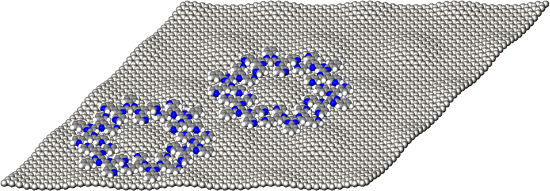
- intermolecular interactions and long-range lateral variations in the substrate–adsorbate interaction was studied by scanning tunnelling microscopy (STM) and force field based calculations, by comparing the phase formation of (sub-) monolayers of the organic molecules (i) 2-phenyl-4,6-bis(6-(pyridin-3-yl)-4
- interaction; large organic molecules; substrate–adsorbate interaction; supramolecular structure; Introduction It is well known that the formation of highly ordered 2D supramolecular networks on smooth surfaces, such as metal substrates or highly oriented pyrolytic graphite (HOPG), is mainly governed by the
- depending on the applied force field varies between 0.625 and 0.985 eV per molecule (Table 1), we see that these additional intermolecular interactions which apply for higher adsorbate densities would be much lower than the corrugation of the adsorption potential. Hence, at sub-monolayer coverage it is


Single-pass Kelvin force microscopy and dC/dZ measurements in the intermittent contact: applications to polymer materials
Beilstein J. Nanotechnol. 2011, 2, 15–27, doi:10.3762/bjnano.2.2
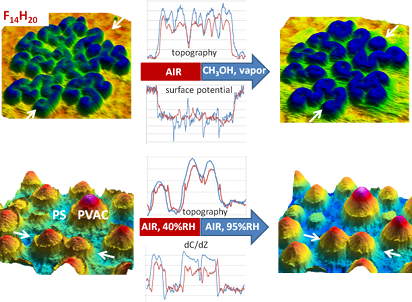
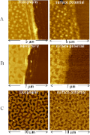
- illustrated in Figure 2B which shows the dependence of phase changes as a function of DC bias voltage between a conducting probe and different locations of the F14H20 adsorbate on Si substrate. The phase-versus-DC-bias curve (colored blue) was detected when the probe was over a domain of the toroid-like self
- voltages needed for nullification of the electrostatic is the main function of KFM. The topography and surface potential images, which were recorded on the F14H20 adsorbate on Si substrate, are presented in Figure 3. These images were obtained with Asp just above (Figure 3A) and below (Figure 3B) its value





Defects in oxide surfaces studied by atomic force and scanning tunneling microscopy
Beilstein J. Nanotechnol. 2011, 2, 1–14, doi:10.3762/bjnano.2.1
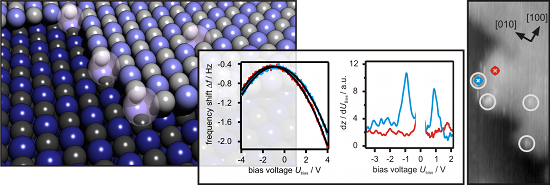
- understand possible reaction pathways, a detailed characterization of color centers is highly desirable. Information about their local position and thus coordination, electronic structure, local contact potential and possible adsorbate interaction are of fundamental interest. In the following, color centers
- on the MgO surface are investigated in detail and classified by their charge state. From calculations it has been proposed that color centers are directly involved in chemical reactions [23][24], e.g., as adsorption sites due to more attractive defect-adsorbate interactions compared with the pristine
- Figure 6. Color centers in magnesium oxide The high local resolution of the NC-AFM image shown in Figure 5 serves as the starting point for adsorbate-defect interaction studies. The tip, representing the adsorbate, scans laterally across the defect positions at constant height along the step direction


Other Beilstein-Institut Open Science Activities



