


Search results
Search for "colloids" in Full Text gives 130 result(s) in Beilstein Journal of Nanotechnology.
Ceria/silicon carbide core–shell materials prepared by miniemulsion technique
Beilstein J. Nanotechnol. 2011, 2, 638–644, doi:10.3762/bjnano.2.67
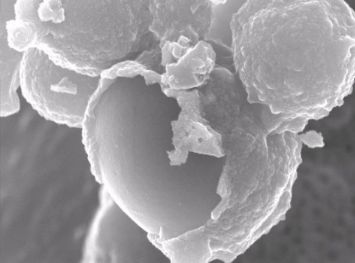
- of nonionic Lutensol AT50 results in larger spheres of 500 nm (Figure 2A). This is not surprising, as nonionic surfactants are less effective in stabilizing colloids. Thus a larger amount of nonionic surfactant is required to achieve the same particle size as with an ionic surfactant. The variation


Fabrication of multi-parametric platforms based on nanocone arrays for determination of cellular response
Beilstein J. Nanotechnol. 2011, 2, 545–551, doi:10.3762/bjnano.2.58
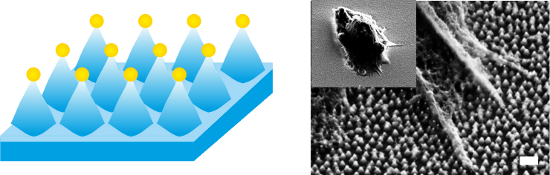
- autocatalytic process that allows for the spatially resolved deposition of metal on to metal surfaces or colloids. Gold nanoparticle arrays with gold particle diameters of approximately 30–45 nm were prepared (Figure S1b). Finally, a reactive ion etching (RIE) process was employed to generate nanocone arrays


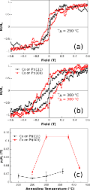
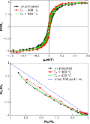
Nanoscaled alloy formation from self-assembled elemental Co nanoparticles on top of Pt films
Beilstein J. Nanotechnol. 2011, 2, 473–485, doi:10.3762/bjnano.2.51
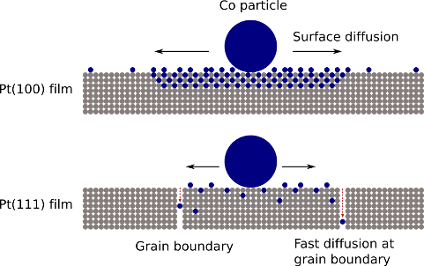
- probe microscopy techniques [5], one is left with processes relying on the self-assembly of colloids or micelles [6][7][8]. In the context of magnetic NPs, two prominent examples, both dealing with the preparation of magnetically attractive FePt NPs, which successfully demonstrated fulfillment of the




Platinum nanoparticles from size adjusted functional colloidal particles generated by a seeded emulsion polymerization process
Beilstein J. Nanotechnol. 2011, 2, 459–472, doi:10.3762/bjnano.2.50
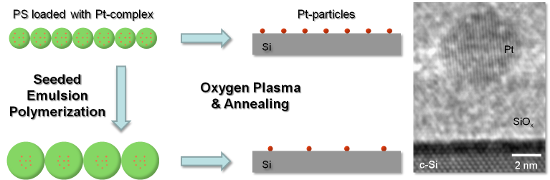
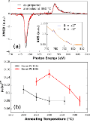
- -assembled monolayer of functional colloids is prepared on a solid substrate and subsequently treated by oxygen plasma processing in order to remove the organic constituents. This step, however, leads to a saturated state of a residual mix of materials. In order to determine parameters influencing this
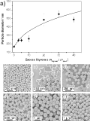
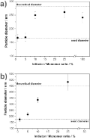
- saturation state, the type of surfactant, the amount of precursor loading and the size of the colloids are varied. By short annealing at high temperatures platinum nanoparticles are generated from the saturated state particles. Typically, the present fabrication method delivers a maximum interparticle
- distance of about 260 nm for well-defined crystalline platinum nanoparticles limited by deformation processes due to softening of the organic material during the plasma applications. Keywords: colloid lithography; functional colloids; miniemulsion polymerization; nanoparticles; seeded emulsion



Organic–inorganic nanosystems
Beilstein J. Nanotechnol. 2011, 2, 363–364, doi:10.3762/bjnano.2.41

- masks for subsequent further deposition or etching steps. Applied in this way, the method is a direct extension of the seminal work by Fischer and Zingsheim on hexagonal ordered arrays of polystyrene colloids serving as masks for subsequent metal evaporations [1]. In other cases, based on precursor
- loaded micelles or, more generally, colloids, the organic carriers are completely removed after their self-organization by various plasma treatments while the precursor compounds are transformed into metal oxides or, finally, into metals. In this way, hexagonal ordered arrays of metal nanoparticles can
Other Beilstein-Institut Open Science Activities



