


Search results
Search for "damping" in Full Text gives 196 result(s) in Beilstein Journal of Nanotechnology.
Magnetic reversal dynamics of a quantum system on a picosecond timescale
Beilstein J. Nanotechnol. 2015, 6, 1946–1956, doi:10.3762/bjnano.6.199
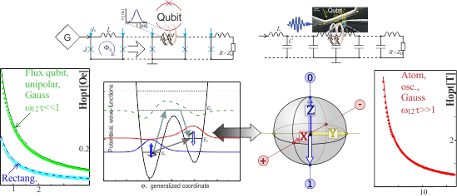
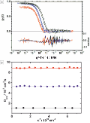
- field; the presence of which allows for the definition of the so-called Larmor frequency, ΩL = γHZ. Classical damping can be set as α = 0 for the simplest case when the decoherence processes in the quantum model can be neglected. For H(t) = H0f(t)cos(ωlt), with ωl = ΩL, ΩLτ >> 1 one can arrive at: For




Large-voltage behavior of charge transport characteristics in nanosystems with weak electron–vibration coupling
Beilstein J. Nanotechnol. 2015, 6, 1853–1859, doi:10.3762/bjnano.6.188
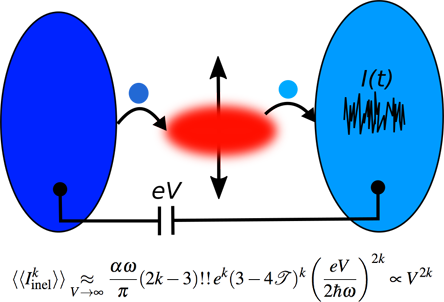
- and the oscillator mode decoupled from any other degrees of freedom apart from the electronic level, i.e., with no external damping studied previously [18][19][20]. The above result (Equation 19) can be, however, applied under far wider conditions (multilevel dot, non-zero temperature and/or external
- damping of the oscillator mode) as we briefly discuss in the concluding section. In the case specified above, we can obtain the large-V asymptotics of the CGF by identifying the known leading contributions of the constituent parts. From the definitions and with the voltage-independent relaxation time
- expressions are well known in the literature [10][12][19][25] and can/have been applied to cases with multiple electronic levels, finite temperatures, and/or external damping (whose magnitude can be even assessed from ab-initio calculations [33]). In particular, all the relevant quantities for the multilevel
Improved atomic force microscopy cantilever performance by partial reflective coating
Beilstein J. Nanotechnol. 2015, 6, 1450–1456, doi:10.3762/bjnano.6.150
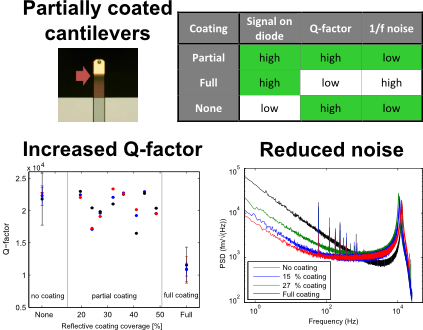
- damping of the cantilever, leading to a lower mechanical quality factor (Q-factor). In dynamic mode operation in high vacuum, a cantilever with a high Q-factor is desired in order to achieve a lower minimal detectable force. The reflective coating can also increase the low-frequency force noise. In
- desired to achieve a lower minimal detectable force gradient. By using a cantilever in an ultra high vacuum environment (UHV), the Q-factor is drastically increased due to the absence of damping by air atmosphere and is limited by the intrinsic properties of the cantilever. It is known that adding a metal
- available short cantilevers [5]. These changes in the cantilever performance can be described by the additional viscoelastic damping and increased susceptibility to temperature fluctuations due to the added metal layer causing a bimetallic effect. Paoline et al. presented a model that uses a complex spring


Nanomechanical humidity detection through porous alumina cantilevers
Beilstein J. Nanotechnol. 2015, 6, 1332–1337, doi:10.3762/bjnano.6.137
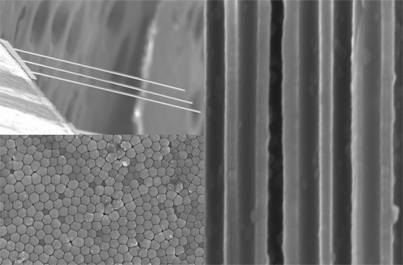
- vacuum, when the vapors are absent, the measurement of the resonance frequency is routinely made compared to measurements in viscous media. At first we emphasized the damping effect on cantilever vibration for porous AAO and standard Si cantilevers explored in the real system (air) and in model (vacuum



Attenuation, dispersion and nonlinearity effects in graphene-based waveguides
Beilstein J. Nanotechnol. 2015, 6, 1221–1228, doi:10.3762/bjnano.6.125
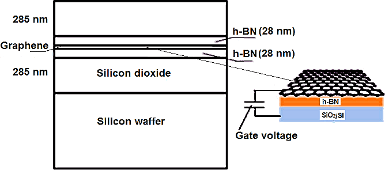
- supported in graphene when and , respectively. By numerical simulations it was proved that energy is absorbed or dissipated when . However, if we consider a fixed graphene chemical potential, the temperature increase causes a finite damping, which is smaller for TM vs TE modes. This is because the real


Stiffness of sphere–plate contacts at MHz frequencies: dependence on normal load, oscillation amplitude, and ambient medium
Beilstein J. Nanotechnol. 2015, 6, 845–856, doi:10.3762/bjnano.6.87
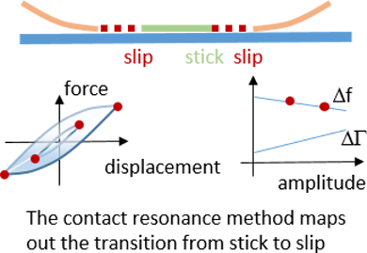
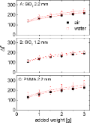
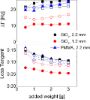
- level on the other. The CM model ignores viscous dissipation. In consequence, the energy dissipated in reciprocating sliding scales as the cube of the oscillation amplitude in the low-amplitude limit. Following from this scaling law, the damping of a resonator, which experiences particle slip in one way
- or another, should go to zero at small amplitudes. An explanation of the contact resonance method, which probes these relations, is given below. Deviating from this scaling prediction, the contacts usually do damp a resonance even at the smallest accessible amplitudes. This type of damping must be
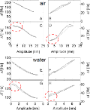
- shown in the four panels at the top and the four panels at the bottom were acquired in air and in water, respectively. In liquids, the maximum achievable amplitude is lower than in air because of damping. Δf and ΔΓ decrease and increase with amplitude, respectively, as is characteristic for partial slip




Stick–slip behaviour on Au(111) with adsorption of copper and sulfate
Beilstein J. Nanotechnol. 2015, 6, 820–830, doi:10.3762/bjnano.6.85
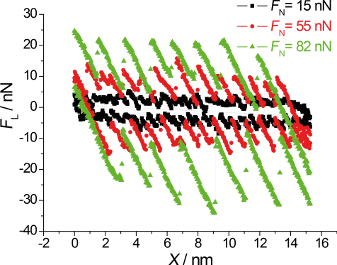
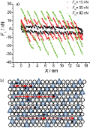
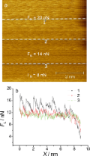
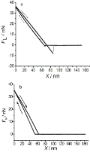
- was observed by Meyer and coworkers [33]: Upon an increase in normal load on a NaCl(001) surface a transition to multiple slip was found. According to [34], who predicted such transitions from theory for low damping conditions and also observed it on HOPG, this process is based on energy minimisation





Mapping of elasticity and damping in an α + β titanium alloy through atomic force acoustic microscopy
Beilstein J. Nanotechnol. 2015, 6, 767–776, doi:10.3762/bjnano.6.79
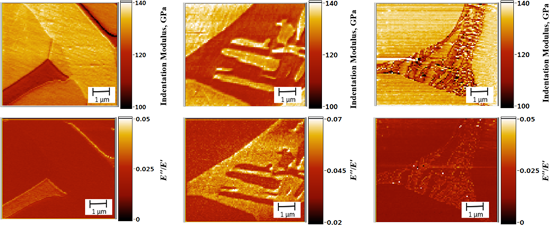
- . Physikalisches Institut, Georg-August-Universität, Friedrich Hund Platz 1, D-37077 Göttingen, Germany 10.3762/bjnano.6.79 Abstract The distribution of elastic stiffness and damping of individual phases in an α + β titanium alloy (Ti-6Al-4V) measured by using atomic force acoustic microscopy (AFAM) is reported
- in the present study. The real and imaginary parts of the contact stiffness k* are obtained from the contact-resonance spectra and by using these two quantities, the maps of local elastic stiffness and the damping factor are derived. The evaluation of the data is based on the mass distribution of the
- cantilever with damped flexural modes. The cantilever dynamics model considering damping, which was proposed recently, has been used for mapping of indentation modulus and damping of different phases in a metallic structural material. The study indicated that in a Ti-6Al-4V alloy the metastable β phase has


Manipulation of magnetic vortex parameters in disk-on-disk nanostructures with various geometry
Beilstein J. Nanotechnol. 2015, 6, 697–703, doi:10.3762/bjnano.6.70
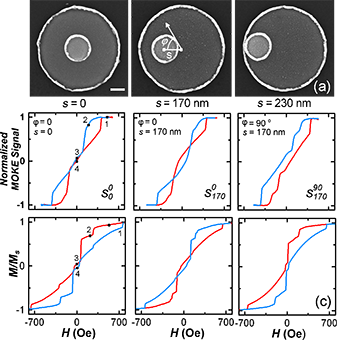
- by using OOMMF software [9] with standard parameters for Py: Ms = 860 Gs, exchange stiffness A = 1.38 · 106 erg/cm, damping factor α = 0.05 [11]. The magnetic anisotropy was chosen zero in order not to insert an asymmetry of magnetic properties into the system. Dimension of the simulated disk-on-disk


Influence of spurious resonances on the interaction force in dynamic AFM
Beilstein J. Nanotechnol. 2015, 6, 420–427, doi:10.3762/bjnano.6.42
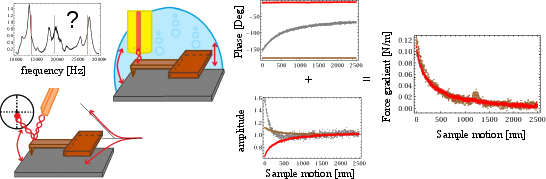
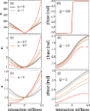
- as calibration method [17][18][19] compared to the standard characterization of the cantilever transfer function. Results and Discussion Interaction stiffness and damping In this section we review two general formulas for the interaction stiffness ki and damping γi without using the assumption that
- motion of the mass: , which from Newton’s second law implies Ar = −mAω2. Hence, from basic trigonometric relationships: Consider that the force Fy(t) has two contributions, a restoring force Frest and a damping force Fdamp, so that Fy(t) = Frest(t) + Fdamp(t). The restoring force is directly proportional
- to the position of the moving mass, whereas the damping is directly proportional to its velocity. Let us define k as being the proportionality constant between the force and the position and γ the proportionality constant between the damping force and the speed of the mass. Hence, Comparing Equation


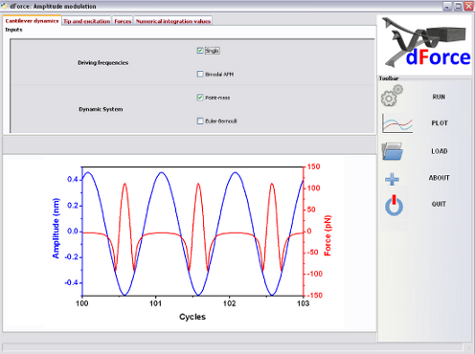
Dynamic force microscopy simulator (dForce): A tool for planning and understanding tapping and bimodal AFM experiments
Beilstein J. Nanotechnol. 2015, 6, 369–379, doi:10.3762/bjnano.6.36
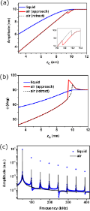
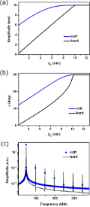
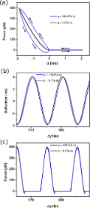
- , where E is the Young modulus of the cantilever, I the area moment of inertia, α1 the internal damping coefficient of the cantilever, ρ the cantilever mass density, b, h and L are the width, thickness and length of the cantilever, respectively, α0 is the hydrodynamic damping of the medium, and w(x,t) is




Mechanical properties of MDCK II cells exposed to gold nanorods
Beilstein J. Nanotechnol. 2015, 6, 223–231, doi:10.3762/bjnano.6.21
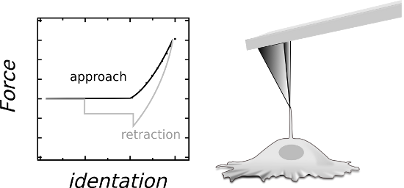
- concentration-dependent QCM measurements and found that damping (dissipation) increases steadily from 2.5 to 25 μg/mL until eventually leveling off (Figure 6). Generally, dark-field micrographs showed that particles are homogeneously distributed within the cell interior with a trend to accumulate around the


Tunable light filtering by a Bragg mirror/heavily doped semiconducting nanocrystal composite
Beilstein J. Nanotechnol. 2015, 6, 193–200, doi:10.3762/bjnano.6.18
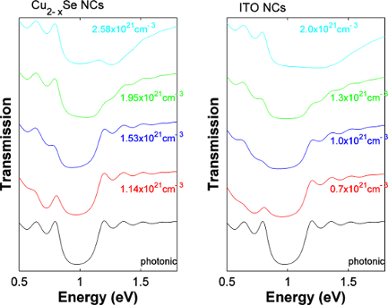
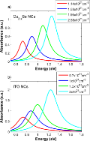
- optical properties in heavily doped semiconductor NCs in the NIR, with a complex dielectric function given by [27][28][29][30][31]: where where Γ is the free carrier damping and is the plasma frequency of the free carriers of the system. Here, NC is the carrier density, e the charge of the electron, m
- considered a dispersion of Cu2−xSe NCs in toluene with a spherical shape and a diameter of 15 nm, with ε∞ = 11 [27][43]. The carrier density-dependent effective mass and damping constant were taken from [43] with the following parameters: m1* = 0.445·m0, m2* = 0.394·m0, m3* = 0.334·m0, and m4* = 0.336·m0 and
- of effective mass and damping constant. A blue shift of up to 0.7 eV and an increase in intensity with increasing carrier density is observed. The calculated results are in good agreement with experimental results obtained in [27][28][29][30][31][32]. In those works, a modulation of the plasmonic


Accurate, explicit formulae for higher harmonic force spectroscopy by frequency modulation-AFM
Beilstein J. Nanotechnol. 2015, 6, 149–156, doi:10.3762/bjnano.6.14
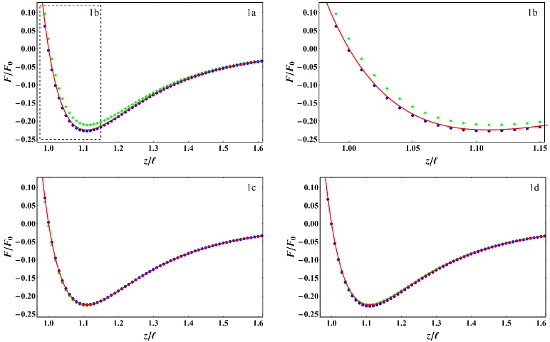
- –surface interaction Here, k is the effective cantilever spring constant, ω0 is the fundamental resonance frequency in the absence of tip–surface interaction, q(t) is the tip position, γ is the damping coefficient, and F0 and ω are the amplitude and frequency of the driving force, respectively. As the
- . The derivation of Feven relies on its sole dependence upon tip–sample separation in Equation 6. This is not the case for Fodd, which is out of phase with q(t). This issue is resolved by noting that many dissipative forces have the form [13] with Γ, the generalised damping coefficient, depending only
- therefore have the same solutions. We may then refer to Table 1 for these solutions. For example, using Equation 15, the formula for the generalized damping coefficient for n = 2 is readily derived as (Equation 20): Expressions in terms of higher harmonics may be similarly derived. We have shown that by


High-frequency multimodal atomic force microscopy
Beilstein J. Nanotechnol. 2014, 5, 2459–2467, doi:10.3762/bjnano.5.255
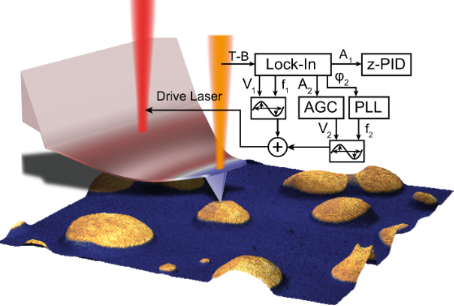
- squeeze-film damping of the cantilever, the latter of which is roughly constant while in feedback. We used a thin-film blend of polystyrene (PS) and poly(methyl methacrylate) (PMMA) as a sample (PS–PMMA–15M, Bruker AFM probes); its separation into soft and hard domains makes it a widely used standard for
- due to viscous damping, however the detection bandwidth scales linearly with the dissipated power. The linear scaling is due to the fact that both the dissipated power (see Equation 1) and the cantilever AC-bandwidth, which is proportional to (f0/Q), scale proportionally with the resonance frequency


Inorganic Janus particles for biomedical applications
Beilstein J. Nanotechnol. 2014, 5, 2346–2362, doi:10.3762/bjnano.5.244

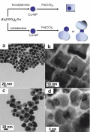
- . attributed this broadening and damping to the tunnelling of conduction band electrons of the Au nanoparticles into the projected density of states of the Fe3O4 domains, the so-called “interface decay channel” [56]. As a metal oxide starts to nucleate heterogeneously on the gold nanoparticles, the induced






Localized surface plasmon resonances in nanostructures to enhance nonlinear vibrational spectroscopies: towards an astonishing molecular sensitivity
Beilstein J. Nanotechnol. 2014, 5, 2275–2292, doi:10.3762/bjnano.5.237
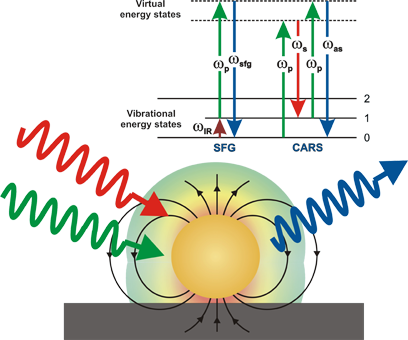
- described as: where Aijk(l) (NR) and are the non-resonant amplitudes and phase; Aijk(l) (q), Γq and ωq are the oscillator strength, the damping factor and the vibrational frequency of the q-th vibrational mode; ωIR, ωp and ωS are the infrared, the pump and the Stokes beam frequencies. The oscillator




Modeling viscoelasticity through spring–dashpot models in intermittent-contact atomic force microscopy
Beilstein J. Nanotechnol. 2014, 5, 2149–2163, doi:10.3762/bjnano.5.224
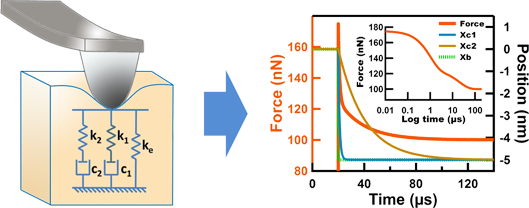
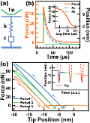
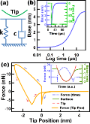
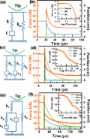
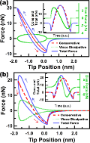
- displacement while the former experience dissipation through subsequent surface relaxation of stress initially stored in springs. In the case of the Nafion model we have varied the magnitude of c1 and c2 (see Figure 3a) to observe the effect of changing the relative importance of the damping elements. Figure 7
- shows the results for the case when both dashpots have the same damping constant. Figure 7a illustrates how dissipation decreases when the frequency increases for the range studied here (10–200 kHz). It is interesting to see in Figure 7b that regardless of the amplitude setpoint (A1/A01) the level of
- increases within a range of 0.4 to 0.5 of the ratio A1/A01. In contrast, for Figure 8, when the dashpot c2 is set to a high damping value compared to c1 (notice that the dashpot c2 in Figure 3a hardly yields when compared to c1) the behavior of dissipation changes drastically compared to the results of


Properties of plasmonic arrays produced by pulsed-laser nanostructuring of thin Au films
Beilstein J. Nanotechnol. 2014, 5, 2102–2112, doi:10.3762/bjnano.5.219
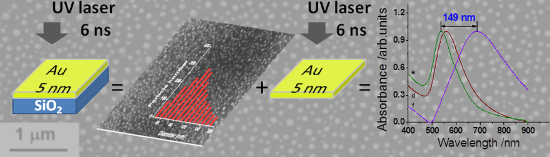
- indicate damping confirmed by short dephasing times not exceeding 4 fs, the self-organized Au NP structures reveal quite a strong enhancement of the optical signal. This was consistent with the near-field modeling and micro-Raman measurements as well as a test of the electrochemical sensing capability
- microscope and inspection spectroscopic measurements. The effect of the nanostructure morphology on plasmonic properties (such as resonance position and damping), the near- and mid-field enhancement of the optical signal, and evidence of sensing capability are discussed. Moreover, the possibility of tuning
- enhanced Raman spectroscopy)). In the estimation of the plasmon damping effect, the relation between the observable Г and dephasing time T2 = 2/Γ can be applied, where Г is the FWHM of the plasmon resonance. For simplified analysis, it is assumed that the line broadening effects are independent and


Dissipation signals due to lateral tip oscillations in FM-AFM
Beilstein J. Nanotechnol. 2014, 5, 2048–2057, doi:10.3762/bjnano.5.213
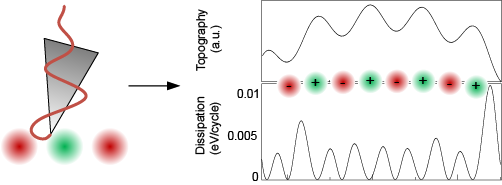
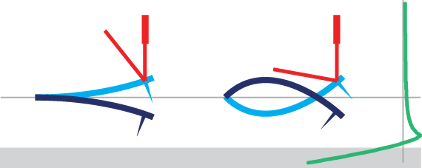
- microscopy. The coupling is induced by the interaction between tip and surface. Energy is transferred from the normal to the lateral excitation, which can be detected as damping of the cantilever oscillation. However, energy can be transferred back into the normal oscillation, if not dissipated by the
- usually uncontrolled mechanical damping of the lateral excitation. For certain cantilevers, this dissipation mechanism can lead to dissipation rates larger than 0.01 eV per period. The mechanism produces an atomic contrast for ionic crystals with two maxima per unit cell in a line scan. Keywords: atomic
- oscillation. Energy loss of the oscillation occurs not only due to mechanical damping of the cantilever, but also due to interaction between tip and surface, so that the damping signal can be used for imaging, even with atomic resolution [4]. There is a broad consensus, that the observed dissipation is due to


Dynamic calibration of higher eigenmode parameters of a cantilever in atomic force microscopy by using tip–surface interactions
Beilstein J. Nanotechnol. 2014, 5, 1899–1904, doi:10.3762/bjnano.5.200
- sets of cantilever parameters from Table 1. The cantilever is excited by using multifrequency drive (specified below) with frequencies being integer multiples of the base frequency δω = 2π·0.1 kHz. The tip–surface force F is represented by the vdW-DMT model [35] with the nonlinear damping term being
- part, Fdis, depends on the damping factor γ1 = 2.2 × 10⁻⁷ kg/s and the damping decay length λz = 1.5 nm. The force (Equation 6) and its cross-sections are depicted in Figure 2. Calibration by using a nonlinear tip–surface force In order to find k2 and α2 from the nonlinear system (Equation 3 and
- , the method should work in liquid or high-damping environments, however, experimental implementation in liquid will suffer from actuation-related effects, squeeze-film damping close to the surface and spurious resonances. [37]. Conclusion We outlined a theoretical framework for experimental calibration


![[Graphic 25]](/bjnano/content/inline/2190-4286-5-200-i35.png?max-width=637&scale=1.18182) , using Equation 9 for two different cantilevers: ...
, using Equation 9 for two different cantilevers: ...
Quasi-1D physics in metal-organic frameworks: MIL-47(V) from first principles
Beilstein J. Nanotechnol. 2014, 5, 1738–1748, doi:10.3762/bjnano.5.184
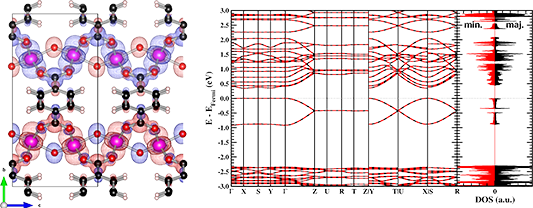
- ]. Dispersive interactions, which play an important role in the flexibility of the crystal structure of MOFs [61], are included through the DFT-D3 method as formulated by Grimme et al. [62][63], including Becke–Johnson damping [64]. Due to the presence of Pulay stresses [65], MIL-47(V) tends to collapse during


Multi-frequency tapping-mode atomic force microscopy beyond three eigenmodes in ambient air
Beilstein J. Nanotechnol. 2014, 5, 1637–1648, doi:10.3762/bjnano.5.175
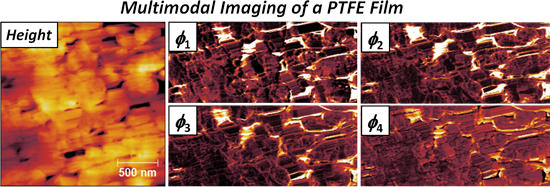
- , and that the work reported here represents by no means an exhaustive study. High-damping environments may offer even greater complexities [31] and our amplitude-modulation/open-loop results are not directly applicable to vacuum environments [24][32]. Methods Experimental The tetramodal experiments



Trade-offs in sensitivity and sampling depth in bimodal atomic force microscopy and comparison to the trimodal case
Beilstein J. Nanotechnol. 2014, 5, 1144–1151, doi:10.3762/bjnano.5.125
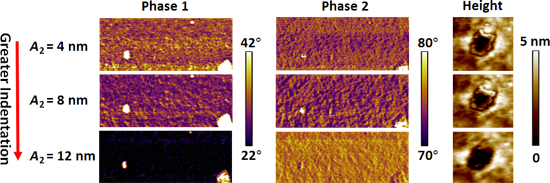
- damping and excitation terms with the factor 1/Q. The last term on the right hand side indicates that the tip–sample forces are normalized by the product of the force constant times the free amplitude. Thus, the external forces influence the dynamics more or less when the product kAo becomes smaller or
- used): (a) maximum indentation depth vs cantilever force constant; (b) peak forces corresponding to (a); (c) maximum indentation vs cantilever quality factor, Q (unrealistically low values of Q were chosen to illustrate the effect of high damping); (d) maximum indentation vs first and second eigenmode


Dry friction of microstructured polymer surfaces inspired by snake skin
Beilstein J. Nanotechnol. 2014, 5, 1091–1103, doi:10.3762/bjnano.5.122

- . The error channel (also known as the amplitude channel) visualizes the change in damping of the cantilever amplitude while scanning the surface. Only images obtained with the error channel are shown, because this visualization method is helpful to gain a more vivid imaging of the surface topography





