


Search results
Search for "drug delivery systems" in Full Text gives 142 result(s) in Beilstein Journal of Nanotechnology.
Nanofibers for drug delivery – incorporation and release of model molecules, influence of molecular weight and polymer structure
Beilstein J. Nanotechnol. 2015, 6, 1939–1945, doi:10.3762/bjnano.6.198
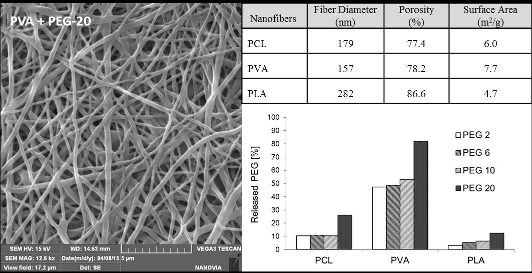
- ; nanofibrous carriers; needle-free electrospinning; release kinetics; Introduction To date, numerous drug delivery systems have been developed, such as hydrogels that carry drugs or highly sophisticated electronic microchips [1][2]. The required release rates of the therapeutic agents depend on the medicinal

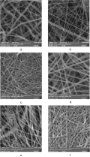


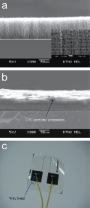
Atomic scale interface design and characterisation
Beilstein J. Nanotechnol. 2015, 6, 1708–1711, doi:10.3762/bjnano.6.174

- , where these nanomaterials have been used as substrates for neural growth, as drug delivery systems and as electrodes for both extra cellular recordings and for in vivo recordings [21]. Finally, although carbon is often seen as the “poster child” of nanomaterials, it is important not to forget the
Analyzing collaboration networks and developmental patterns of nano-enabled drug delivery (NEDD) for brain cancer
Beilstein J. Nanotechnol. 2015, 6, 1666–1676, doi:10.3762/bjnano.6.169
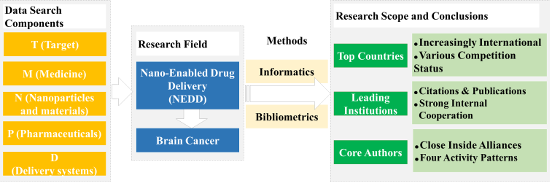
- conjugates and so on [6][7][8]. Among these, the brain tumor-targeting drug delivery systems, which increase drug accumulation in the tumor region and reduce toxicity in the normal brain and peripheral tissue, are a promising new approach [9]. Collaboration fosters interactions between different actors


Structural and magnetic properties of iron nanowires and iron nanoparticles fabricated through a reduction reaction
Beilstein J. Nanotechnol. 2015, 6, 1652–1660, doi:10.3762/bjnano.6.167
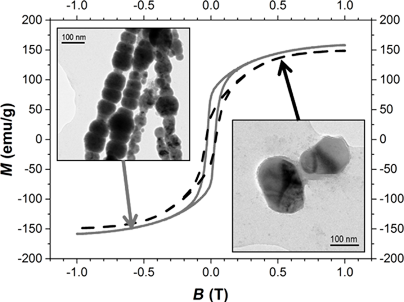
- inexpensive, a lot of them are biocompatible and low-toxic, it makes them very interesting from an application point of view. So far, they have been applied in many biomedical applications including magnetic resonance imaging (MRI) contrast enhancements [1], direct drug delivery systems [2], hyperthermia
- different applications. For instance, in the case of drug delivery systems nanostructures need to exhibit rather superparamagnetic behaviour with low coercivity. On the other hand, in the case of magnetic recording media there are needed materials with a high value of coercivity. Thus, it is very important



Peptide-equipped tobacco mosaic virus templates for selective and controllable biomineral deposition
Beilstein J. Nanotechnol. 2015, 6, 1399–1412, doi:10.3762/bjnano.6.145
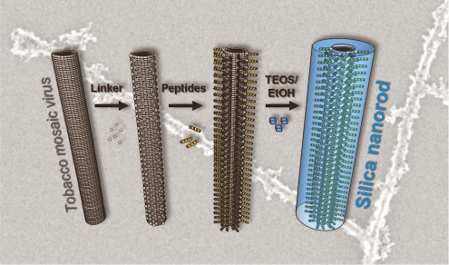
- example, as a structural modifier or filler in rubber [1], food [2][3] or healthcare products [4], bioceramics for medical purposes [5], mesoporous nanoparticulate or tubular drug delivery systems as reviewed in [6], sensor surfaces [7], or biocatalytic formulations as reviewed in [8]. An important focus




PLGA nanoparticles as a platform for vitamin D-based cancer therapy
Beilstein J. Nanotechnol. 2015, 6, 1306–1318, doi:10.3762/bjnano.6.135
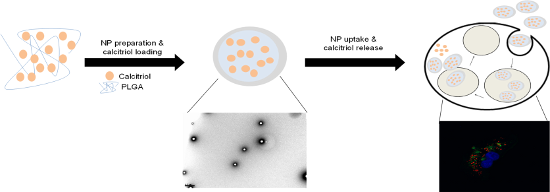
- discussed drawbacks continue to be highlighted as major challenges in developing formulations for clinical use. To overcome some of these limitations, we propose drug delivery systems for new calcitriol formulations. These nanosystems, namely nanoparticles (NPs), must meet several requirements such as


Overview about the localization of nanoparticles in tissue and cellular context by different imaging techniques
Beilstein J. Nanotechnol. 2015, 6, 263–280, doi:10.3762/bjnano.6.25
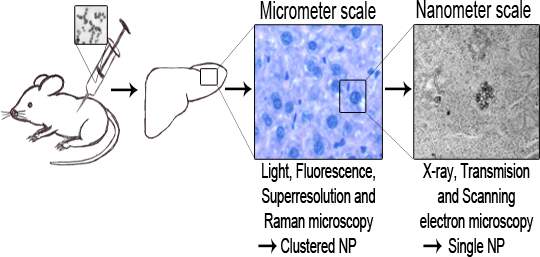
- manifold. For example, nanomaterials find application in surgical implants to improve tissue formation or due to their antibacterial action, they may be useful for gene or drug delivery systems as well as diagnostic imaging tools [3][4][5][6][7]. On the other hand, due to the entirely new properties of NP



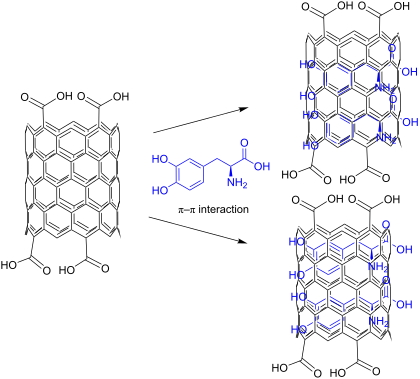
Release behaviour and toxicity evaluation of levodopa from carboxylated single-walled carbon nanotubes
Beilstein J. Nanotechnol. 2015, 6, 243–253, doi:10.3762/bjnano.6.23
- carriers for proteins and pharmaceuticals to treat diseases by Bangham and Horne in the 1960s [1]. Since then, multidisciplinary researchers have been actively investigating advanced drug delivery systems by directing drugs and/or carriers with sustained release properties directly to a the specific site




Functionalized polystyrene nanoparticles as a platform for studying bio–nano interactions
Beilstein J. Nanotechnol. 2014, 5, 2403–2412, doi:10.3762/bjnano.5.250
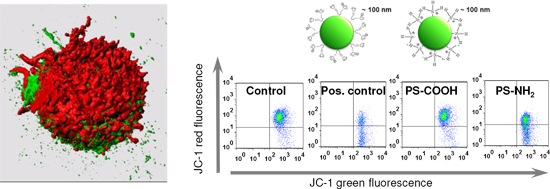
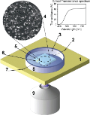
- new drug delivery systems and predict functionalization-dependent health hazards that nanoparticles might exhibit. Polystyrene synthesis. Spinning disc confocal microscopy of acute monocytic leukemia THP-1 cells, differentiated THP-1 cells, and human macrophages. Cell membranes are stained with


Nanoencapsulation of ultra-small superparamagnetic particles of iron oxide into human serum albumin nanoparticles
Beilstein J. Nanotechnol. 2014, 5, 2259–2266, doi:10.3762/bjnano.5.235
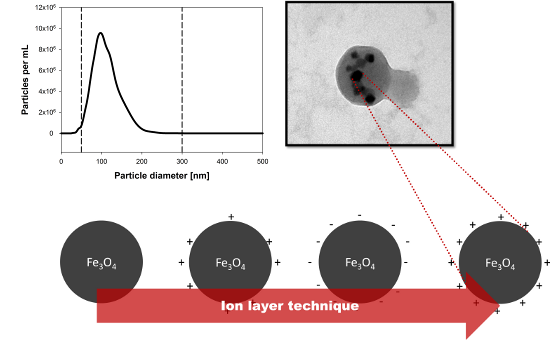
- Technische Universität Darmstadt, Technical Chemistry, D-64287 Darmstadt, Germany Merck KGaA, D-64287 Darmstadt, Germany 10.3762/bjnano.5.235 Abstract Human serum albumin nanoparticles have been utilized as drug delivery systems for a variety of medical applications. Since ultra-small superparamagnetic


Imaging the intracellular degradation of biodegradable polymer nanoparticles
Beilstein J. Nanotechnol. 2014, 5, 1905–1917, doi:10.3762/bjnano.5.201
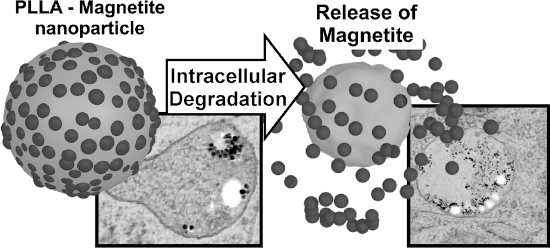
- ), University Medical Center of the Johannes Gutenberg-University Mainz, Langenbeckstraße 1, 55131 Mainz, Germany 10.3762/bjnano.5.201 Abstract In recent years, the development of smart drug delivery systems based on biodegradable polymeric nanoparticles has become of great interest. Drug-loaded nanoparticles
- is not to be expected. Therefore, the degradation behavior of nano-sized PLLA materials should be very interesting as many drug delivery systems are currently being investigated for their use in vitro and in vivo. Investigations of in vivo degradation of PLLA are currently restricted to at least
- , biodegradable polymeric nanoparticles are a promising vehicle for smart drug delivery systems and to this regard, it is even more important to examine intracellular degradation dynamics of these bio-polymers. The objective of this work is to follow the fate of intracellular PLLA nanoparticles over a long time


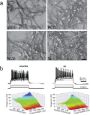
Carbon-based smart nanomaterials in biomedicine and neuroengineering
Beilstein J. Nanotechnol. 2014, 5, 1849–1863, doi:10.3762/bjnano.5.196
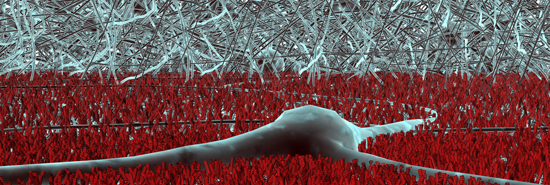
- localise in the lungs, liver and spleen [79], and that the urinary system excrete them [80]. Hydrogels and thin-films based on NDs have also been used as drug delivery systems by virtue of their ease of surface functionalisation and small size. They have been reported for successfully delivering several


Biocompatibility of cerium dioxide and silicon dioxide nanoparticles with endothelial cells
Beilstein J. Nanotechnol. 2014, 5, 1795–1807, doi:10.3762/bjnano.5.190
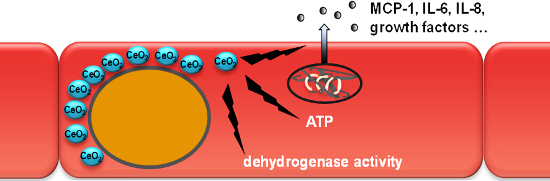
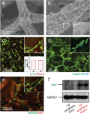
- ]. SiO2 nanoparticles are employed in the fabrication of electric and thermal insulators [6], as drug-delivery systems in nanomedicine [7][8], as anticaking and thickener agents in food production [9][10], as well as in cosmetics, drugs and printer toners [11]. Human exposure to these nanoparticles arises


Nanodiamond-DGEA peptide conjugates for enhanced delivery of doxorubicin to prostate cancer
Beilstein J. Nanotechnol. 2014, 5, 937–945, doi:10.3762/bjnano.5.107
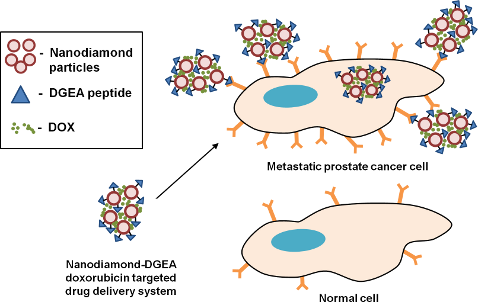
- targeted drug delivery systems can provide an avenue to overcome these issues. Nanodiamonds (ND), in particular, have been researched over the past five years for use in various drug delivery systems but minimal work has been done that incorporates targeting capability. In this study, a novel targeted drug


Morphological characterization of fullerene–androsterone conjugates
Beilstein J. Nanotechnol. 2014, 5, 374–379, doi:10.3762/bjnano.5.43
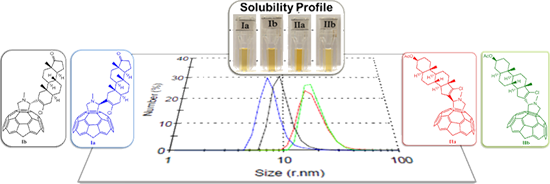
- ][7], nucleotides, sugars and steroids [8][9], have allowed the solubilization of these hybrid derivatives in aqueous media, thus enhancing certain biological activities. For the potential use of C60 derivatives as drug delivery systems, the size of the particles is important. In general, fast drug


Extracellular biosynthesis of gadolinium oxide (Gd2O3) nanoparticles, their biodistribution and bioconjugation with the chemically modified anticancer drug taxol
Beilstein J. Nanotechnol. 2014, 5, 249–257, doi:10.3762/bjnano.5.27

- fungus based approach for the synthesis of this material for the first time. We show that the thermophilic fungus Humicola sp. can be used for the synthesis of Gd2O3 nanoparticles at 50 °C. Since Gd2O3 nanoparticles have proved their value in site-specific drug delivery systems for cancer therapy, we
- relaxation, and can be useful as a multimodal contrast agent for in vivo imaging [5]. It can also be easily doped with other lanthanides and exploited as a fluorescent tag, thus replacing other fluorescent organic molecules. Gadolinium oxide nanoparticles are also employed in site-specific drug delivery
- systems for cancer therapy. Gadolinium compounds are used in neutron capture therapy (NCT) as an alternative for boron-10 [6][7]. NCT is mainly associated with tumor-specific delivery systems and involves the production of localized cytotoxic radiations by a non-radioactive nuclide delivered to tumor


En route to controlled catalytic CVD synthesis of densely packed and vertically aligned nitrogen-doped carbon nanotube arrays
Beilstein J. Nanotechnol. 2014, 5, 219–233, doi:10.3762/bjnano.5.24
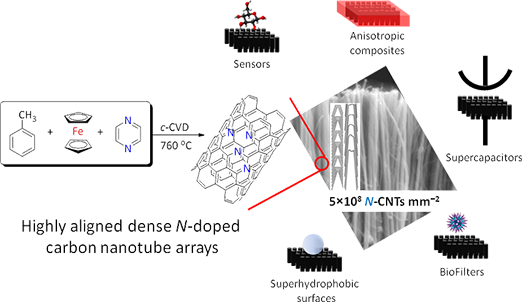
- be used as high surface area electrodes. Apart from this, the ‘bamboo’-like N-CNTs obtained here could provide a new opening in drug delivery systems due to their rigid ‘needle-like’ morphology. These N-CNTs with a high content of ferromagnetic nanoparticles could potentially serve as magnetically





