Search results
Search for "electrostatic interactions" in Full Text gives 141 result(s) in Beilstein Journal of Nanotechnology.
The study of surface wetting, nanobubbles and boundary slip with an applied voltage: A review
Beilstein J. Nanotechnol. 2014, 5, 1042–1065, doi:10.3762/bjnano.5.117
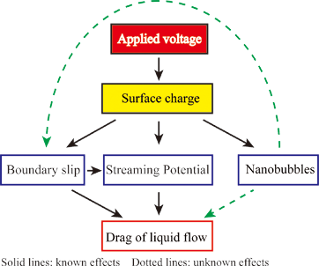
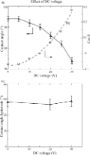
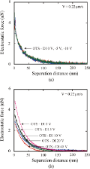
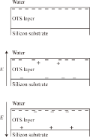
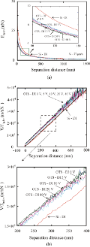
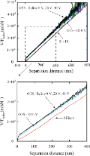
- protonation/deprotonation. The charged solid surface will lead to a layer in which ions are strongly attracted to the charged surface and do not move because of electrostatic interactions. Furthermore, there is another layer close to the surface called diffuse layer which is composed of ions that are










Energy transfer in complexes of water-soluble quantum dots and chlorin e6 molecules in different environments
Beilstein J. Nanotechnol. 2013, 4, 895–902, doi:10.3762/bjnano.4.101
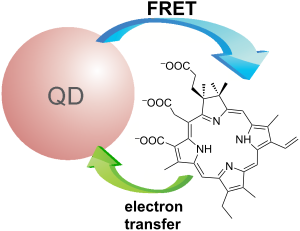
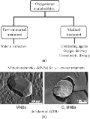
- dissipation occurs in all types of QD–Ce6 complexes and their contribution to the intracomplex energy transfer varies from 70% in covalently bonded complexes to ≈90% in complexes formed by electrostatic interactions and may be responsible for QD and Ce6 PL quenching. Electron transfer is the other possible
- electrostatic interactions in aqueous solution as a function of n. (a) Evolution of PL spectra of 5 nm QDs (dotted line) and sensibilized luminescence of Ce6 (solid line) extracted from PL spectra of the QD–Ce6 complexes. The PL excitation wavelength is 475 nm. The intensity of the Ce6 emission is multiplied by


Atomic force microscopy recognition of protein A on Staphylococcus aureus cell surfaces by labelling with IgG–Au conjugates
Beilstein J. Nanotechnol. 2013, 4, 743–749, doi:10.3762/bjnano.4.84
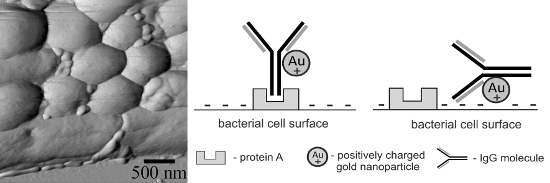
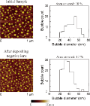
- B. licheniformis. Some of the observed labels (10%) were found on bacilli surfaces, which was undesirable for the selective labelling and discrimination of protein A-positive and -negative cells. We suppose that this was a nonspecific binding that can be explained by electrostatic interactions


Large-scale atomistic and quantum-mechanical simulations of a Nafion membrane: Morphology, proton solvation and charge transport
Beilstein J. Nanotechnol. 2013, 4, 567–587, doi:10.3762/bjnano.4.65
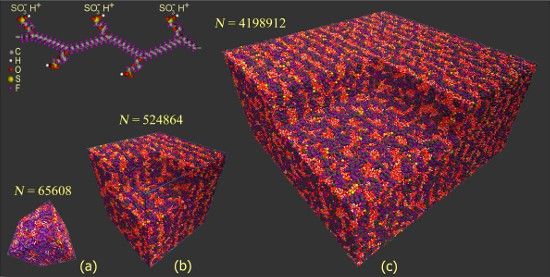
- interaction terms (a Lennard–Jones "9-6" potential for the van der Waals interactions and a Coulombic term for electrostatic interactions). We used the same force field both for the neutral and the charged species (hydronium cations and sulfonic acid anions SO3−). For the neutral species, Coulomb interactions
- details are identical to those described in our work [27]. Integration step was 1 fs. A 12 Å cut-off radius was applied for Coulomb and van der Waals interactions. The electrostatic interactions were treated by using the PPPM method with a precision of 10−6. The dielectric constant was set to 1. All the
- extent determined by electrostatic interactions and directly related to ion pairing. The accepted mechanism of the ionic conductivity involves the mobile ions moving from one polymer chain to another by a chain-flexing process called segmental motion [77]. To clarify the issue of whether the driving


Molecular dynamics simulations of mechanical failure in polymorphic arrangements of amyloid fibrils containing structural defects
Beilstein J. Nanotechnol. 2013, 4, 429–440, doi:10.3762/bjnano.4.50
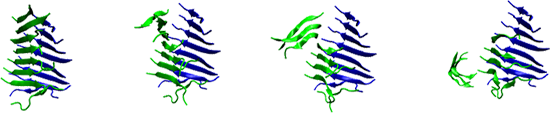
- understood by examining the intersheet interfaces that are affected during the SMD simulation. Both “slide” and “peel” modes disrupt the electrostatic interactions between the charged termini and force the hydrophobic core to be exposed to solvent molecules. For the three polymorphs containing eight peptides
- break suddenly because the interactions stabilising the fibrils (hydrogen bonding and hydrophobic forces) are short-ranged in comparison to the long-range electrostatic interactions within the uncapped fibrils. This highlights how a relatively simple modification at the terminus end can have a
- molecules [39] with periodic boundary conditions applied in all three directions. As the peptide sequence carried no net charge, neutralisation with counter-ions was not necessary. Long-range electrostatic interactions were calculated using the particle mesh Ewald (PME) method with a 9 Å cut-off. The models


Selective surface modification of lithographic silicon oxide nanostructures by organofunctional silanes
Beilstein J. Nanotechnol. 2013, 4, 218–226, doi:10.3762/bjnano.4.22
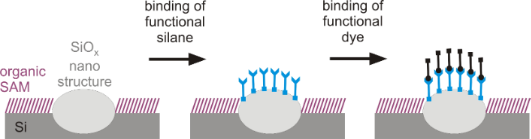
- fluorescence signal is comparably weak (roughly a factor of 10 above the background noise level). The main reason for this is the quenching by the underlying silicon. Nevertheless, other high-quantum-yield xanthene dyes (e.g., rhodamine 6G) that are bound to the nanostructures by electrostatic interactions


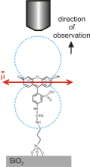
![[Graphic 2]](/bjnano/content/inline/2190-4286-4-22-i2.png?max-width=637&scale=1.18182) (red arrow) of FITC bound to a SiO2 surface.
(red arrow) of FITC bound to a SiO2 surface.
FTIR nanobiosensors for Escherichia coli detection
Beilstein J. Nanotechnol. 2012, 3, 485–492, doi:10.3762/bjnano.3.55
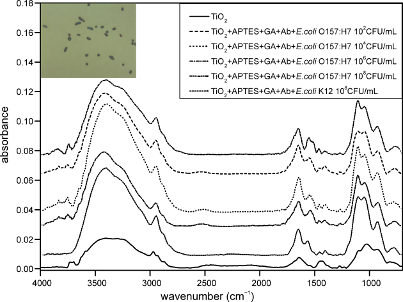
- to entrap pathogens with electrostatic interactions not differentiating between pathogens. Determination of the detection limits of E. coli O157:H7 Tests to establish the detection limit of the device were carried out using serial dilutions of E. coli ranging in concentration from 1 × 10⁸ CFU/mL to
- and K12) on a titania thin film (Figure 5a), on films with only the specific antibody for E. coli O157:H7, and on films with APTES and Ab (Figure 5c) were tested. Figure 5a shows the FTIR spectra of different strains of E. coli (O157:H7 and K12) adsorbed onto the film surface with electrostatic
- interactions, illustrating that the substrate cannot discriminate between different strains and the different spectra of the pathogens are clearly visible. In contrast, in films with specific antibodies, only the binding of E. coli O157:H7 was visible and is reported in Figure 5b and 5c, although in films with


Macromolecular shape and interactions in layer-by-layer assemblies within cylindrical nanopores
Beilstein J. Nanotechnol. 2012, 3, 475–484, doi:10.3762/bjnano.3.54
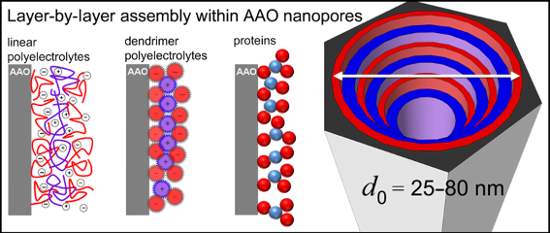
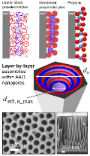
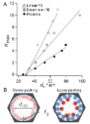
- negatively charged surface, followed by b-BSA (MW = 67 kDa) adsorption through molecular recognition. Linear-polyelectrolytes (linear-PEs) self-assembled into multilayers by electrostatic interactions between 70 kDa poly(sodium 4-styrene sulfonate) (PSS) and 50–65 kDa poly(allyl amine) hydrochloride (PAH
- charged surfaces [46][47][48]. Furthermore, polyelectrolyte films are dynamic self-assemblies, in the sense that the internal structure of the film can undergo rearrangements to achieve optimal packing density due to flexible electrostatic interactions. Furthermore, it is expected that the high degree of




An NC-AFM and KPFM study of the adsorption of a triphenylene derivative on KBr(001)
Beilstein J. Nanotechnol. 2012, 3, 221–229, doi:10.3762/bjnano.3.25
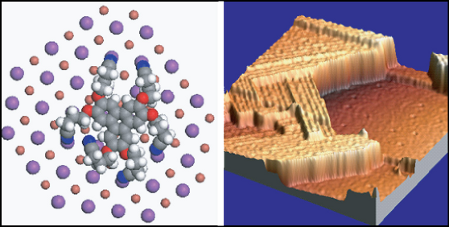
- molecules on this type of surface is dominated by van der Waals and electrostatic interactions, and that the charge transfer between the substrate and the molecule is negligible [39]. The KBr slab was composed of 6 × 6 × 3 unit cells. Two KBr layers were free to relax during the simulations. (a) Molecular




Molecular-resolution imaging of pentacene on KCl(001)
Beilstein J. Nanotechnol. 2012, 3, 186–191, doi:10.3762/bjnano.3.20
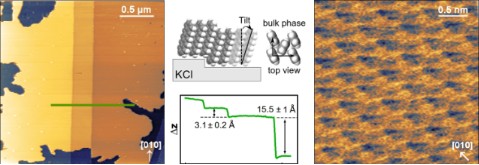
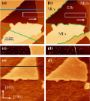
- molecules with the substrate is much weaker than on metals because the partial transfer of electrons is expected to be weak, such that the interaction is dominated by van der Waals and electrostatic interactions, as opposed to chemical bonding. A unique tool to investigate the thin-film structure of


X-ray spectroscopy characterization of self-assembled monolayers of nitrile-substituted oligo(phenylene ethynylene)s with variable chain length
Beilstein J. Nanotechnol. 2012, 3, 12–24, doi:10.3762/bjnano.3.2
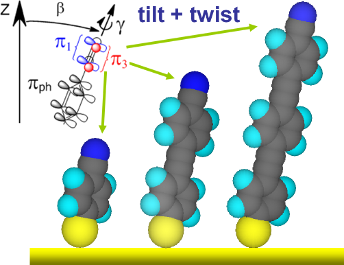
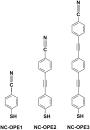
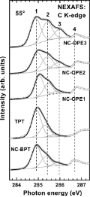
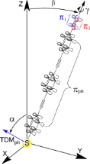
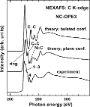
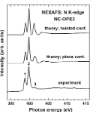
- contrast to the aliphatic NC-terminated SAMs in which the introduction of the nitrile tail group results in a significant disturbance of the molecular orientation and orientational order [54]. This disturbance can be understood in terms of the strong electrostatic interactions between the nitrile groups



Investigation on structural, thermal, optical and sensing properties of meta-stable hexagonal MoO3 nanocrystals of one dimensional structure
Beilstein J. Nanotechnol. 2011, 2, 585–592, doi:10.3762/bjnano.2.62
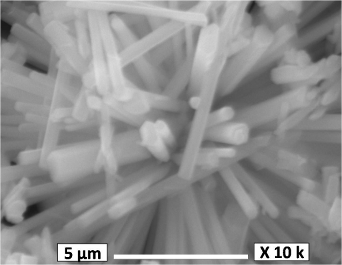
- (aq) + 6 HNO3 → 7 MoO3 (s) + 6 NH4NO3 (aq) + 7 H2O Here, molybdenum is located at the center and six oxygen atoms are coordinated in octahedral sites. During the nucleation, these octahedral structures interact with each other through corners (a-axis) and edges (c-axis) by means of electrostatic
- interactions between NH4+ and OH− ions. The stacking and assembling of these octahedral structures result in the formation of a stable hexagonal structure. Thus, the NH4+ functional group present in the reaction condition acts indirectly as a structure directing agent [4][23]. Moreover, the initial seed nuclei


Distinguishing magnetic and electrostatic interactions by a Kelvin probe force microscopy–magnetic force microscopy combination
Beilstein J. Nanotechnol. 2011, 2, 552–560, doi:10.3762/bjnano.2.59
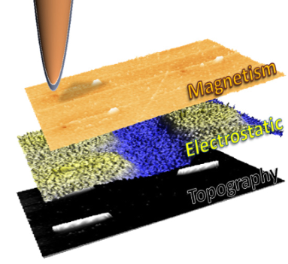
- electrostatic interactions are not compensated, an incorrect interpretation of the MFM could be made. This is especially problematic in samples with low magnetic moment where it is crucial to distinguish clearly the origin of the interaction for a correct interpretation of the results [10]. Results and
- proportional to the total force gradient (that can be composed of magnetic and/or electrostatic interactions). The experiments in the present work were performed in ambient conditions, in the non-contact dynamic mode (with low amplitude modulation) and with the PLL feedback activated. In addition, KPFM [17
- based materials [10][11]. In general, these materials present low magnetic moment at room temperature. In addition, since the substrate and the nanomagnets present quite different electronic behavior, the sample can exhibit large surface potential differences, which cause heterogeneous electrostatic


Microfluidic anodization of aluminum films for the fabrication of nanoporous lipid bilayer support structures
Beilstein J. Nanotechnol. 2011, 2, 104–109, doi:10.3762/bjnano.2.12
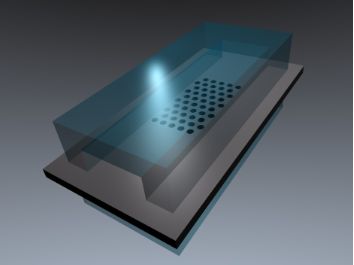
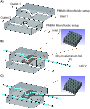
- . Vesicle rupture is probably aided via electrostatic interactions of the negative phosphate of the zwitterionic POPC-heads with the protonated amino groups from the APTES molecules immobilized on the surface [42]. In principle, one could also expect coverage of the inside pore walls, as has been observed


Manipulation of gold colloidal nanoparticles with atomic force microscopy in dynamic mode: influence of particle–substrate chemistry and morphology, and of operating conditions
Beilstein J. Nanotechnol. 2011, 2, 85–98, doi:10.3762/bjnano.2.10
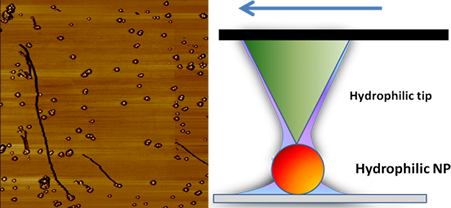
- of the dynamical processes occurring during manipulation, i.e., collisions between probing tips and particles, friction between particles and substrates, electrostatic interactions among all of them, etc. For this reason, colloidal particles have appeared as model nano-objects because they can be
- is essentially affected by electrostatic interactions arising from residues from the synthesis (citric acid) that may be adsorbed on the particles. It is thus normal, in the absence of both physical contact and notable intermolecular forces between the particles, that their mobility is independent of


Single-pass Kelvin force microscopy and dC/dZ measurements in the intermittent contact: applications to polymer materials
Beilstein J. Nanotechnol. 2011, 2, 15–27, doi:10.3762/bjnano.2.2
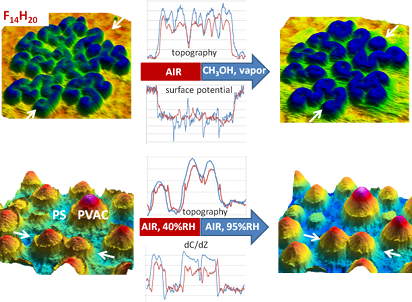
- directly from the photodetector (AM–AM) or from the LIA-1 (AM–FM). The latter block scheme configuration is shown in Figure 1. In the AM–FM, the electrostatic interactions are excited by an AC voltage applied to the probe at ωelec = 3–5 kHz, which is within the bandwidth of ωmech. The electrostatic
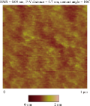
- corresponding to the transition to the intermittent contact regime. The topography image recorded in the non-contact mode is practically featureless. At the conditions near the transition, it may be possible to detect weak cross-talk patterns, which are caused by the long-distance electrostatic interactions
- Sergei Magonov John Alexander Agilent Technologies, 4330 Chandler Blvd., Chandler, AZ 85226, U.S.A. 10.3762/bjnano.2.2 Abstract We demonstrate that single-pass Kelvin force microscopy (KFM) and capacitance gradient (dC/dZ) measurements with force gradient detection of tip–sample electrostatic