


Search results
Search for "growth rate" in Full Text gives 132 result(s) in Beilstein Journal of Nanotechnology.
Dense lying self-organized GaAsSb quantum dots on GaAs for efficient lasers
Beilstein J. Nanotechnol. 2011, 2, 333–338, doi:10.3762/bjnano.2.39
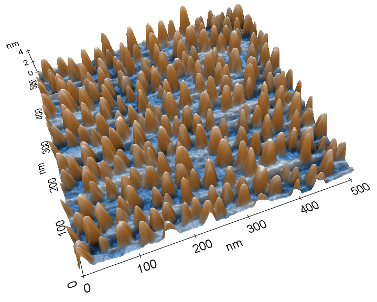
- GaSb QDs were grown on an As-rich surface. The nominal coverage for all samples was 3 monolayers (ML) with a growth rate of ≈0.3 ML/s. The samples were cooled down to room temperature under the adjusted Sb flux immediately after the QD growth for topographic tapping-mode measurements with a Park XE-70


Formation of precise 2D Au particle arrays via thermally induced dewetting on pre-patterned substrates
Beilstein J. Nanotechnol. 2011, 2, 318–326, doi:10.3762/bjnano.2.37
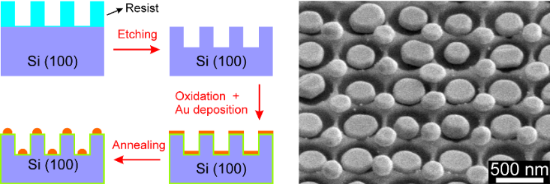
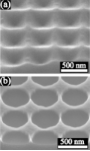
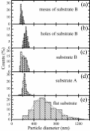
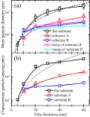
- and Thompson has shown that the void growth rate Rv decreases with increasing film thickness t dramatically (Rv t−3) [32]. Therefore, it is reasonable that the particle size and particle spacing increases with film thickness (Figure 8). Dewetting of the Au films on the substrate A (pyramidal pits





Studies towards synthesis, evolution and alignment characteristics of dense, millimeter long multiwalled carbon nanotube arrays
Beilstein J. Nanotechnol. 2011, 2, 293–301, doi:10.3762/bjnano.2.34
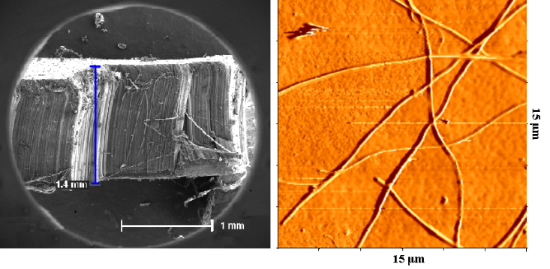
- molecular source used and additional growth promoters such as H2, as well as H2O or oxygen containing organic molecules such as ethers, or ketones as oxidizing agents, have a subtle influence on the purity, growth rate and final growth height of vertically oriented CNTs. Oxygen containing organic molecules


Recrystallization of tubules from natural lotus (Nelumbo nucifera) wax on a Au(111) surface
Beilstein J. Nanotechnol. 2011, 2, 261–267, doi:10.3762/bjnano.2.30
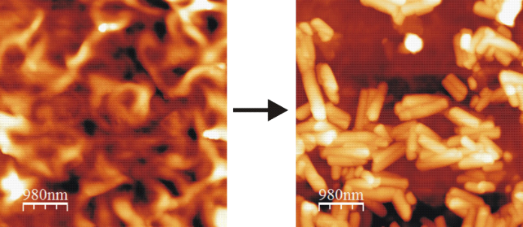
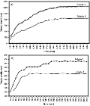
- . Comparing the growth of both tubules – 1 and 2 in Figure 1 (plotted in Figure 3a) – it is obvious that the growth rate of tubule 2 was lower and its final length was shorter, but both tubules reached their final length after the same time (about 3.5 hours). On the other hand, although radial growth follows
- concentration of molecules in solution. These two observations combined suggest that both the growth rate as well as the saturation length depends on the availability of molecules on the surface, or more precisely, within the “capture zone” surrounding each tubule. Discussion As on many other substrates such as


Low-temperature solution growth of ZnO nanotube arrays
Beilstein J. Nanotechnol. 2010, 1, 128–134, doi:10.3762/bjnano.1.15
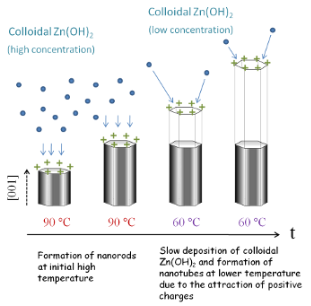
- to the substrate [29]. The proposed growth mechanism was based on the competition between growth rate and diffusion rate. However, our experiment cannot be explained by the gradient of ion concentration, such as Zn2+, since there was no concentration gradient in the solution. To understand the
- grown at 60 °C suggest a relatively high polar surface energy, and as a result, the polar surface of ZnO was growing considerably. It is also clear that the reaction process for attachment of an atom to the interface was limited by the low temperature, so that the growth rate was slow. This is a reason
- that the length of ZnO nanorods in Figure 6 was smaller than that of the nanorods grown at 90 °C. All these results suggest that (1) the surface energy difference of ZnO crystal between polar and non-polar face strongly depends on the pH of the reaction solution, and (2) the growth rate greatly depends


Review and outlook: from single nanoparticles to self-assembled monolayers and granular GMR sensors
Beilstein J. Nanotechnol. 2010, 1, 75–93, doi:10.3762/bjnano.1.10
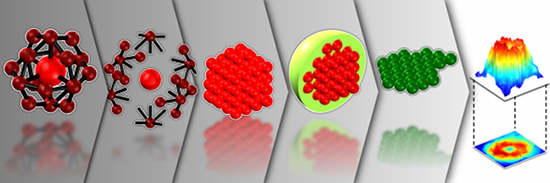
- evolution are given by with the solutions (Figure 6) The absolute concentration of the material absorbed by nucleation seeds is [S] = [A1]0 + [A2]0 − [B] − [A1] − [A2] and, therefore, the particle growth rate is given by v(t) = d[S]/dt. Further, the ratio x = A1/A2 of material absorbed at time t with the




Enhanced visible light photocatalysis through fast crystallization of zinc oxide nanorods
Beilstein J. Nanotechnol. 2010, 1, 14–20, doi:10.3762/bjnano.1.3
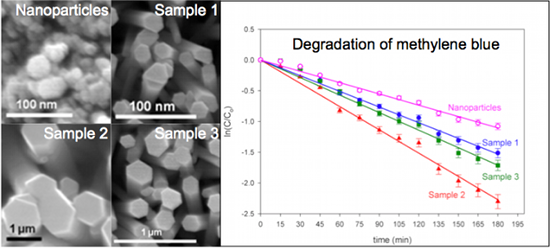
- to maintain the growth rate [20]. The substrate was then removed and washed several times with deionised water and then annealed at 250 °C for 1 h to remove any unreacted organic deposits. Microwave synthesis of ZnO nanorods on seeded substrates was carried out in a commercial microwave oven operated


Other Beilstein-Institut Open Science Activities



