


Search results
Search for "heterostructures" in Full Text gives 138 result(s) in Beilstein Journal of Nanotechnology.
Inorganic Janus particles for biomedical applications
Beilstein J. Nanotechnol. 2014, 5, 2346–2362, doi:10.3762/bjnano.5.244
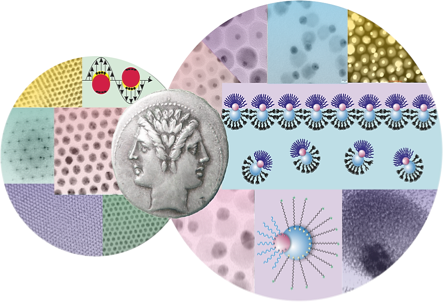
- interfacial strain [10]. The main synthetic routes for obtaining inorganic dumbbell-like heterostructures include heterogeneous nucleation [52][53], asymmetric modification at interfaces [41], and non-epitaxial deposition on the full surface of the first nanoparticle followed by thermal dewetting of the shell
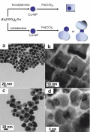
- monitored by optical spectroscopy [56][73]. The synthetic route can easily be applied to other material compositions as previously demonstrated by the formation of heterostructures composed out of gold and manganese oxide [39]. Au@MnO heterodimers were prepared using preformed Au nanoparticles as seeds, as






Hybrid spin-crossover nanostructures
Beilstein J. Nanotechnol. 2014, 5, 2230–2239, doi:10.3762/bjnano.5.232
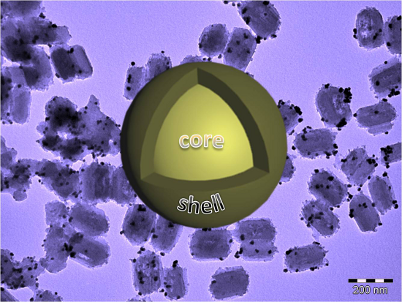
- core–multishell NPs contains two active magnetic species. Catala and Mallah reported that it is possible to carry out epitaxial growth of a 3D PBA different from that used for the core in the case of 10 nm Cs[NiIICrIII(CN)6]@Cs[CoIICrIII(CN)6] heterostructures [19] or 50 nm CsI[CoIICrIII(CN)6]@CsI
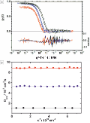
- Talham to study the photoinduced switching of the magnetism of KjNik[Cr(CN)6]l@RbaCob[Fe(CN)6] heterostructures [27]. These nanoscale heterostructures exhibited a photo-response not seen in either constituent on its own (Figure 5). The changes induced by the light irradiation occur in the RbCoFe lattice


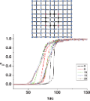

Synthesis, characterization, and growth simulations of Cu–Pt bimetallic nanoclusters
Beilstein J. Nanotechnol. 2014, 5, 1371–1379, doi:10.3762/bjnano.5.150
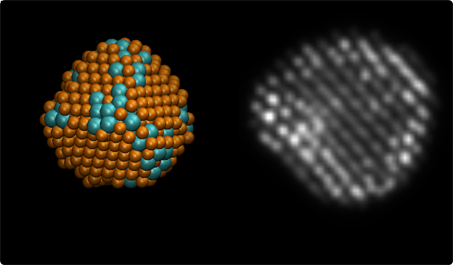
- , heterostructures, and alloy nanocrystals, and this diversity potentiates the increase of the mass specific activity (MSA) of the nanoparticle while also minimizing the cost by using precious metals only in the surface of the particles. Thus, in order to attain a better control on shape, size and composition of the


Functionalized nanostructures for enhanced photocatalytic performance under solar light
Beilstein J. Nanotechnol. 2014, 5, 994–1004, doi:10.3762/bjnano.5.113
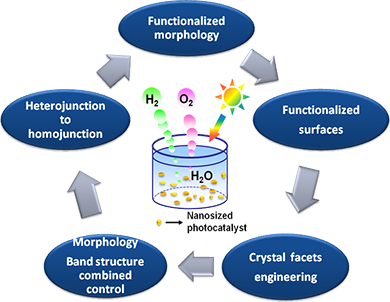
- semiconductors, followed by a further discussion of the heterostructures with improved matching of both band structures and crystal lattices. We then elaborate on the heterostructure design of the targeted materials from macroscopic regulation of compositions and phases, to the more precise control at the
- preferential exposure of Zn(0001) faces showed high photocatalytic activity [38]. Wang et al. constructed ZnO–CdS heterostructures by employing ZnO rods enclosed with well-developed {1100} and {0001} facets to promote photocatalytic hydrogen evolution [39]. Pan et al. found that {001}, {101} and {010} facets
- capable of splitting pure water, which provides a new route to the development of nanosized photocatalysts for water splitting [64]. From single heterojunction to long range ordered homojunction Semiconductor heterostructures can be engineered to combine functionalities that result from the bulk


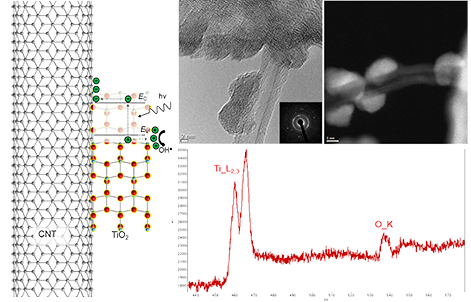
Growth and characterization of CNT–TiO2 heterostructures
Beilstein J. Nanotechnol. 2014, 5, 946–955, doi:10.3762/bjnano.5.108


Biomolecule-assisted synthesis of carbon nitride and sulfur-doped carbon nitride heterojunction nanosheets: An efficient heterojunction photocatalyst for photoelectrochemical applications
Beilstein J. Nanotechnol. 2014, 5, 770–777, doi:10.3762/bjnano.5.89
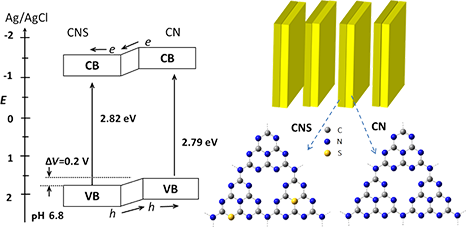
- improved charge separation. To test our hypothesis, we designed a strategy to construct CN/CNS heterostructures. In our method, we firstly grow CNS nanosheets by using a biomolecule-assisted pyrolysis method, followed by growing CN on preformed CNS nanosheets to form a well-mixed CN/CNS heterostructure


Nanostructure sensitization of transition metal oxides for visible-light photocatalysis
Beilstein J. Nanotechnol. 2014, 5, 696–710, doi:10.3762/bjnano.5.82
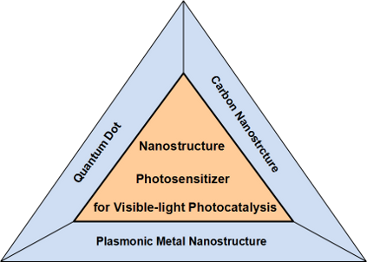
- –CdS heterostructures and found that the hydrogen evolution rate over ZnO disk–CdS nanoparticle heterostructures is 2.8 times higher than the hydrogen evolution rate of the ZnO rod–CdS nanoparticle because photoexcited electron–hole separation is significantly enhanced by polar interfaces [35] and the
- CdSe to TiO2 via oxygen vacancy states mediated by N-doping [39][40]. There are also a large number of heterostructures in literature consisting of quantum dots and transition metal oxides, for instance, CdS/CdSe co-sensitized TiO2 [41], CdTe or CdTe/CdSe quantum dots on TiO2 nanotube arrays [42][43
- evaluation of size dependent electron transfer rates in CdSe–TiO2 semiconductor heterostructures [56]. Based on femtosecond transient absorption measurement it was found that the CB of CdSe quantum dots become more negative and the energy difference between the CB of CdSe and TiO2 is much larger with




Enhanced photocatalytic activity of Ag–ZnO hybrid plasmonic nanostructures prepared by a facile wet chemical method
Beilstein J. Nanotechnol. 2014, 5, 639–650, doi:10.3762/bjnano.5.75
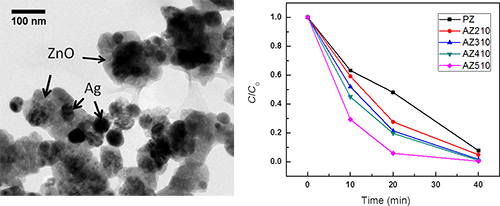
- because of the presence of many small crystals and suggests the crystalline nature of heterostructures. The SAD pattern further confirms the formation of crystalline hexagonal phase of Ag–ZnO hybrid nanostructures. The high-resolution TEM image of ZnO nanostructures in Figure 3b clearly shows lattice


Towards precise defect control in layered oxide structures by using oxide molecular beam epitaxy
Beilstein J. Nanotechnol. 2014, 5, 596–602, doi:10.3762/bjnano.5.70
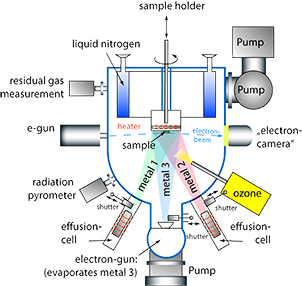
- briefly review the ALL-oxide MBE technique and its unique capabilities in the deposition of atomically smooth single-crystal thin films of various complex oxides, artificial compounds and heterostructures, introducing our goal of pursuing a deep investigation of such systems with particular emphasis on
- interface effects occurring in oxides heterostructures [2]. In the last decades, their study has revealed the presence of unexpected properties, such as superconductivity [3][4], metallicity [5][6] and magnetism [7], which cannot be ascribed to any of the constituent phases taken singularly. Many, sometimes
- urgent need for a synergetic cross-fertilization of the chemistry and physics approaches. Recognizing this, researchers at the Max-Planck Institute for Solid State Research (MPI-FKF) have pursued a long-standing program to synthesize and investigate epitaxial metal oxide thin films and heterostructures


Photovoltaic properties of ZnO nanorods/p-type Si heterojunction structures
Beilstein J. Nanotechnol. 2014, 5, 173–179, doi:10.3762/bjnano.5.17
- . Experimental In this work, we investigate n-type ZnO/p-type Si heterostructures. P-type (100) silicon wafer with a resistance of 2.32 Ω cm was cut into pieces of the size of 0.5 cm2. Cut silicon pieces were cleaned in 2-propanol, acetone and deionized water for 5 minutes by using an ultrasonic cleaner. Then
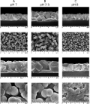
- characteristics for the ZnO:Al/ZnONR/Si/Al heterostructures measured under dark (top) and under light conditions (down). SEM images of the three investigated types of structures with different surface morphologies. External quantum efficiency of the PV structures of samples A, B and C based on zinc oxide nanorods
- . Average sizes of ZnO NRs and ZnO NRs covered ZnO:Al grown at different pH values. Electrical parameters of investigated PV structures grown on p Si substrates. Photovoltaic parameters for the investigated heterostructures. Acknowledgements This work was partially supported by the European Union within



Photoelectrochemical and Raman characterization of In2O3 mesoporous films sensitized by CdS nanoparticles
Beilstein J. Nanotechnol. 2013, 4, 255–261, doi:10.3762/bjnano.4.27
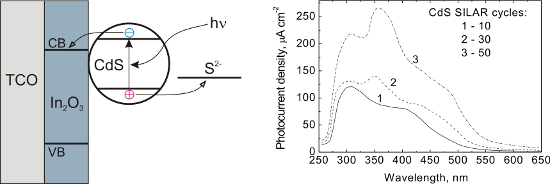
- approximately 700 mV when increasing the temperature of the oxide annealing (Figure 7). Figure 8 shows the photocurrent–potential curves recorded under visible-light illumination of In2O3(200)/CdS and In2O3(400)/CdS heterostructures (curves 3 and 4) in an S2−-containing electrolyte. For comparison, similar


Electronic and transport properties of kinked graphene
Beilstein J. Nanotechnol. 2013, 4, 103–110, doi:10.3762/bjnano.4.12
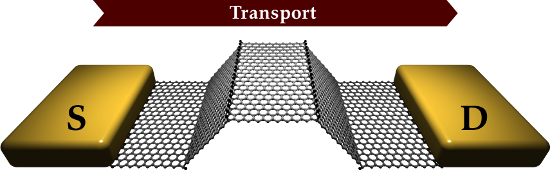
- transport across the kink lines. We finally consider pseudo-ribbon-based heterostructures and propose that such structures present a novel approach for band gap engineering in nanostructured graphene. Keywords: adsorption and reactivity; curvature effects; DFT calculations; electronic transport; graphene


Synthesis and electrical characterization of intrinsic and in situ doped Si nanowires using a novel precursor
Beilstein J. Nanotechnol. 2012, 3, 564–569, doi:10.3762/bjnano.3.65
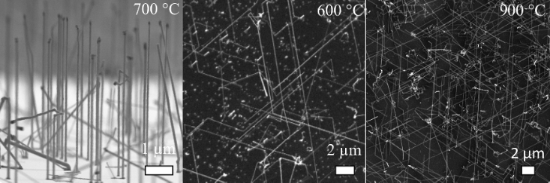
- of dopant intentionally to the Au catalyst particle [22]. Much more common and effective is to add a gaseous dopant, such as PH3, B2H6 or B(CH3)3, to the precursor gas feed during growth. Thus, for example, p–i–n+-type doped Si-NW heterostructures with a resistivity of a few mΩ·cm have been achieved





